Association of Visual Impairment With Risk of Incident Dementia in a Women's Health Initiative Population
- PMID: 32297918
- PMCID: PMC7163778
- DOI: 10.1001/jamaophthalmol.2020.0959
Association of Visual Impairment With Risk of Incident Dementia in a Women's Health Initiative Population
Abstract
Importance: Dementia affects a large and growing population of older adults. Although past studies suggest an association between vision and cognitive impairment, there are limited data regarding longitudinal associations of vision with dementia.
Objective: To evaluate associations between visual impairment and risk of cognitive impairment.
Design, setting, and participants: A secondary analysis of a prospective longitudinal cohort study compared the likelihood of incident dementia or mild cognitive impairment (MCI) among women with and without baseline visual impairment using multivariable Cox proportional hazards regression models adjusting for characteristics of participants enrolled in Women's Health Initiative (WHI) ancillary studies. The participants comprised community-dwelling older women (age, 66-84 years) concurrently enrolled in WHI Sight Examination (enrollment 2000-2002) and WHI Memory Study (enrollment 1996-1998, ongoing). The study was conducted from 2000 to the present.
Exposures: Objectively measured visual impairment at 3 thresholds (visual acuity worse than 20/40, 20/80, or 20/100) and self-reported visual impairment (determined using composite survey responses).
Main outcomes and measures: Hazard ratios (HRs) and 95% CIs for incident cognitive impairment after baseline eye examination were determined. Cognitive impairment (probable dementia or MCI) was based on cognitive testing, clinical assessment, and centralized review and adjudication. Models for (1) probable dementia, (2) MCI, and (3) probable dementia or MCI were evaluated.
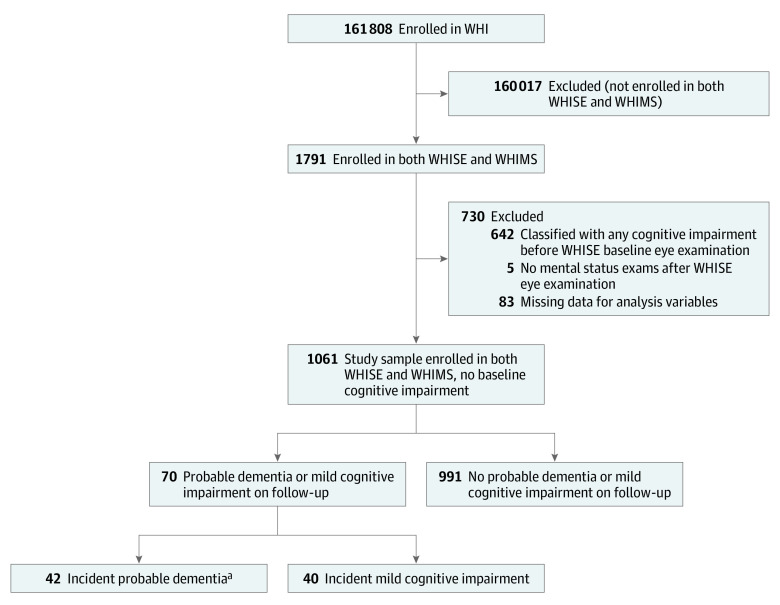
Results: A total of 1061 women (mean [SD] age, 73.8 [3.7] years) were identified; 206 of these women (19.4%) had self-reported visual impairment and 183 women (17.2%) had objective visual impairment. Forty-two women (4.0%) were ultimately classified with probable dementia and 28 women (2.6%) with MCI that did not progress to dementia. Mean post-eye examination follow-up was 3.8 (1.8) years (range, 0-7 years). Women with vs without baseline objective visual impairment were more likely to develop dementia. Greatest risk for dementia was among women with visual acuity of 20/100 or worse at baseline (HR, 5.66; 95% CI, 1.75-18.37), followed by 20/80 or worse (HR, 5.20; 95% CI, 1.94-13.95), and 20/40 or worse (HR, 2.14; 95% CI, 1.08-4.21). Findings were similar for risk of MCI, with the greatest risk among women with baseline visual acuity of 20/100 or worse (HR, 6.43; 95% CI, 1.66-24.85).
Conclusions and relevance: In secondary analysis of a prospective longitudinal cohort study of older women with formal vision and cognitive function testing, objective visual impairment appears to be associated with an increased risk of incident dementia. However, incident cases of dementia and the proportion of those with visual impairment were low. Research is needed to evaluate the effect of specific ophthalmic interventions on dementia.
Conflict of interest statement
Figures
References
-
- Alzheimer’s Association 2020. Alzheimer’s disease facts and figures. Accessed March 11, 2020. https://www.alz.org/media/Documents/alzheimers-facts-and-figures_1.pdf
Publication types
MeSH terms
Grants and funding
- HHSN268201600001C/HL/NHLBI NIH HHS/United States
- HHSN268201600003C/HL/NHLBI NIH HHS/United States
- P30 AG059307/AG/NIA NIH HHS/United States
- P30 AG066515/AG/NIA NIH HHS/United States
- P30 AG049638/AG/NIA NIH HHS/United States
- HHSN268201600002C/HL/NHLBI NIH HHS/United States
- HHSN268201600004C/HL/NHLBI NIH HHS/United States
- HHSN268201600018C/HL/NHLBI NIH HHS/United States
- RF1 AG054068/AG/NIA NIH HHS/United States
- P50 AG005142/AG/NIA NIH HHS/United States
- R03 AG056453/AG/NIA NIH HHS/United States
- P50 AG047366/AG/NIA NIH HHS/United States
LinkOut - more resources
Full Text Sources
Medical
Miscellaneous