. 2020 Jul;92(7):919-923.
doi: 10.1002/jmv.25894. Epub 2020 Apr 27.

Case fatality rate analysis of Italian COVID-19 outbreak

Affiliations

Case fatality rate analysis of Italian COVID-19 outbreak

Giovanni Giangreco. J Med Virol. 2020 Jul.

Abstract

The Italian outbreak of COVID-19 cases is a public health emergency and there is a worldwide tremendous interest in the evaluation of the Italian epidemic evolution. Indeed, from February 2020, Italy is facing an explosion of COVID-19 cases. In particular, the Italian observed case fatality rate (CFR) is much higher than the other countries. Recently, it has been hypothesized that the extensive number of intergenerational contacts-typical of Italian culture-could contribute to explain the high number of deaths observed in Italy. However, through an analysis performed for all the Italian regions, here it is shown that the deaths are localized in specific regions and that the CFRs of different Italian regions are overlapping with the rates of European countries. Moreover, through correlation analyses between CFRs and different social habits, it is shown that no positive correlation is observed between social behaviors and CFRs. In conclusion, this analysis clearly rejects the possibility that social habits and intergenerational contacts can contribute to explaining such a profound effect on the number of deaths observed in Italy during the COVID-19 outbreak and more effort should be addressed to evaluate the real amount of positive cases.

Keywords: COVID-19; Italy; SARS-CoV-2; case fatality rate; outbreak; social behavior.


Figures

Figure 1
Figure 1
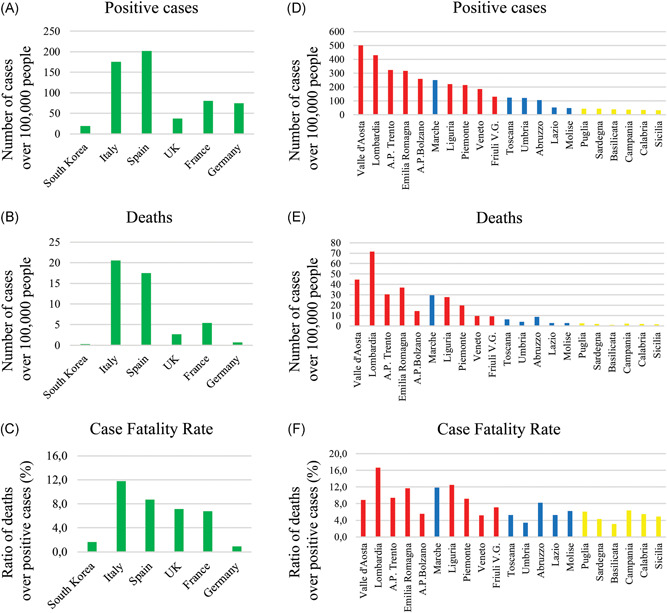
Analyses of SARS‐CoV‐2 positive cases, deaths, and CFRs. A, Histogram showing the number of SARS‐CoV‐2 positive cases for South Korea, Italy, Spain, UK, France, and Germany normalized on the population and showed as a number of cases over 100 000 people. B, Histogram showing the number of SARS‐CoV‐2 deaths for South Korea, Italy, Spain, UK, France, and Germany normalized on the population and showed a number of cases over 100 000 people. C, Histogram showing the case fatality rate for South Korea, Italy, Spain, UK, France, and Germany: percentage of deaths over positive cases was calculated. D, Histogram showing the number of SARS‐CoV‐2 positive cases for Italian regions normalized on the population and showed as number of cases over 100 000 people. In red are shown Northern regions; in blue Central regions; in yellow are shown Southern regions. E, Histogram showing the number of SARS‐CoV‐2 deaths for Italian regions normalized on the population and showed as a number of cases over 100 000 people. In red are shown Northern regions; in blue Central regions; in yellow are shown Southern regions. F, Histogram showing the case fatality rate for Italian regions: percentage of deaths over positive cases was calculated. In red are shown Northern regions; in blue Central regions; in yellow are shown Southern regions. AP, autonomous province; CFR, case fatality rate
Figure 2
Figure 2
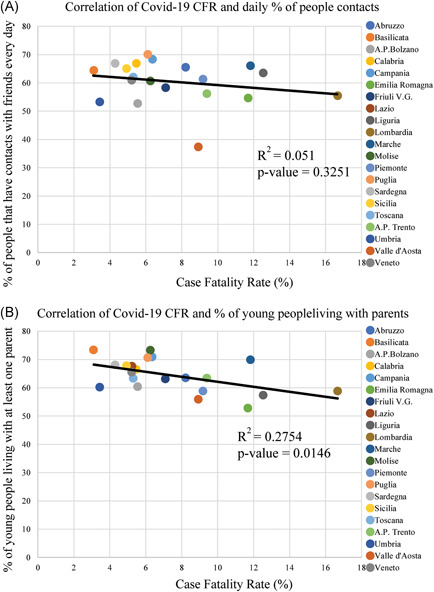
Correlation of CFRs and variables of social behavior for Italian regions. A, Correlation of CFRs and percentage of people that have contacts with friends every day for all Italian regions. R 2 and P‐value of two‐tailed Student's t distribution are shown. B, Correlation of CFRs and percentage of young people (18‐34 years of age) that live with at least one parent for all Italian regions. R 2 and P‐value of two‐tailed Student's t distribution are shown. CFR, case fatality rate

References

    1. Huang C, Wang Y, Li X, et al. Clinical features of patients infected with 2019 novel coronavirus in Wuhan, China. Lancet. 2020;395(10223):497‐506. - PMC - PubMed
    1. Wu YC, Chen CS, Chan YJ. The outbreak of COVID‐19: an overview. J Chin Med Assoc. 2020;83(3):217‐220. - PMC - PubMed
    1. Remuzzi A, Remuzzi G. COVID‐19 and Italy: what next? Lancet. 2020;S0140‐6736(20):30627‐30629. - PMC - PubMed
    1. Dowd JB, Rotondi V, Adriano L, et al. Demographic science aids in understanding the spread and fatality rates of COVID‐19. medRxiv. 2020. 10.1101/2020.03.15.20036293 - DOI - PMC - PubMed
    1. Day M. Covid‐19: surge in cases in Italy and South Korea makes pandemic look more likely. BMJ. 2020;368:m751. - PubMed

MeSH terms