. 2020 Aug 2;16(8):1989-1996.
doi: 10.1080/21645515.2019.1710409. Epub 2020 Apr 16.

BBIQ, a pure TLR7 agonist, is an effective influenza vaccine adjuvant

Affiliations

BBIQ, a pure TLR7 agonist, is an effective influenza vaccine adjuvant

Deepender Kaushik et al. Hum Vaccin Immunother. .

Abstract

Better adjuvants are needed for vaccines against seasonal influenza. TLR7 agonists are potent activators of innate immune responses and thereby may be promising adjuvants. Among the imidazoquinoline compounds, 1-benzyl-2-butyl-1H-imidazo[4,5-c]quinolin-4-amine (BBIQ) was reported to be a highly active TLR7 agonist but has remained relatively unexplored because of its commercial unavailability. Indeed, in silico molecular modeling studies predicted that BBIQ had a higher TLR7 docking score and binding free energy than imiquimod, the gold standard TLR7 agonist. To circumvent the availability issue, we developed an improved and higher yield method to synthesize BBIQ. Testing BBIQ on human and mouse TLR7 reporter cell lines confirmed it to be TLR7 specific with significantly higher potency than imiquimod. To test its adjuvant potential, BBIQ or imiquimod were admixed with recombinant influenza hemagglutinin protein and administered to mice as two intramuscular immunizations 2 weeks apart. Serum anti-influenza IgG responses assessed by ELISA 2 weeks after the second immunization confirmed that the mice that received vaccine admixed with BBIQ had significantly higher anti-influenza IgG1 and IgG2c responses than mice immunized with antigen alone or admixed with imiquimod. This confirmed BBIQ to be a TLR7-specific adjuvant able to enhance humoral immune responses.

Keywords: in-silico modeling; Imidazoquinoline; TLR7; TLR8; adjuvant; imiquimod; influenza; vaccine.


Figures
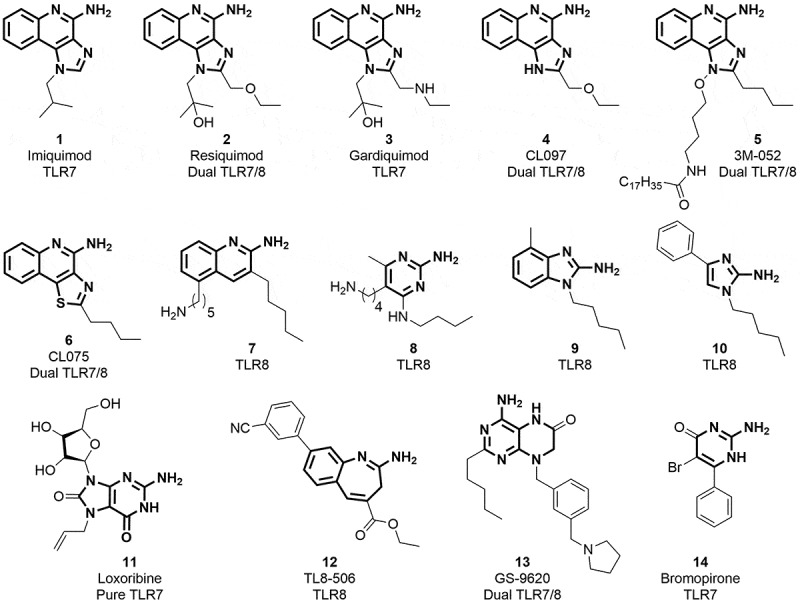
Figure 1.
Figure 1.
Chemical structures of known TLR7 and 8 ligands as derived from structure–activity relationship (SAR) studies.
Figure 2.
Figure 2.
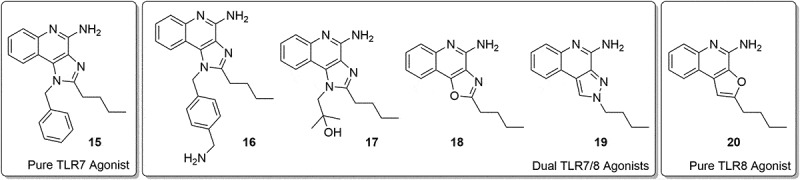
Examples of structures of some TLR7 and TLR8 single and dual agonists.
Scheme 1.
Scheme 1.
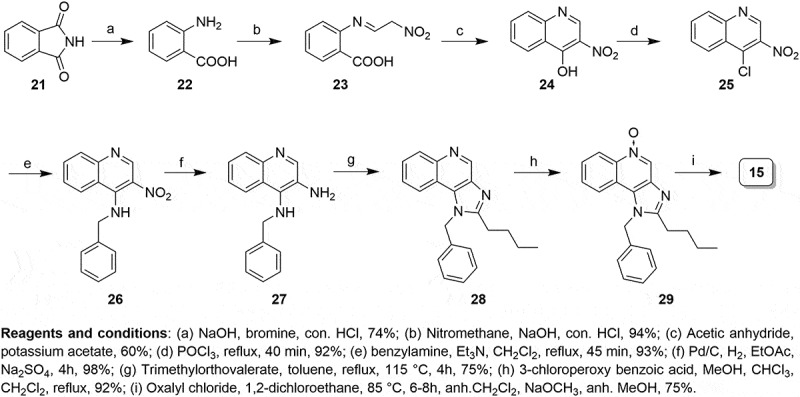
Schematic of improved synthesis method for production of BBIQ.
Figure 3.
Figure 3.
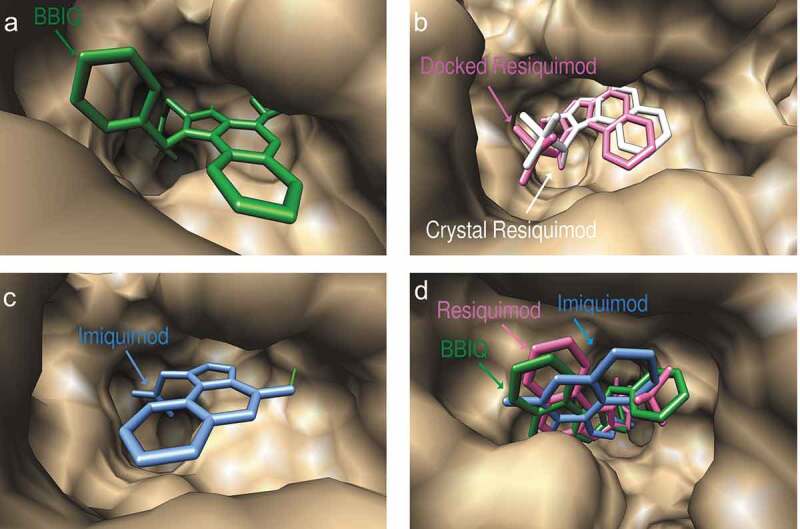
Predicted docked conformations of BBIQ (a), resiquimod (b) and imiquimod (c) to the ligand-binding site of human TLR7, showing predicted hydrogen bonds in green. Figure 3(b) shows a comparison of the predicted and crystal confirmed conformation of resiquimod in the hTLR7 binding pocket with a goodness of fit shown by the Root-mean-square-deviation (RMSD) value of 0.93 Å. Figure 3(d) shows the comparison of the predicted binding poses of BBIQ (in green), resiquimod (in pink) and imiquimod (in blue) in the hTLR7 binding pocket.
Figure 4.
Figure 4.
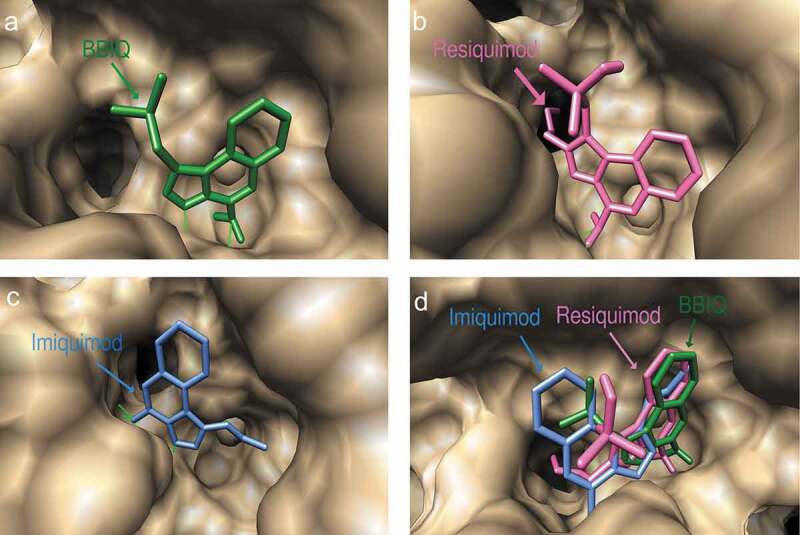
Predicted docked conformations of BBIQ (a), resiquimod (b) and imiquimod (c) on mouse TLR7, showing the amino acids forming hydrogen bonds in the ligand-binding site. Figure 4(d) shows the predicted binding poses of BBIQ (in green), resiquimod (in pink) and imiquimod (in blue) in the mTLR7 binding pocket.
Figure 5.
Figure 5.
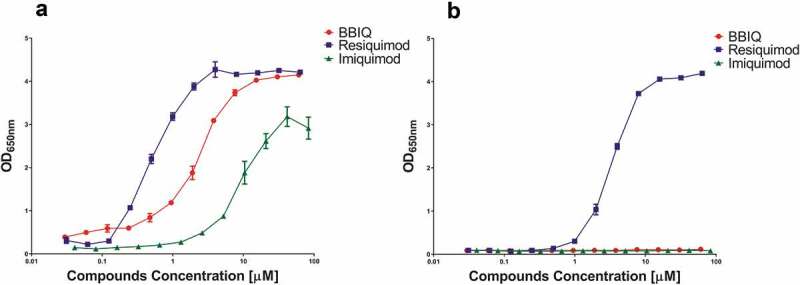
The relative potency of BBIQ, resiquimod and imiquimod for human TLR7 and TLR8 as measured using HEK reporter cell lines transfected with human TLR7 (a) or TLR8 (b). NFkB activation was measured by production of SEAP as determined with QUANTI-Blue Solution. Shown is mean ± standard error of the OD readings of duplicate samples.
Figure 6.
Figure 6.
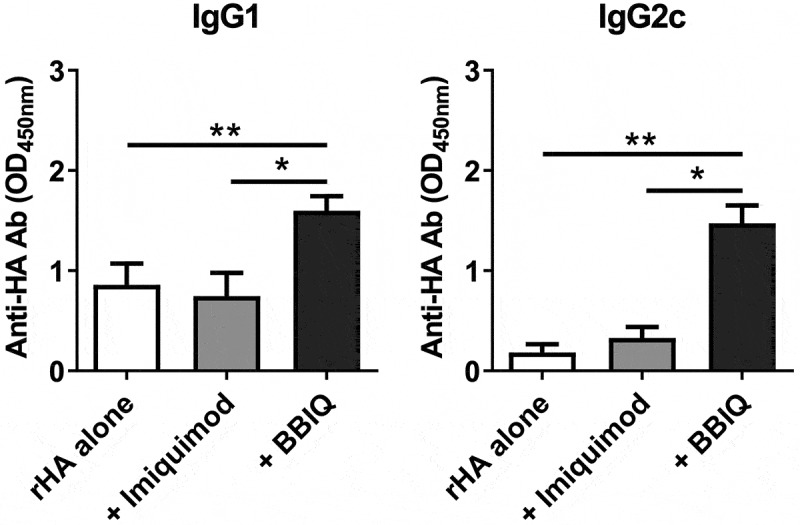
BBIQ enhances IgG antibody responses in influenza vaccinated mice. Female C57BL/6 mice, 6 to 8 week old, were immunized twice i.m. at a 2-week interval with recombinant hemagglutinin (rHA) protein 1μg alone or admixed with 10μg imiquimod or BBIQ in 50μl total volume. Blood samples were collected 2 weeks after the second immunization and antigen-specific IgG1 or IgG2c antibodies measured by ELISA with results shown as the OD (*p < .05, **p < .01).

References

    1. Petrovsky N. Comparative safety of vaccine adjuvants: a summary of current evidence and future needs. Drug Saf. 2015;38:1059–74. doi: 10.1007/s40264-015-0350-4. - DOI - PMC - PubMed
    1. Warshakoon HJ, Hood JD, Kimbrell MR, Malladi S, Wu WY, Shukla NM, Agnihotri G, Sil D, David SA.. Potential adjuvantic properties of innate immune stimuli. Hum Vaccin. 2009;5:381–94. doi: 10.4161/hv.5.6.8175. - DOI - PubMed
    1. Petrovsky N, Aguilar JC. Vaccine adjuvants: current state and future trends. Immunol Cell Biol. 2004;82:488–96. doi: 10.1111/imcb.2004.82.issue-5. - DOI - PubMed
    1. Dowling DJ. Recent advances in the discovery and delivery of TLR7/8 agonists as vaccine adjuvants. Immuno Horizons. 2018;2:185–97. doi: 10.4049/immunohorizons.1700063. - DOI - PubMed
    1. Awate S, Babiuk LA, Mutwiri G. Mechanisms of action of adjuvants. Front Immunol. 2013;4:114. doi: 10.3389/fimmu.2013.00114. - DOI - PMC - PubMed

Publication types