Review
. 2020 Apr 16;16(4):e1008630.
doi: 10.1371/journal.pgen.1008630. eCollection 2020 Apr.

Deconstructing cerebellar development cell by cell

Affiliations
Review

Deconstructing cerebellar development cell by cell

Max J van Essen et al. PLoS Genet. .

Abstract

The cerebellum is a pivotal centre for the integration and processing of motor and sensory information. Its extended development into the postnatal period makes this structure vulnerable to a variety of pathologies, including neoplasia. These properties have prompted intensive investigations that reveal not only developmental mechanisms in common with other regions of the neuraxis but also unique strategies to generate neuronal diversity. How the phenotypically distinct cell types of the cerebellum emerge rests on understanding how gene expression differences arise in a spatially and temporally coordinated manner from initially homogeneous cell populations. Increasingly sophisticated fate mapping approaches, culminating in genetic-induced fate mapping, have furthered the understanding of lineage relationships between early- versus later-born cells. Tracing the developmental histories of cells in this way coupled with analysis of gene expression patterns has provided insight into the developmental genetic programmes that instruct cellular heterogeneity. A limitation to date has been the bulk analysis of cells, which blurs lineage relationships and obscures gene expression differences between cells that underpin the cellular taxonomy of the cerebellum. This review emphasises recent discoveries, focusing mainly on single-cell sequencing in mouse and parallel human studies that elucidate neural progenitor developmental trajectories with unprecedented resolution. Complementary functional studies of neural repair after cerebellar injury are challenging assumptions about the stability of postnatal cellular identities. The result is a wealth of new information about the developmental mechanisms that generate cerebellar neural diversity, with implications for human evolution.


Conflict of interest statement

The authors have declared that no competing interests exist.

Figures
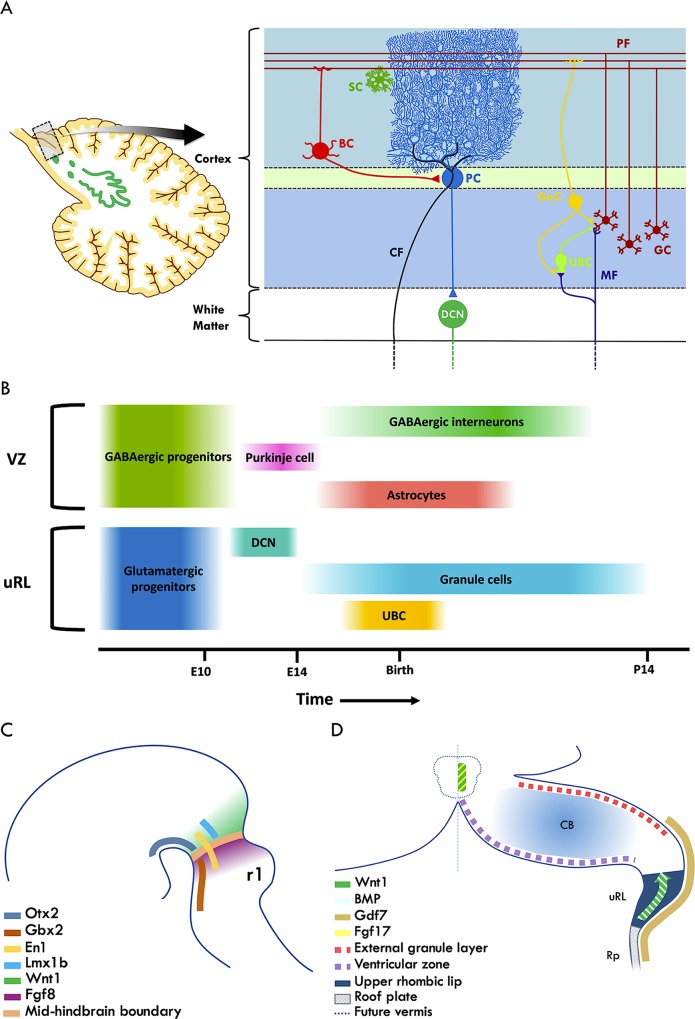
Fig 1
Fig 1. Specification of the CB and the major constituent cell types in mouse.
(A) Organisation of cell types in the mature CB. Afferent input is transmitted via MFs and CFs. BC, GoC, SC, and UBC are interneuron subtypes. (B) Progenitors in two germinal zones, the VZ and uRL, produce distinct neuronal and glial cellular subtypes sequentially. (C) The future CB develops immediately posterior to the mid-hindbrain boundary. Patterning genes and secreted molecules involved in specifying this territory are indicated. (D) The Rp and cerebellar midline have important signalling functions that establish distinct regions of the CB, including the uRL and future vermis. BC, basket cell; BMP, bone morphogenetic protein; CB, cerebellum; CF, climbing fibre; DCN, deep cerebellar nuclear neuron; E, embryonic day; En1, engrailed homeobox 1; Fgf8, fibroblast growth factor 8; Fgf17, fibroblast growth factor 17; Gbx2, gastrulation brain homeobox 2; Gdf7, growth differentiation factor 7; GC, granule cell; GoC, Golgi cell; Lmx1b, LIM homeobox transcription factor 1 beta; MF, mossy fibre; Otx2, orthodenticle homeobox 2; P, postnatal day; PC, Purkinje cell; PF, parallel fibre; r1, rhombomere 1; Rp, roof plate; SC, stellate cell; UBC, unipolar brush cell; uRL, upper rhombic lip; VZ, ventricular zone; Wnt1, wingless-type MMTV integration site family, member 1.
Fig 2
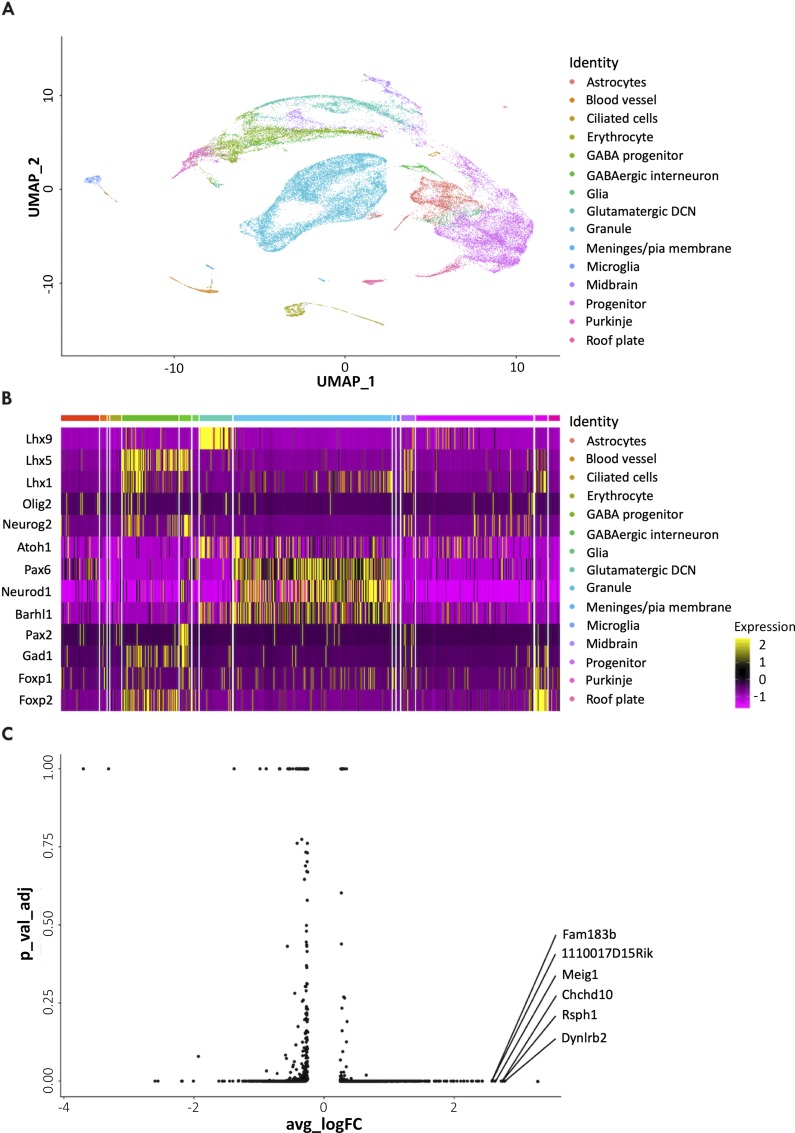
Fig 2. Single-cell characterisation of cellular subtypes in the mouse cerebellum.
Data from Carter and colleagues [36] was downloaded from the European Nucleotide Archive (PRJEB23051). In total, 39,245 cells meeting the authors’ quality control cutoffs were projected in UMAP space using Seurat v 3.1.0 according to the embedded metadata. The FindMarkers command was used to perform differential expression testing (ranked Wilcoxon sum test) to distinguish cell type–specific markers. Scaled data were visualised using the DoHeatmap command. (A) UMAP projection of the single-cell data set identifies all known major subtypes of the developing cerebellum. Nonneural cell types are also visualised. Differential gene expression at cellular resolution readily distinguishes the major cellular subtypes of the cerebellum (B) and identifies a novel cell type (C). (B) Heatmap of selected, established transcriptional markers of the respective cell types. Each vertical bar represents a single cell. Column (cell identity) width is proportional to the number of cells present in that cluster. (C) Volcano plot of differential gene expression in a rare cell type labelled ‘ciliated cells’. The labels indicate genes that encode ciliary proteins, which are significantly enriched in this cell type. Atoh1, atonal bHLH transcription factor 1; Barhl1, BarH like homeobox 1; Chchd10, coiled-coil-helix-coiled-coil-helix domain containing 10; DCN, deep cerebellar nuclear neuron; Dynlrb2, dynein light chain roadblock-type 2; Fam183b, family with sequence similarity 183, member B; Foxp, forkhead box P; Gad1, glutamate decarboxylase 1; Lhx, LIM homeobox protein; Meig1, meiosis expressed gene 1; Neurod1, neurogenic differentiation 1; Neurog2, neurogenin 2; Olig2, oligodendrocyte transcription factor 2; Pax, paired box; Rsph1, radial spoke head 1 homolog; UMAP, Uniform Manifold Approximation and Projection.

References

    1. Bruchhage MMK, Bucci MP, Becker EBE. Cerebellar involvement in autism and ADHD. Handb Clin Neurol. 2018;155:61–72. 10.1016/B978-0-444-64189-2.00004-4 . - DOI - PubMed
    1. Sathyanesan A, Zhou J, Scafidi J, Heck DH, Sillitoe RV, Gallo V. Emerging connections between cerebellar development, behaviour and complex brain disorders. Nat Rev Neurosci. 2019;20(5):298–313. 10.1038/s41583-019-0152-2 . - DOI - PMC - PubMed
    1. Rakic P, Sidman RL. Histogenesis of cortical layers in human cerebellum, particularly the lamina dissecans. J Comp Neurol. 1970;139(4):473–500. 10.1002/cne.901390407 . - DOI - PubMed
    1. Haldipur P, Bharti U, Alberti C, Sarkar C, Gulati G, Iyengar S, et al. Preterm delivery disrupts the developmental program of the cerebellum. PLoS ONE. 2011;6(8):e23449 10.1371/journal.pone.0023449 - DOI - PMC - PubMed
    1. Yachnis AT, Rorke LB. Cerebellar and brainstem development: an overview in relation to Joubert syndrome. J Child Neurol. 1999;14(9):570–3. 10.1177/088307389901400904 . - DOI - PubMed

Publication types