


Growth, Body Composition, and Neurodevelopmental Outcomes at 2 Years Among Preterm Infants Fed an Exclusive Human Milk Diet in the Neonatal Intensive Care Unit: A Pilot Study
- PMID: 32298596
- PMCID: PMC7360515
- DOI: 10.1089/bfm.2019.0210
Growth, Body Composition, and Neurodevelopmental Outcomes at 2 Years Among Preterm Infants Fed an Exclusive Human Milk Diet in the Neonatal Intensive Care Unit: A Pilot Study
Abstract
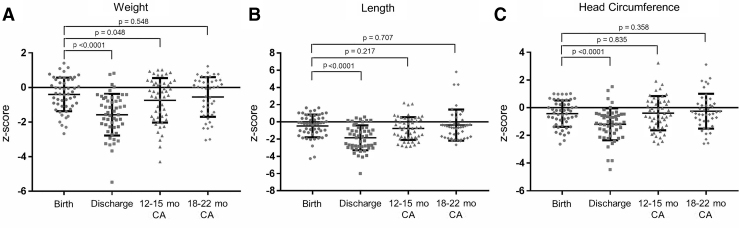
Background: Long-term outcomes of preterm infants fed an exclusive human milk-based (EHM) diet using a donor human milk-based fortifier are not well defined. Materials and Methods: Infants ≤1,250 g birth weight (BW) were studied prospectively at two outpatient visits: 12-15 and 18-22 months corrected age (CA). Dual-energy X-ray absorptiometry and Bayley Scales of Infant and Toddler Development III (BSID-III) were performed at 18-22 months CA. Results: In this pilot study, 51 preterm infants (gestational age 27.8 ± 2.6 weeks and BW 893 ± 204 g) were evaluated. While anthropometric z-scores were significantly lower at discharge compared with birth, z-scores returned to birth levels by 12-15 months CA (length and head circumference [HC]) and 18-22 months CA (weight). Body composition at 2 years of age was similar to term-matched controls. Inpatient growth was significantly correlated with bone density, lean mass (LM), and fat-free mass at 18-22 months CA. Increased mother's own milk (MOM) was significantly correlated with decreased fat mass indices. BSID-III showed that 0% of cognitive composite scores were <70. Conclusions: In addition to returning to BW, length, and HC z-scores by 2 years of age, body composition analysis revealed that increase in body size was appropriate as reflected by LM and bone density similar to matched term controls without an increase in fat mass. No child had severe cognitive developmental delay using a cutoff score of 70. Inpatient growth and increased receipt of MOM correlated with favorable growth and body composition outcomes. Positive outcomes as shown in this study to confirm postdischarge safety of an EHM diet during hospitalization.
Keywords: body composition; growth; human milk; neurodevelopment; nutrition; premature infants.
Conflict of interest statement
A.B.H. receives research support from Fresenius Kabi for the Randomized SMOF Study and Prolacta Bioscience for an unrelated study in cardiac infants and the human milk cream study. K.M.H. receives speaker honoraria from Prolacta Bioscience and Abbott Nutrition. No industry funding was received for this study. The remaining authors declare no potential conflict of interest.
Figures
References
-
- American Academy of Pediatrics Section on Breastfeeding. Breastfeeding and the use of human milk. Pediatrics 2012;129:e827–e841 - PubMed
-
- Schanler RJ. Outcomes of human milk-fed premature infants. Semin Perinatol 2011;35:29–33 - PubMed
-
- American Academy of Pediatrics Committe on Nutrition, Section on Breastfeeding, Committee on Fetus and Newborn. Donor human milk for the high-risk infant: Preparation, safety, and usage options in the united states. Pediatrics 2017;139:e20163440. - PubMed
-
- Sullivan S, Schanler RJ, Kim JH, et al. An exclusively human milk-based diet is associated with a lower rate of necrotizing enterocolitis than a diet of human milk and bovine milk-based products. J Pediatr 2010;156:562.e561–567.e561 - PubMed
