


Physical exercise, mental health problems, and suicide attempts in university students
- PMID: 32299418
- PMCID: PMC7164166
- DOI: 10.1186/s12888-020-02583-3
Physical exercise, mental health problems, and suicide attempts in university students
Abstract
Background: Physical inactivity and mental health problems are both major public health concerns worldwide. Although several studies have demonstrated the health benefits of regular physical exercise, few epidemiological studies have investigated the nature of the association between different aspects of physical exercise and mental health, and little is known regarding the possible link to suicidality.
Study aim: To examine the association between frequency, intensity, and duration of physical exercise and mental health problems, and to explore whether low levels of physical activity is related to self-harm and suicide attempts among college and university students.
Methods: We employed data from the SHoT2018-study, a national health survey for higher education in Norway, in which 50,054 students aged 18-35 years participated. Physical exercise was assessed with three questions (frequency, intensity, and duration). Mental health problems were assessed with both a screening tool assessing psychological distress (Hopkins Symptom Checklist-25; HSCL-25) and self-reported depressive disorder (using a pre-defined list of conditions). Suicide attempts and self-harm were assessed with two items from the Adult Psychiatric Morbidity Survey.
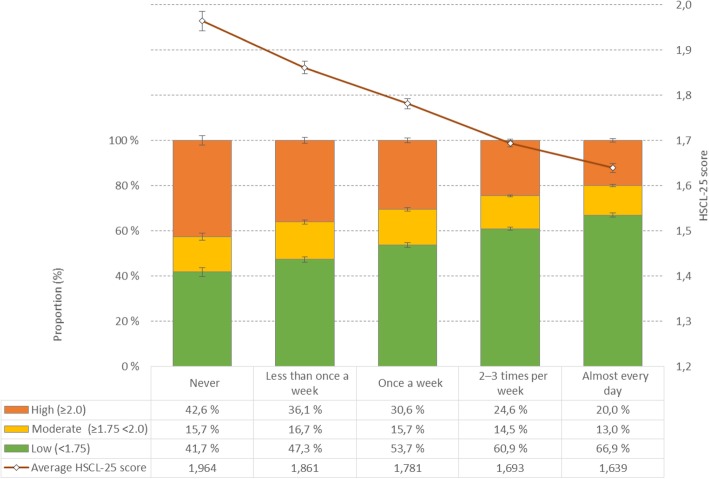
Results: Physical exercise was negatively associated with all measures of mental health problems and suicidality in a dose-response manner. The strongest effect-sizes were observed for frequency of physical exercise. Women with low levels of physical activity had a near three-fold increased odds of both scoring high on the HSCL-25, and self-reported depression, compared to women exercising almost every day. Even stronger effect-sizes were observed for men (ORs ranging from 3.5 to 4.8). Also, physical exercise duration and intensity were significantly associated with mental health problems, but with generally smaller ORs. Similarly, graded associations were also observed when examining the link to self-harm and suicide attempts (ORs ranging from 1.9 to 2.5).
Conclusion: Given the demonstrated dose-response association between inactivity and both poor mental health, self-harm, and suicidal attempt, there is a need to facilitate college students to become more physically active. This is a shared responsibility that resides both on a political level and on the post-secondary institutions. The cross-sectional nature of the study means that one should be careful to draw firm conclusion about the direction of causality.
Keywords: College students; Depression; Mental health; Physical exercise; Self-harm; Suicide attempt.
Conflict of interest statement
The authors of this paper have no competing interests to report.
Figures
References
-
- Gordon BR, McDowell CP, Hallgren M, Meyer JD, Lyons M, Herring MP. Association of Efficacy of resistance exercise training with depressive symptoms meta-analysis and meta-regression analysis of randomized clinical trials. Jama Psychiatry. 2018;75(6):566–576. doi: 10.1001/jamapsychiatry.2018.0572. - DOI - PMC - PubMed
Publication types
MeSH terms
Grants and funding
LinkOut - more resources
Full Text Sources
Medical
