Observational Study
. 2020 Aug;28(8):1020-1027.
doi: 10.1038/s41431-020-0618-8. Epub 2020 Apr 16.

The uptake of predictive DNA testing in 40 families with a pathogenic BRCA1/BRCA2 variant. An evaluation of the proband-mediated procedure

Affiliations
Observational Study

The uptake of predictive DNA testing in 40 families with a pathogenic BRCA1/BRCA2 variant. An evaluation of the proband-mediated procedure

Fred H Menko et al. Eur J Hum Genet. 2020 Aug.

Abstract

When hereditary breast and ovarian cancer (HBOC) due to a BRCA1/BRCA2 germline pathogenic variant is diagnosed, the proband will be asked to inform other at-risk family members. In the Netherlands, a guideline was introduced in 2012 which provided detailed recommendations regarding this proband-mediated procedure. We now evaluated the uptake of predictive BRCA1/BRCA2 testing in 40 consecutive HBOC families diagnosed in our centre in 2014. We performed a retrospective observational study of all 40 families in which a pathogenic BRCA1/BRCA2 germline variant was identified during 2014. We scored the uptake of predictive and confirmatory testing by the end of 2018 and explored factors associated with the level of uptake. Two families were excluded. In the remaining 38 families, among 239 family members ≥18 years at 50% risk of being a mutation carrier or at 25% risk if the family member at 50% risk was deceased, 102 (43%) were tested. Among 108 females 25-75 years of age at 50% risk, 59 (55%) underwent predictive or confirmatory testing, and among 43 males at 50% risk with daughters ≥18 years, 22 (51%) were tested. Factors which complicated cascade screening included family members living abroad, probands not wanting to share information and limited pedigree information. In conclusion, the standard proband-mediated procedure of informing relatives seems to be far from optimal. We suggest a tailored approach for each family, including the option of a direct approach to at-risk family members by the geneticist. In addition, we suggest detailed monitoring and follow-up of families.


Conflict of interest statement

The authors declare that they have no conflict of interest.

Figures
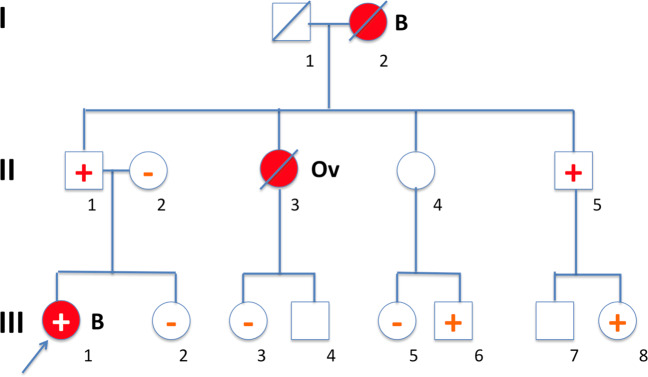
Fig. 1
Fig. 1. Scoring of at-risk and tested family members.
In this fictitious pedigree (A), a pathogenic BRCA1 germline variant was identified in the proband affected with breast cancer (III-1). Subsequently, both her parents were tested and, as expected based on pedigree data (no breast or ovarian cancer had occurred in the maternal family members, data not shown), the father of the proband proved to be a carrier of the pathogenic germline BRCA1 variant. As a next step, a letter was sent to the family for circulation amongst the proband’s at-risk paternal family members. Testing of the proband and both her parents was labelled as diagnostic testing, while subsequent testing of additional family members was labelled as predictive or confirmatory testing for unaffected and affected at-risk relatives, respectively. When the family first received the letter, five adult relatives were at 50% risk, or at 25% risk if a parent at 50% risk was deceased, comprising the relatives II-4, II-5, III-2, III-3 and III-4. Three of these five relatives were tested. It should be noted that additional family members were tested, including III-5 and III-6 once they learned that their mother did not wish to be tested, and III-8 based on cascade testing after her father was found to be mutation carrier. In the current study, II-4 was scored as untested; however, the fact that the offspring III-5 and III-6 were tested is relevant and is given as extra information in Table 1. The fact that individual III-8 was tested has been added to the total number of tested family members, but individual III-8 was not counted as an at-risk family member since she was originally not at-risk (before her father was tested) according to the criteria used.
Fig. 2
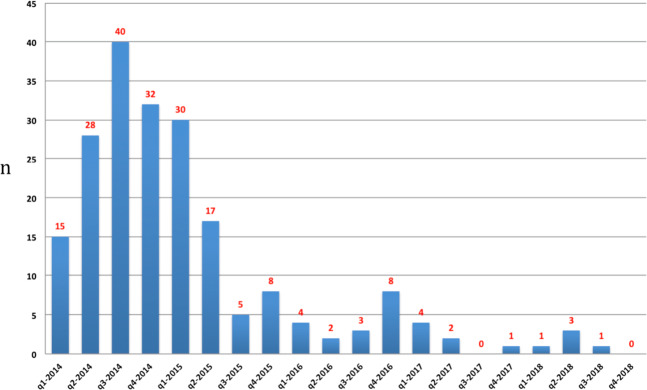
Fig. 2. DNA testing in 38 families with a pathogenic BRCA1/BRCA2 germline variant 2014–8.
The number of DNA tests performed in 38 families with a pathogenic BRCA1/BRCA2 germline variant evaluated quarterly (q), based on our laboratory registry. Both diagnostic tests, predictive and confirmatory tests are listed. Two tests performed abroad are listed in Table 2 (total number 206) but not in Fig. 2 since the dates of testing are unknown (total number 204).

References

    1. Szabo CI, King MC. Inherited breast and ovarian cancer. Hum Mol Genet. 1995;4:1811–7. doi: 10.1093/hmg/4.suppl_1.1811. - DOI - PubMed
    1. Hereditary Tumours. Guidelines for Diagnosis and Prevention. Leiden:The Netherlands Foundation for the Detection of Hereditary Tumours and Dutch Society for Clinical Genetics; 2010. ISBN 978-90-806183-2-9 (in Dutch).
    1. Golmard L, Delnatte C, Laugé A, Moncoutier V, Lefol C, Abidallah K, et al. Breast and ovarian cancer predisposition due to de novo BRCA1 and BRCA2 mutations. Oncogene. 2016;35:1324–7. doi: 10.1038/onc.2015.181. - DOI - PubMed
    1. Tuffaha HW, Mitchell A, Ward BL, Connely L, Butler JRG, Norris S, et al. Cost-effectiveness analysis of germ-line BRCA testing in women with breast cancer and cascade testing in family members of mutation carriers. Genet Med. 2018;20:985–94. doi: 10.1038/gim.2017.231. - DOI - PubMed
    1. Menko FH, Ter Stege JA, van der Kolk LE, Jeanson KN, Schats W, Moha DA, et al. The uptake of presymptomatic genetic testing in hereditary breast-ovarian cancer and Lynch syndrome: a systematic review of the literature and implications for clinical practice. Fam Cancer. 2019;18:127–35. doi: 10.1007/s10689-018-0089-z. - DOI - PubMed

Publication types