. 2020 Apr 16;10(1):6493.
doi: 10.1038/s41598-020-63491-w.

In-vitro analysis of free radical scavenging activities and suppression of LPS-induced ROS production in macrophage cells by Solanum sisymbriifolium extracts

Affiliations

In-vitro analysis of free radical scavenging activities and suppression of LPS-induced ROS production in macrophage cells by Solanum sisymbriifolium extracts

Garland K More et al. Sci Rep. .

Abstract

The current study aims to evaluate the antioxidant, cytotoxicity activities and suppression of LPS-induced oxidative stress production and characterization of phytochemicals in Solanum sisymbriifolium leaf extracts. The 2,2-diphenyl-1-picrylhydrazyl (DPPH) and 2,2'-azino-bis3-ethylbenzothiazoline-6-sulphonic acid (ABTS) radical scavenging activity of the leaves of S. sisymbriifolium extracted with solvents of various polarities viz. water: ethanol, ratio 50: 50; ethyl acetate and dichloromethane, was assessed. The cytotoxicity of the extracts was determined using the [3-(4, 5-dimethylthiazol-2-yl)-2, 5-diphenyltetrazolium bromide] (MTT) assay on RAW 264.7 macrophage (Murine) cells and real-time cell analysis (RTCA) xCELLigence system was used for determining cell viability. Cell-based detection of reactive oxygen species (ROS) was investigated utilizing a 2',7'-Dichlorodihydrofluorescein diacetate (H2DCF-DA) assay. The DPPH and ABTS scavenging activity results of extracts revealed a dose-dependent response with significantly lower activity in both DPPH and ABTS. The superoxide dismutase (SOD) enzyme activity was then evaluated and extracts displayed a high SOD enzyme activity with 90-50% activity. Cytotoxicity results revealed that S. sisymbriifolium extracts were not toxic to RAW 264.7 macrophage cells at the tested concentrations. All three extracts decreased the production of ROS in macrophage cells. Phytochemical analysis using Fourier-transform infrared spectroscopy (FTIR) indicated the presence of metabolite functional groups which may be responsible for the antioxidant activity. The current study indicates that S. sisymbriifolium contains phytochemicals that scavenge free radicals, with less toxicity, and suppresses the LPS-induced ROS production in RAW 264.7 macrophage cells.


Conflict of interest statement

Mr. G.K.M. has been funded by National Research Foundation (NRF) Thuthuka and the Collage of Agriculture and Environmental Science at University of South Africa. Mr. G.K.M. and Mr R.T.M. declare no potential conflict of interest.

Figures
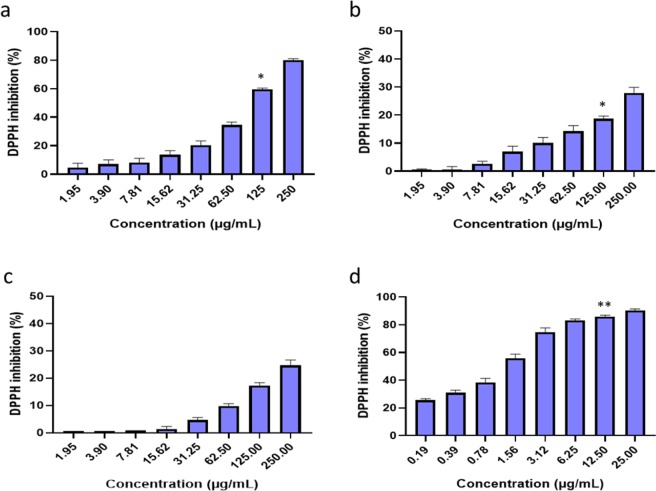
Figure 1
Figure 1
DPPH radical scavenging activities of various concentrations of S. sisymbriifolium leaf phytochemicals extracted with different solvents including 50% ethanol (a), ethyl-acetate (b), dichloromethane (c) and positive control (Ascorbic acid) (d) and the goodness of fit of R2 ≥ 0. 900. The bar graphs with asterisks (*), (**) denotes a significant difference (p ≤ 0.05), (p ≤ 0.01) when compared to the control based on Duncan’s multiple comparison test. Data is represented as Mean ± SD, n = 3.
Figure 2
Figure 2
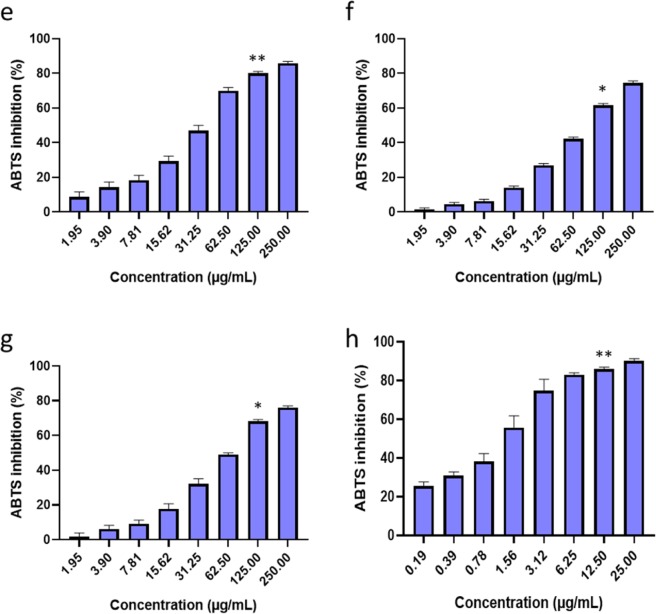
ABTS cation radical scavenging activities of various concentrations of S. sisymbriifolium leaf phytochemicals extracted with different solvents including those of 50% ethanol (e), ethyl-acetate (f), dichloromethane (g) and ascorbic acid (h) and the goodness of fit of R2 ≥ 0. 900. The bar graphs with asterisks (*), (**) denotes a significant difference (p ≤ 0.05), (p ≤ 0.01) when compared to the control based on Duncan’s multiple comparison test. Data is represented as Mean ± SD, n = 3.
Figure 3
Figure 3
EC50 values of S. sisymbriifolium leaf extracts on macrophage cells tested at a concentration range of 2.0–250 µg/mL and Curcumin 2.0–250 µM. Cell proliferation assay were performed in triplicate and the mean ± SD were calculated with *p < 0.05. The bar graphs with asterisks (*) denotes a significant difference (p ≤ 0.05) when compared to the control based on Duncan’s multiple comparison test.
Figure 4
Figure 4
Monitoring the effect of S. sisymbriifolium (WE, EAA and DCM) extracts (100 µg/mL) on the viability of macrophage cells during 72 h exposure by the RTCA system.
Figure 5
Figure 5
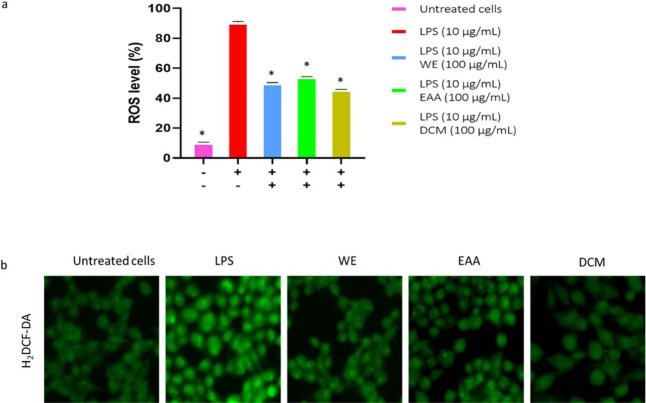
Effective inhibition of LPS-induced ROS production by S. sisymbriifolium extracts in macrophage cells (a). Statistical analysis: one-way ANOVA with Duncan multiple range test for means ± SD separation where *P < 0.05 was considered to indicate statistically significant difference compared to the LPS-treated group. (b) Images of the effects of LPS-induced ROS production by extracts imaged by confocal microscope using the H2DCFDA dye.
Figure 6
Figure 6
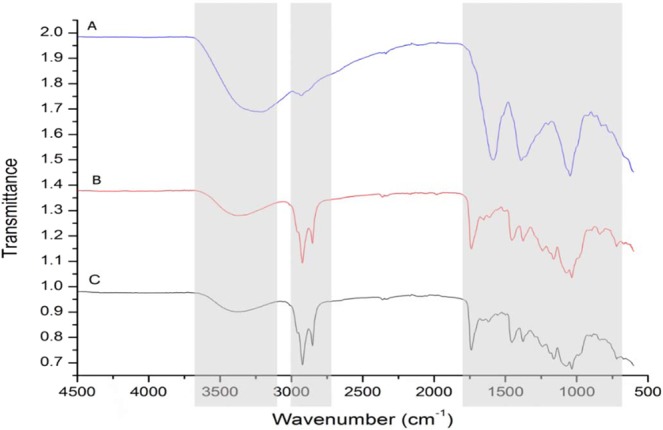
FTIR spectra of 50% water-ethanol (A), ethyl-acetate (B) and dichloromethane (C) extract of S. sisymbriifolium leaves. The shaded portions show the differences between the three extracts.

References

    1. Loperena R, Harrison DG. Oxidative stress and hypertensive diseases. Med. Clin. North. Am. 2017;101:169–193. doi: 10.1016/j.mcna.2016.08.004. - DOI - PMC - PubMed
    1. Reuter S, Gupta SC, Chaturvedi MM, Aggarwal BB. Oxidative stress, inflammation, and cancer: how are they linked? Free. Radic. Biol. Medicine. 2010;49:1603–1616. doi: 10.1016/j.freeradbiomed.2010.09.006. - DOI - PMC - PubMed
    1. Chen S, Hsu C, Tsai M, Chen R. Inhibition of oxidative stress by low-molecular-weight polysaccharides with various functional groups in skin fibroblasts. Int. J. Mol. Sci. 2013;14:19399–19415. doi: 10.3390/ijms141019399. - DOI - PMC - PubMed
    1. Vogiatzi G, Tousoulis D, Stefanadis C. The role of oxidative stress in atherosclerosis. Hellenic J. Cardiol. 2009;1:402–409. - PubMed
    1. Devasagayam, T. P. A., Tilak, J. C., Boloor, K. K., Sane, K. S. Free radicals and antioxidants in human health: Current status and future prospects. J. A. P. I. 52 (2004). - PubMed

Publication types

MeSH terms