


Safety of Dienogest and Other Hormonal Treatments for Endometriosis in Real-World Clinical Practice (VIPOS): A Large Noninterventional Study
- PMID: 32301063
- PMCID: PMC7467487
- DOI: 10.1007/s12325-020-01331-z
Safety of Dienogest and Other Hormonal Treatments for Endometriosis in Real-World Clinical Practice (VIPOS): A Large Noninterventional Study
Abstract
Introduction: Endometriosis is a common gynecologic disease associated with a significant burden on women's health and healthcare systems. Currently approved hormonal treatments for endometriosis can be effective in controlling symptoms, but may have clinically relevant side effects that limit their long-term use. Dienogest 2 mg (Visanne; Bayer AG, Berlin, Germany) is a 19-nortestosterone derivative that significantly reduces menstrual bleeding, dysmenorrhea, premenstrual pain, dyspareunia, and pelvic pain in women with endometriosis. Although dienogest 2 mg has demonstrated efficacy in clinical trials, data regarding long-term and real-world use are limited.
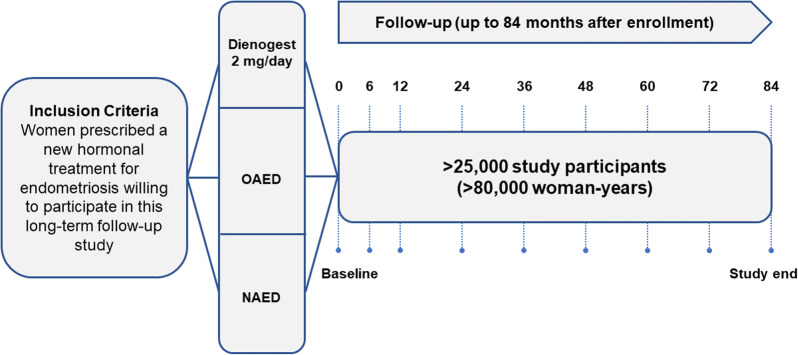
Methods: To our knowledge, the Visanne Post-approval Observational Study (VIPOS) is the largest real-world, noninterventional study performed examining the safety of dienogest and other hormonal treatments for the management of endometriosis in routine clinical practice. Patients self-reported medical and gynecologic history and symptoms and treatment information. Primary clinical outcomes were clinically validated and subject to independent blinded adjudication. Loss to follow-up was minimized through active contact with participating women at 6 months post-enrollment and annually thereafter to ensure almost all clinically relevant outcomes were captured.
Planned outcomes: VIPOS planned to enroll approximately 25,000 women initiating a new treatment for endometriosis, including those prescribed dienogest 2 mg/day and other hormonal medications for endometriosis (approved or nonapproved), from approximately 1000 centers in six European countries. The main clinical outcomes of interest for follow-up are anemia requiring medical intervention, de novo or clinically worsening depression, and treatment-failure patterns that result in drug discontinuation. Additional analyses will characterize the baseline risk factors of medically managed patients with endometriosis and assess treatment utilization patterns. VIPOS was designed to provide real-world information on endometriosis treatment and associated clinical outcomes, while not affecting the prescribing physician's decisions or the classification of patient diagnoses.
Trial registration: European Union Electronic Register of Post-Authorisation Studies (EU PAS) no. 1613, Clinicaltrials.gov: NCT01266421.
Keywords: Dienogest; Endometriosis; Hormonal treatment; Observational; Prospective; Real-world evidence; Women’s health.
Figures
References
-
- Wills HDC, May K, Kennedy S, Kirtley S, Hogg S. NHS evidence—endometriosis annual evidence update. 2010.
-
- Vitale SG, Capriglione S, Peterlunger I, La Rosa VL, Vitagliano A, Noventa M, Valenti G, Sapia F, Angioli R, Lopez S, et al. The role of oxidative stress and membrane transport systems during endometriosis: a fresh look at a busy corner. Oxid Med Cell Longev. 2018;2018:7924021. doi: 10.1155/2018/7924021. - DOI - PMC - PubMed
Publication types
MeSH terms
Substances
Associated data
LinkOut - more resources
Full Text Sources
Medical
