. 2020 Apr;30(4):576-588.
doi: 10.1101/gr.259044.119. Epub 2020 Apr 17.

Arabidopsis retrotransposon virus-like particles and their regulation by epigenetically activated small RNA

Affiliations

Arabidopsis retrotransposon virus-like particles and their regulation by epigenetically activated small RNA

Seung Cho Lee et al. Genome Res. 2020 Apr.

Abstract

In Arabidopsis, LTR retrotransposons are activated by mutations in the chromatin gene DECREASE in DNA METHYLATION 1 (DDM1), giving rise to 21- to 22-nt epigenetically activated siRNA (easiRNA) that depend on RNA DEPENDENT RNA POLYMERASE 6 (RDR6). We purified virus-like particles (VLPs) from ddm1 and ddm1rdr6 mutants in which genomic RNA is reverse transcribed into complementary DNA. High-throughput short-read and long-read sequencing of VLP DNA (VLP DNA-seq) revealed a comprehensive catalog of active LTR retrotransposons without the need for mapping transposition, as well as independent of genomic copy number. Linear replication intermediates of the functionally intact COPIA element EVADE revealed multiple central polypurine tracts (cPPTs), a feature shared with HIV in which cPPTs promote nuclear localization. For one member of the ATCOPIA52 subfamily (SISYPHUS), cPPT intermediates were not observed, but abundant circular DNA indicated transposon "suicide" by auto-integration within the VLP. easiRNA targeted EVADE genomic RNA, polysome association of GYPSY (ATHILA) subgenomic RNA, and transcription via histone H3 lysine-9 dimethylation. VLP DNA-seq provides a comprehensive landscape of LTR retrotransposons and their control at transcriptional, post-transcriptional, and reverse transcriptional levels.


Figures

Figure 1.
Figure 1.
VLP DNA-seq data of LTR retrotransposons in ddm1 and ddm1rdr6. (A) Differential analysis of paired-end sequencing of VLP DNA using Illumina short-read platform. The statistical significance of three comparisons of wild type (WT), ddm1, and ddm1rdr6 is shown with |log2(fold-change)| ≥ 2 and FDR threshold at 5%. Each point corresponds to an annotated transposable element. Multiple ATHILA subfamilies were combined and labeled as “ATHILA.” (B) Coverage of short- and long-read VLP DNA-seq at representative LTR retrotransposon loci (EVADE, AT5TE20395; ATGP3, AT1TE45315; ATCOPIA51, AT1TE36035; SISYPHUS, AT3TE76225) were plotted for ddm1 and ddm1rdr6. Mean read counts per million mapped reads and 95% confidence intervals of biological replicates are shown for WT (yellow; n = 3), ddm1 (blue; n = 2), and ddm1rdr6 (orange, n = 3) short-read libraries. VLP DNA replicate samples were pooled for each genotype and sequenced in aggregate by ONT long-read sequencing. In the LTR retrotransposon annotation, abbreviations for conserved protein domains within the GAG-POL ORF are as follows: (AP) amino peptidase, (INT) integrase, (RT) reverse transcriptase, and (RH) RNase H. Blue and red lines indicate primer binding sites (PBSs) and polypurine tracts (PPTs). The 21- to 22-nt small RNA (sRNA) data were obtained from a previous study (Creasey et al. 2014). Target positions of miRNAs are indicated as arrows (for details, see Supplemental Table S4). Central PPT (cPPT) positions are indicated as dashed lines. Elevated coverage at the edges of strong-stop intermediate and flap DNA is shown as asterisks above ddm1 short-read data.
Figure 2.
Figure 2.
Extrachromosomal DNA of LTR retrotransposons in ddm1 and ddm1rdr6. (A) Southern blotting using an EVADE probe was performed with undigested genomic DNA of F1 and F2 plants from the same parental lines. Integrated DNA copies (IC) and extrachromosomal DNA copies (EC) are indicated. Ethidium bromide (EtBr) staining was used for loading control. (B) Discordant short-read alignments from SISYPHUS (AT3TE76225) and EVADE in ddm1. Read pair orientations (forward or reverse for the first and second mate): RR and FF reads align in the same direction to the reference, indicating inversions, whereas RF reads face outward, indicating circular templates. LTR regions are indicated as blue bars. (C) Inverse PCR with genomic DNA to detect circular extrachromosomal DNA from ATCOPIA51, SISYPHUS, EVADE, and ATGP3 in ddm1 plants. (D) Inverse PCR with VLP DNA and reverse-forward (RF) outward reading primers for SISYPHUS and EVADE. (C,D) PCR primers are listed in Supplemental Table S6.
Figure 3.
Figure 3.
Alignments of ONT long reads from ddm1 VLP DNA. The central polypurine tract (cPPT), PBS, and PPT positions are indicated as dashed lines relative to full and LTR annotation of SISYPHUS (AT3TE76225), EVADE (AT5TE20395), and ATGP3 (AT1TE45315). Gaps in individual reads are indicated with black horizontal lines, and sequence mismatches are shown as colored dots in the read alignments. Pileups of linear intermediates are observed for EVADE, whereas a continuous distribution of fragment lengths is observed in SISYPHUS.
Figure 4.
Figure 4.
DNA and RNA levels of LTR retrotransposons in ddm1 and rdr6 mutants. (A) DNA copy numbers of EVADE, ATGP3, and SISYPHUS in ddm1 and ddm1rdr6 were normalized with a single copy gene (AT5G13440). (B) RT-qPCR data of EVADE elements using POL primers; y-axis indicates relative levels of EVADE genomic RNA to WT after normalization to ACT2. (C,D) EVADE DNA copy number and genomic RNA levels were analyzed in F2 and F3 progenies of F1 plants carrying active EVADE epigenetically inherited from parental rdr6/+ (Epi) crossed with WT pollen. Error bars, SD (n = 3).
Figure 5.
Figure 5.
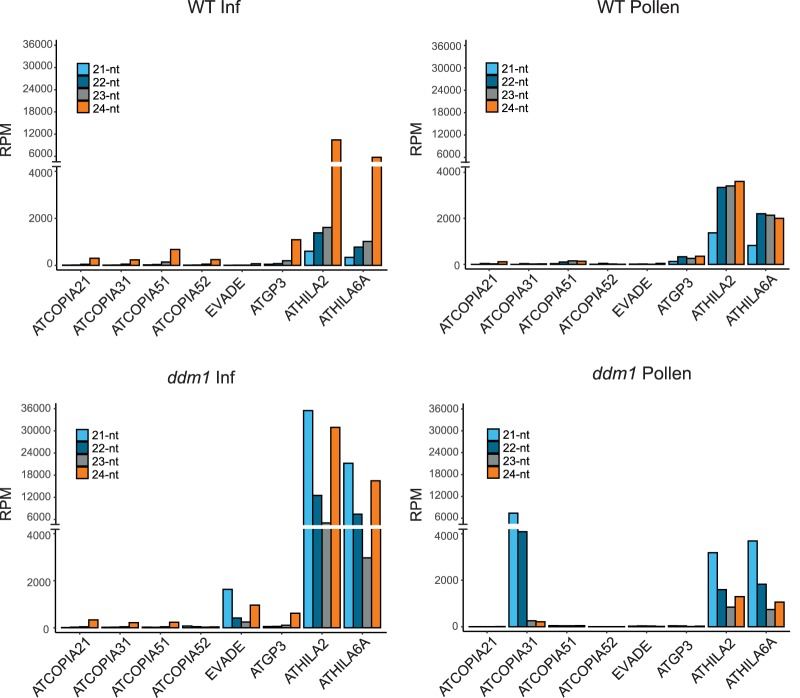
Small RNA profiles of representative LTR retrotransposons; 21-, 22-, 23-, and 24-nt small RNA levels in inflorescence tissues and pollen of WT and ddm1. Reads per million (RPM) were calculated from entire elements, including LTR and coding sequences.
Figure 6.
Figure 6.
Translatome profiles of ddm1 and ddm1rdr6. (A) Differential analysis of polysomal RNA-seq data between ddm1 and ddm1rdr6. Polysomal RNA-seq values were normalized by total RNA seq values to reflect polysomal enrichment (Methods). Red dots indicate significantly regulated genes or transposable elements (TEs) by cut-off values of |log2(fold-change)| > 0.5 and P-values < 0.01 which include ARF4 as an internal control. Significantly regulated ATHILA family elements are labeled with blue dots. (B) Total RNA and microsome-polysomal RNA (M poly) levels are shown for EVADE (AT5TE20395) and SISYPHUS (AT3TE76225). Mean RPM mapped reads and 95% confidence intervals of three biological replicates are shown for ddm1 (blue) and ddm1rdr6 (orange). Conserved protein domains, PBS and PPT, small RNA profiles, and miRNA target sites are indicated as in Figure 1.
Figure 7.
Figure 7.
ATHILA family elements gain RDR6-dependent H3K9me2 in ddm1. H3K9me2 signal at transposable elements from multiple ATHILA families was analyzed in WT, ddm1, and ddm1rdr6 genotypes and correlated with previously published small RNA data (Creasey et al. 2014). RDR6-dependent gains in H3K9me2 colocalize with increased 21- to 22-nt siRNAs in ddm1. Plots depict transposable elements annotations scaled to 5 kb, as well as 2 kb upstream of and downstream from each feature. H3K9me2 ChIP data were normalized by H3, and small RNA data were normalized by counts per million.

References

    1. Arribas-Hernandez L, Marchais A, Poulsen C, Haase B, Hauptmann J, Benes V, Meister G, Brodersen P. 2016. The slicer activity of ARGONAUTE1 is required specifically for the phasing, not production, of trans-acting short interfering RNAs in Arabidopsis. Plant Cell 28: 1563–1580. 10.1105/tpc.16.00121 - DOI - PMC - PubMed
    1. Axtell MJ. 2013. ShortStack: comprehensive annotation and quantification of small RNA genes. RNA 19: 740–751. 10.1261/rna.035279.112 - DOI - PMC - PubMed
    1. Axtell MJ, Jan C, Rajagopalan R, Bartel DP. 2006. A two-hit trigger for siRNA biogenesis in plants. Cell 127: 565–577. 10.1016/j.cell.2006.09.032 - DOI - PubMed
    1. Bachmair A, Garber K, Takeda S, Sugimoto K, Kakutani T, Hirochika H. 2004. Biochemical analysis of long terminal repeat retrotransposons. Methods Mol Biol 260: 73–82. 10.1385/1-59259-755-6:073 - DOI - PubMed
    1. Bachmann AS, Corpuz G, Hareld WP, Wang G, Coller BA. 2004. A simple method for the rapid purification of copia virus-like particles from Drosophila Schneider 2 cells. J Virol Methods 115: 159–165. 10.1016/j.jviromet.2003.09.025 - DOI - PubMed

Publication types