Comparative Study
. 2020 Jun 15;13(6):dmm043927.
doi: 10.1242/dmm.043927.

A comprehensive study of phospholipid fatty acid rearrangements in metabolic syndrome: correlations with organ dysfunction

Affiliations
Comparative Study

A comprehensive study of phospholipid fatty acid rearrangements in metabolic syndrome: correlations with organ dysfunction

Amélie Bacle et al. Dis Model Mech. .

Abstract

The balance within phospholipids (PLs) between saturated fatty acids and monounsaturated or polyunsaturated fatty acids is known to regulate the biophysical properties of cellular membranes. As a consequence, in many cell types, perturbing this balance alters crucial cellular processes, such as vesicular budding and the trafficking/function of membrane-anchored proteins. The worldwide spread of the Western diet, which is highly enriched in saturated fats, has been clearly correlated with the emergence of a complex syndrome known as metabolic syndrome (MetS). MetS is defined as a cluster of risk factors for cardiovascular diseases, type 2 diabetes and hepatic steatosis; however, no clear correlations have been established between diet-induced fatty acid redistribution within cellular PLs and the severity/chronology of the symptoms associated with MetS or the function of the targeted organs. To address this issue, in this study we analyzed PL remodeling in rats exposed to a high-fat/high-fructose diet (HFHF) over a 15-week period. PL remodeling was analyzed in several organs, including known MetS targets. We show that fatty acids from the diet can redistribute within PLs in a very selective manner, with phosphatidylcholine being the preferred sink for this redistribution. Moreover, in the HFHF rat model, most organs are protected from this redistribution, at least during the early onset of MetS, at the expense of the liver and skeletal muscles. Interestingly, such a redistribution correlates with clear-cut alterations in the function of these organs.This article has an associated First Person interview with the first author of the paper.

Keywords: Cardiovascular disease; Hepatic steatosis; Phospholipids; Polyunsaturated fatty acids; Saturated fat; Type 2 diabetes.


Conflict of interest statement

Competing interestsThe authors declare no competing or financial interests.

Figures
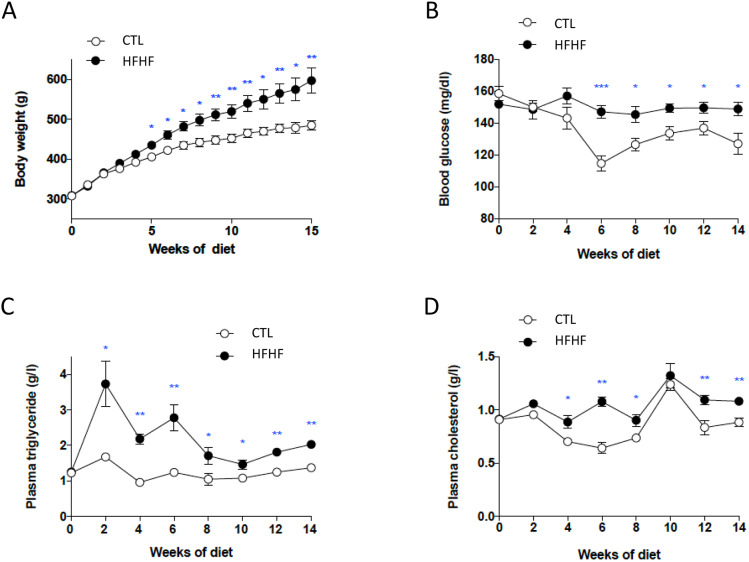
Fig. 1.
Fig. 1.
Longitudinal measurements (under random fed conditions) performed during the study. (A-D) During the longitudinal observation, body weight was measured each week (A) and plasma glucose (B), plasma triglycerides (C) and plasma cholesterol (D) levels were determined every 2 weeks at the same time of day (14:00) for CTL (n=8) and HFHF rats (n=8). Protocols used are described in the Materials and Methods section. Data are presented as means±s.d. Parameters were compared between CTL and HFHF rats using unpaired Student’s t-test; ***P<0.001, **P<0.01 and *P<0.05.
Fig. 2.
Fig. 2.
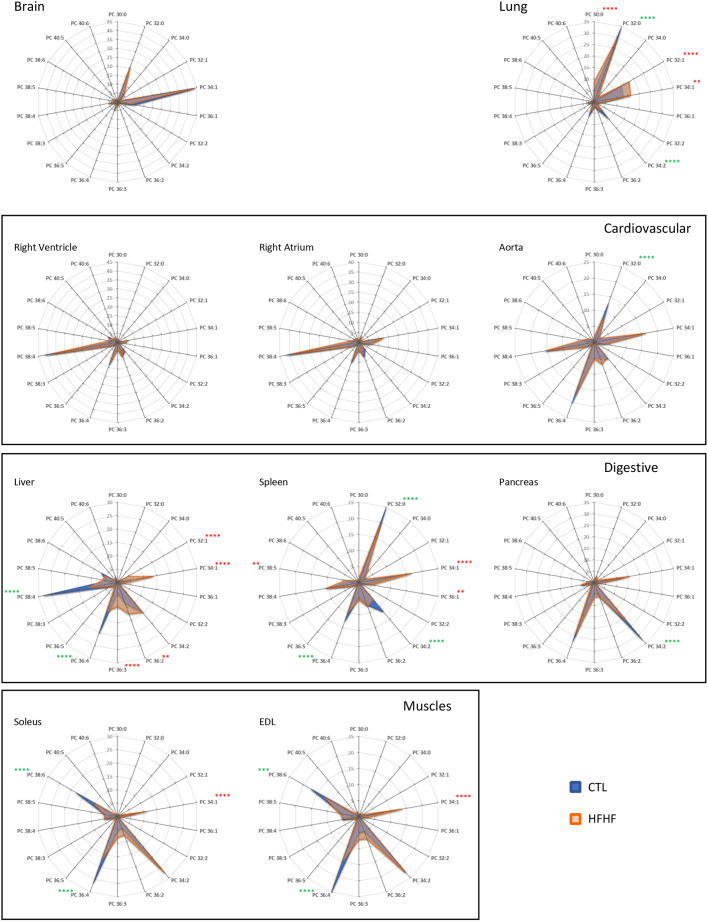
PC species distribution in various organs as a function of the diet. Total lipids were extracted and phospholipid species were purified and analyzed by ESI-MS from samples corresponding to the indicated organs obtained from rats fed either with a control (CTL) or HFHF diet, as described in the Materials and Methods section. PC subspecies distribution is shown in each case. The total carbon chain length (x) and number of carbon-carbon double bonds (y) of the main PC molecular species (x:y) are indicated. Values are the mean±s.d. of four independent determinations from four individuals from both groups in each case. Statistical analysis was performed using two-way ANOVA and completed by Bonferroni post-tests to compare means variation between the two groups of animals for each PC subspecies. Significant differences between CTL and HFHF are indicated (****P<0.0001, ***P<0.001 and **P<0.01) either in green, if a specific subspecies is decreased under the HFHF diet as compared with CTL, or in red, if this subspecies is increased under the HFHF regimen.
Fig. 3.
Fig. 3.
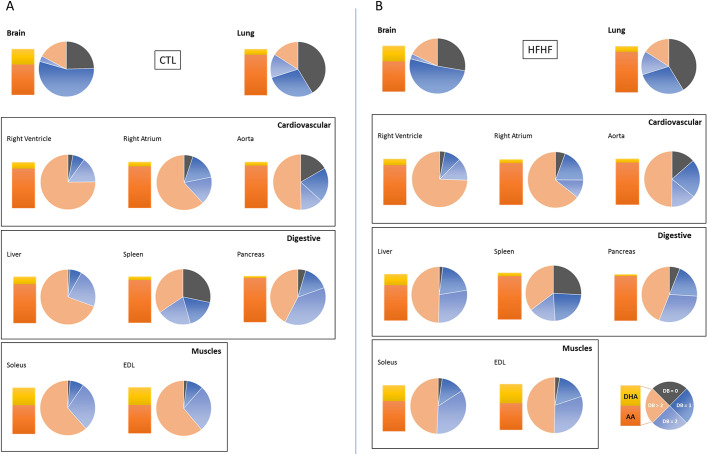
PC double-bond (DB) index and DHA to AA ratios in various organs as a function of the diet. (A,B) Total lipids were extracted and phospholipid species were purified and analyzed by ESI-MS from samples corresponding to the indicated organs obtained either from rats fed with a normal CTL diet (A) or HFHF diet (B), as described in the Materials and Methods section. The relative percentage of saturated (DB=0, no double bonds) versus monounsaturated (DB=1, one double bond), diunsaturated (DB=2, two double bonds) and polyunsaturated (DB>2, more than two double bonds) PC species was obtained from the PC subspecies distribution displayed in Fig. 2. The ratio of DHA- to AA-containing PC subspecies in the various organs is also displayed.
Fig. 4.
Fig. 4.
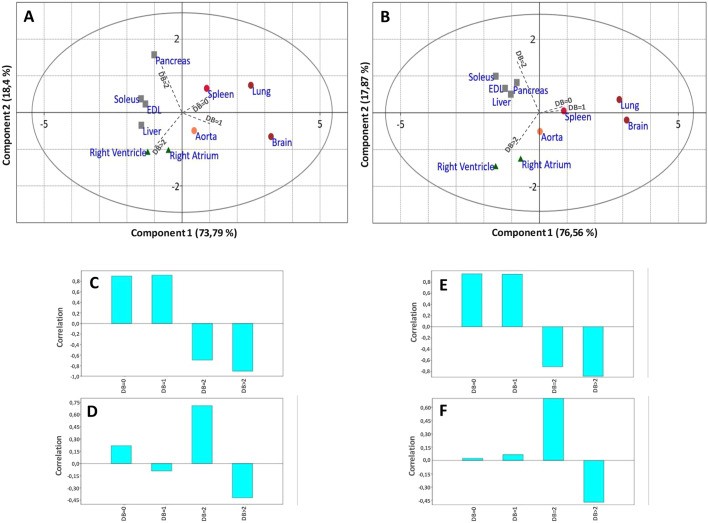
PCAs of the PC DB index as a function of the organ and in response to the HFHF diet. (A,B) PCA score plot of the different organs in the normal (CTL) diet (A) and in the HFHF diet (B). (C,D) PCA-1 (C) and PCA-2 (D) loading plots for A. (E,F) PCA-1 (E) and PCA-2 (F) loading plots for B. DB is the number of double bonds in PC species.
Fig. 5.
Fig. 5.
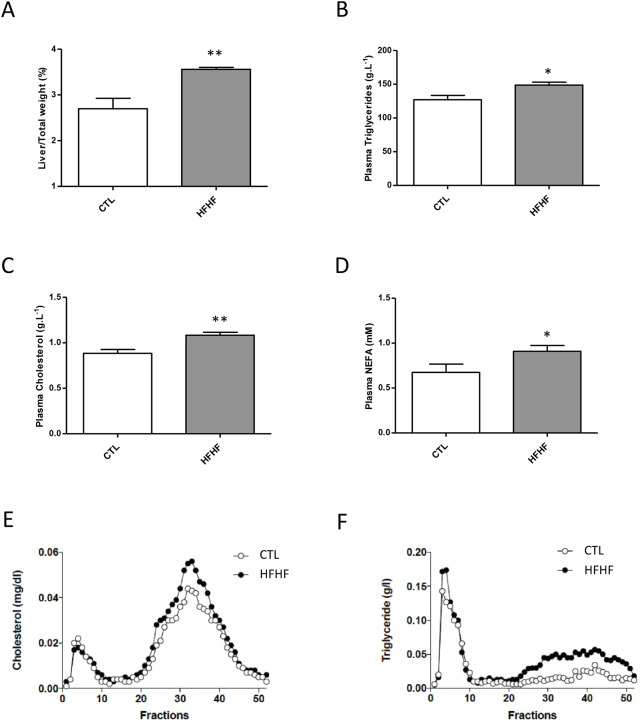
Effects of the diet on liver weight and circulating lipid profiles. (A-F) Livers from rats fed either a control (CTL) or HFHF diet for 15 weeks were dissected and weighed; the liver/total weight ratio was determined (A). A total of 15 weeks after the initiation of the different diets, plasma triglycerides (B), cholesterol (C) and NEFA (D) levels were measured after a 3-h fasting period to allow gastric emptying. In parallel, plasma samples were collected and subjected to fractionation by FPLC and cholesterol (E) and triglyceride (F) concentrations in each fraction were measured. See the Materials and Methods section for details. All determinations were performed on six rats from each group. Values are the mean±s.d. Parameters were compared between CTL and HFHF rats using unpaired Student's t-test. **P<0.01 and *P<0.05.
Fig. 6.
Fig. 6.
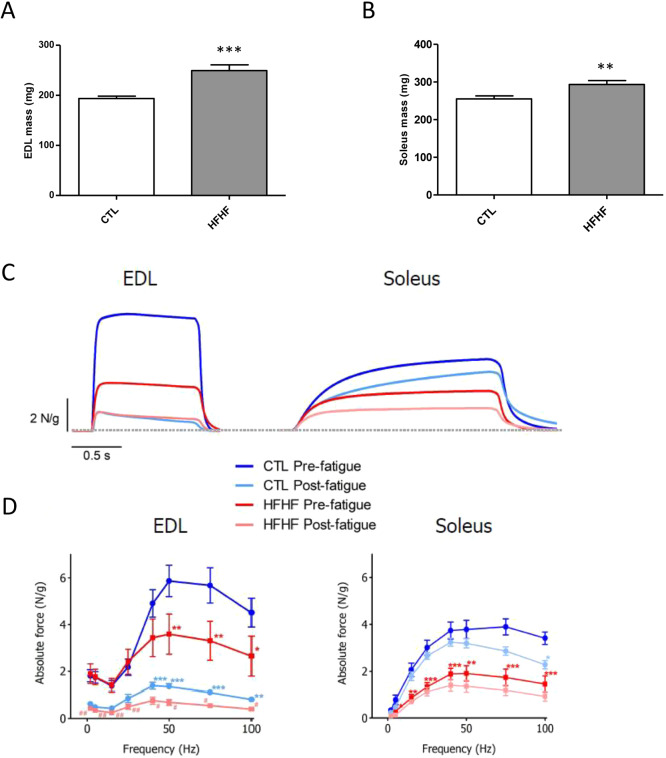
Effects of the diet on the function of skeletal muscles. (A,B) A total of 15 weeks after the initiation of the different diets (CTL or HFHF), the EDL (A) and soleus (B) muscles were dissected and their weight was determined for comparison between CTL and HFHF rats (n=11). Values are means±s.e.m. Parameters were compared between CTL and HFHF rats using unpaired Student's t-test. (C,D) Effects of the HFHF diet on tetanus amplitude and fatigue of EDL and soleus muscle. Examples of tetanus responses to electrical field stimulation at 100 Hz for EDL (left) and soleus (right) before and after a fatigue protocol in CTL (blue traces) and HFHF rats (red traces) (C). Force-frequency relationships for the same types of muscle (D). Values are means±s.e.m. Statistical tests were performed using one-way analysis of variance and a Dunnett's multiple comparison as post-test; ***P<0.001, **P<0.01 and *P<0.05.
Fig. 7.
Fig. 7.
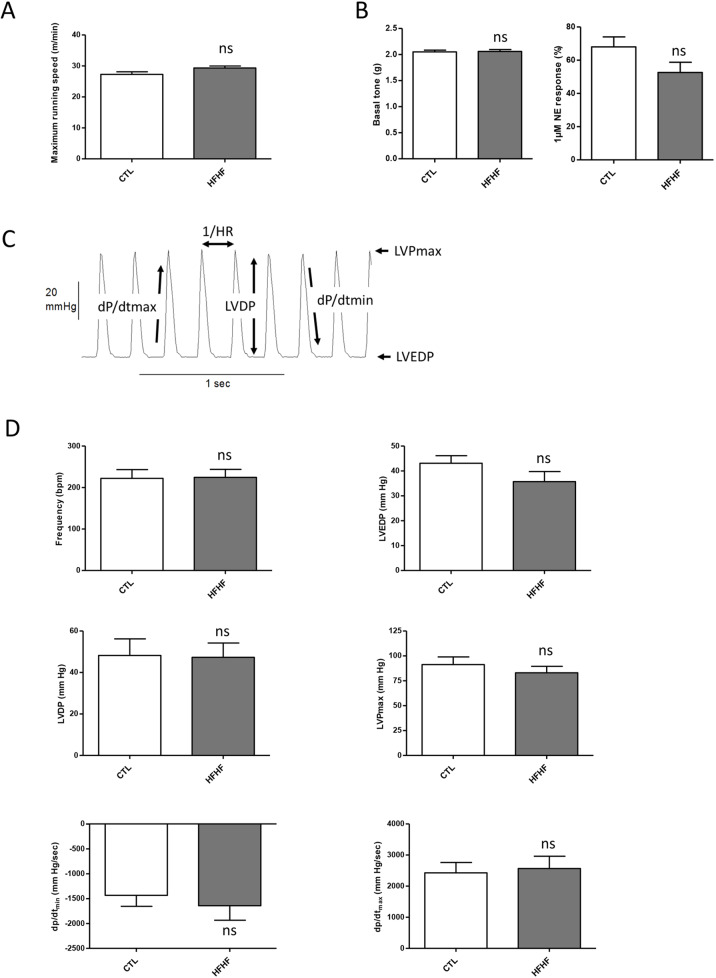
Effects of the diet on the cardiovascular system. (A) The maximum running speed was determined 15 weeks after the initiation of the different diets: CTL (n=7) or HFHF (n=8). (B) At the same time point, the basal tone and the induced contraction was measured on rat aorta rings. Aorta rings obtained from four CTL and five HFHF rats were mounted between a fixed clamp and incubated in Krebs solution to determine the basal tone (left panel); norepinephrine (NE; 1 µM) was added to the same aorta rings to evoke the sustained contractile response (right panel). (C,D) The pressure developed by the contractile left ventricle of the animals was also determined using a Langendorff set-up. Rat hearts from either CTL (n=11) or HFHF (n=12) groups were submitted to the protocol illustrated in Fig. S15. Parameters recorded during the whole protocol are illustrated in C. The results obtained during the pre-ischemic period are presented in D as means±s.e.m. Pre-ischemic parameters were compared between CTL and HFHF rats using unpaired Student's t-test; ns, non-significant. bpm, beats/min; dP/dtmax, maximal contraction velocity; dP/dtmin, maximal relaxation velocity; LVDP, left-ventricular developed pressure; LVEDP, left-ventricular end-diastolic pressure; LVPmax, maximum left-ventricular pressure.

References

    1. Antonny B., Vanni S., Shindou H. and Ferreira T. (2015). From zero to six double bonds: phospholipid unsaturation and organelle function. Trends Cell Biol. 25, 427-436. 10.1016/j.tcb.2015.03.004 - DOI - PubMed
    1. Bacle A. and Ferreira T. (2019). Strategies to counter saturated fatty acid (SFA)-mediated lipointoxication. In The Molecular Nutrition of Fats (ed. Patel V. B.), pp. 347-363. Academic Press.
    1. Bell R. M., Mocanu M. M. and Yellon D. M. (2011). Retrograde heart perfusion: The Langendorff technique of isolated heart perfusion. J. Mol. Cell. Cardiol. 50, 940-950. 10.1016/j.yjmcc.2011.02.018 - DOI - PubMed
    1. Braverman N. E. and Moser A. B. (2012). Functions of plasmalogen lipids in health and disease. Biochim. Biophys. Acta 1822, 1442-1452. 10.1016/j.bbadis.2012.05.008 - DOI - PubMed
    1. Carneiro-Júnior M. A., Quintão-Júnior J. F., Drummond L. R., Lavorato V. N., Drummond F. R., da Cunha D. N. Q., Amadeu M. A., Felix L. B., de Oliveira E. M., Cruz J. S. et al. (2013). The benefits of endurance training in cardiomyocyte function in hypertensive rats are reversed within four weeks of detraining. J. Mol. Cell. Cardiol. 57, 119-128. 10.1016/j.yjmcc.2013.01.013 - DOI - PubMed

Publication types

MeSH terms