


Prospective evaluation of the multisensor HeartLogic algorithm for heart failure monitoring
- PMID: 32304098
- PMCID: PMC7368302
- DOI: 10.1002/clc.23366
Prospective evaluation of the multisensor HeartLogic algorithm for heart failure monitoring
Abstract
Background: The HeartLogic algorithm measures data from multiple implantable cardioverter-defibrillator-based sensors and combines them into a single index. The associated alert has proved to be a sensitive and timely predictor of impending heart failure (HF) decompensation.
Hypothesis: We describe a multicenter experience of remote HF management by means of HeartLogic and appraise the value of an alert-based follow-up strategy.
Methods: The alert was activated in 104 patients. All patients were followed up according to a standardized protocol that included remote data reviews and patient phone contacts every month and at the time of alerts. In-office examinations were performed every 6 months or when deemed necessary.
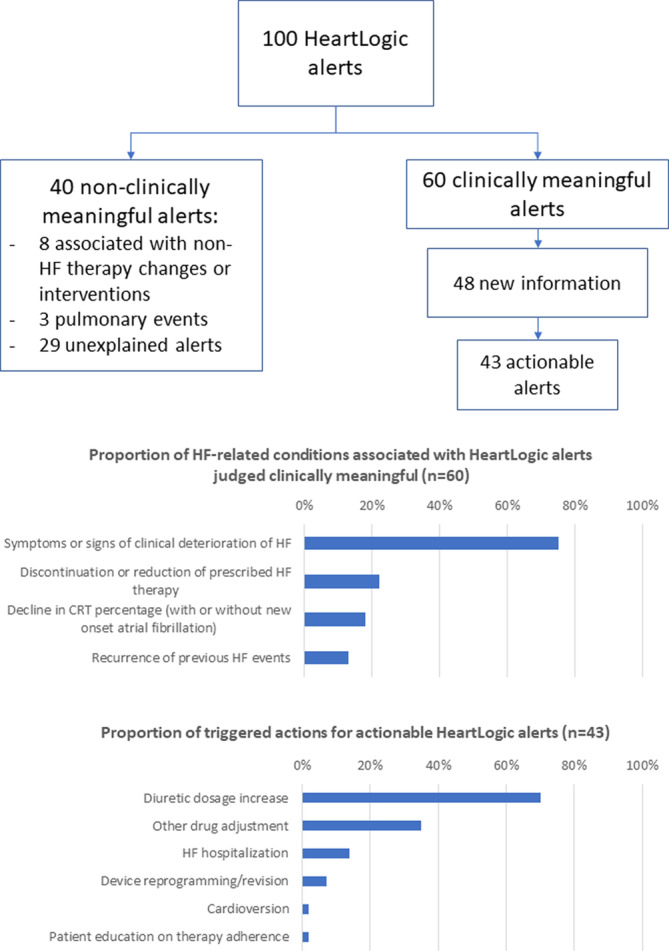
Results: During a median follow-up of 13 (10-16) months, the overall number of HF hospitalizations was 16 (rate 0.15 hospitalizations/patient-year) and 100 alerts were reported in 53 patients. Sixty alerts were judged clinically meaningful, and were associated with multiple HF-related conditions. In 48 of the 60 alerts, the clinician was not previously aware of the condition. Of these 48 alerts, 43 triggered clinical actions. The rate of alerts judged nonclinically meaningful was 0.37/patient-year, and the rate of hospitalizations not associated with an alert was 0.05/patient-year. Centers performed remote follow-up assessments of 1113 scheduled monthly transmissions (10.3/patient-year) and 100 alerts (0.93/patient-year). Monthly remote data review allowed to detect 11 (1%) HF events requiring clinical actions (vs 43% actionable alerts, P < .001).
Conclusions: HeartLogic allowed relevant HF-related clinical conditions to be identified remotely and enabled effective clinical actions to be taken; the rates of unexplained alerts and undetected HF events were low. An alert-based management strategy seemed more efficient than a scheduled monthly remote follow-up scheme.
Keywords: CRT; ICD; decompensation; heart failure; telemedicine.
© 2020 The Authors. Clinical Cardiology published by Wiley Periodicals, Inc.
Conflict of interest statement
M. Campari and S. Valsecchi are employees of Boston Scientific. L. Santini received lecture fees from Abbott, Boston Scientific and Biotronik. The other authors report no conflicts.
Figures
References
-
- Ponikowski P, Voors AA, Anker SD, et al. 2016 ESC guidelines for the diagnosis and treatment of acute and chronic heart failure: the task force for the diagnosis and treatment of acute and chronic heart failure of the European Society of Cardiology (ESC)developed with the special contribution of the heart failure association (HFA) of the ESC. Eur Heart J. 2016;37:2129‐2200. - PubMed
-
- Conraads VM, Tavazzi L, Santini M, et al. Sensitivity and positive predictive value of implantable intrathoracic impedance monitoring as a predictor of heart failure hospitalizations: the SENSE‐HF trial. Eur Heart J. 2011;32:2266‐2273. - PubMed
-
- van Veldhuisen DJ, Braunschweig F, Conraads V, et al. Intrathoracic impedance monitoring, audible patient alerts, and outcome in patients with heart failure. Circulation. 2011;124:1719‐1726. - PubMed
-
- Boriani G, Da Costa A, Quesada A, et al. Effects of remote monitoring on clinical outcomes and use of healthcare resources in heart failure patients with biventricular defibrillators: results of the MORE‐CARE multicentre randomized controlled trial. Eur J Heart Fail. 2017;19:416‐425. - PubMed
Publication types
MeSH terms
LinkOut - more resources
Full Text Sources
Medical
Research Materials
Miscellaneous
