Acalabrutinib with or without obinutuzumab versus chlorambucil and obinutuzmab for treatment-naive chronic lymphocytic leukaemia (ELEVATE TN): a randomised, controlled, phase 3 trial
- PMID: 32305093
- PMCID: PMC8151619
- DOI: 10.1016/S0140-6736(20)30262-2
Acalabrutinib with or without obinutuzumab versus chlorambucil and obinutuzmab for treatment-naive chronic lymphocytic leukaemia (ELEVATE TN): a randomised, controlled, phase 3 trial
Erratum in
-
Department of Error.Lancet. 2020 May 30;395(10238):1694. doi: 10.1016/S0140-6736(20)31018-7. Lancet. 2020. PMID: 32473678 No abstract available.
Abstract
Background: Acalabrutinib is a selective, covalent Bruton tyrosine-kinase inhibitor with activity in chronic lymphocytic leukaemia. We compare the efficacy of acalabrutinib with or without obinutuzumab against chlorambucil with obinutuzumab in patients with treatment-naive chronic lymphocytic leukaemia.
Methods: ELEVATE TN is a global, phase 3, multicentre, open-label study in patients with treatment-naive chronic lymphocytic leukaemia done at 142 academic and community hospitals in 18 countries. Eligible patients had untreated chronic lymphocytic leukaemia and were aged 65 years or older, or older than 18 years and younger than 65 years with creatinine clearance of 30-69 mL/min (calculated by use of the Cockcroft-Gault equation) or Cumulative Illness Rating Scale for Geriatrics score greater than 6. Additional criteria included an Eastern Cooperative Oncology Group performance status score of 2 or less and adequate haematologic, hepatic, and renal function. Patients with significant cardiovascular disease were excluded, and concomitant treatment with warfarin or equivalent vitamin K antagonists was prohibited. Patients were randomly assigned (1:1:1) centrally via an interactive voice or web response system to receive acalabrutinib and obinutuzumab, acalabrutinib monotherapy, or obinutuzumab and oral chlorambucil. Treatments were administered in 28-day cycles. To reduce infusion-related reactions, acalabrutinib was administered for one cycle before obinutuzumab administration. Oral acalabrutinib was administered (100 mg) twice a day until progressive disease or unacceptable toxic effects occurred. In the acalabrutinib-obinutuzumab group, intravenous obinutuzumab was given on days 1 (100 mg), 2 (900 mg), 8 (1000 mg), and 15 (1000 mg) of cycle 2 and on day 1 (1000 mg) of cycles 3-7. In the obinutuzumab-chlorambucil group, intravenous obinutuzumab was given on days 1 (100 mg), 2 (900 mg), 8 (1000 mg), and 15 (1000 mg) of cycle 1 and on day 1 (1000 mg) of cycles 2-6. Oral chlorambucil was given (0·5 mg/kg) on days 1 and 15 of each cycle, for six cycles. The primary endpoint was progression-free survival between the two combination-therapy groups, assessed by independent review committee. Crossover to acalabrutinib was allowed in patients who progressed on obinutuzumab-chlorambucil. Safety was assessed in all patients who received at least one dose of treatment. Enrolment for this trial is complete, and the study is registered at ClinicalTrials.gov, NCT02475681.
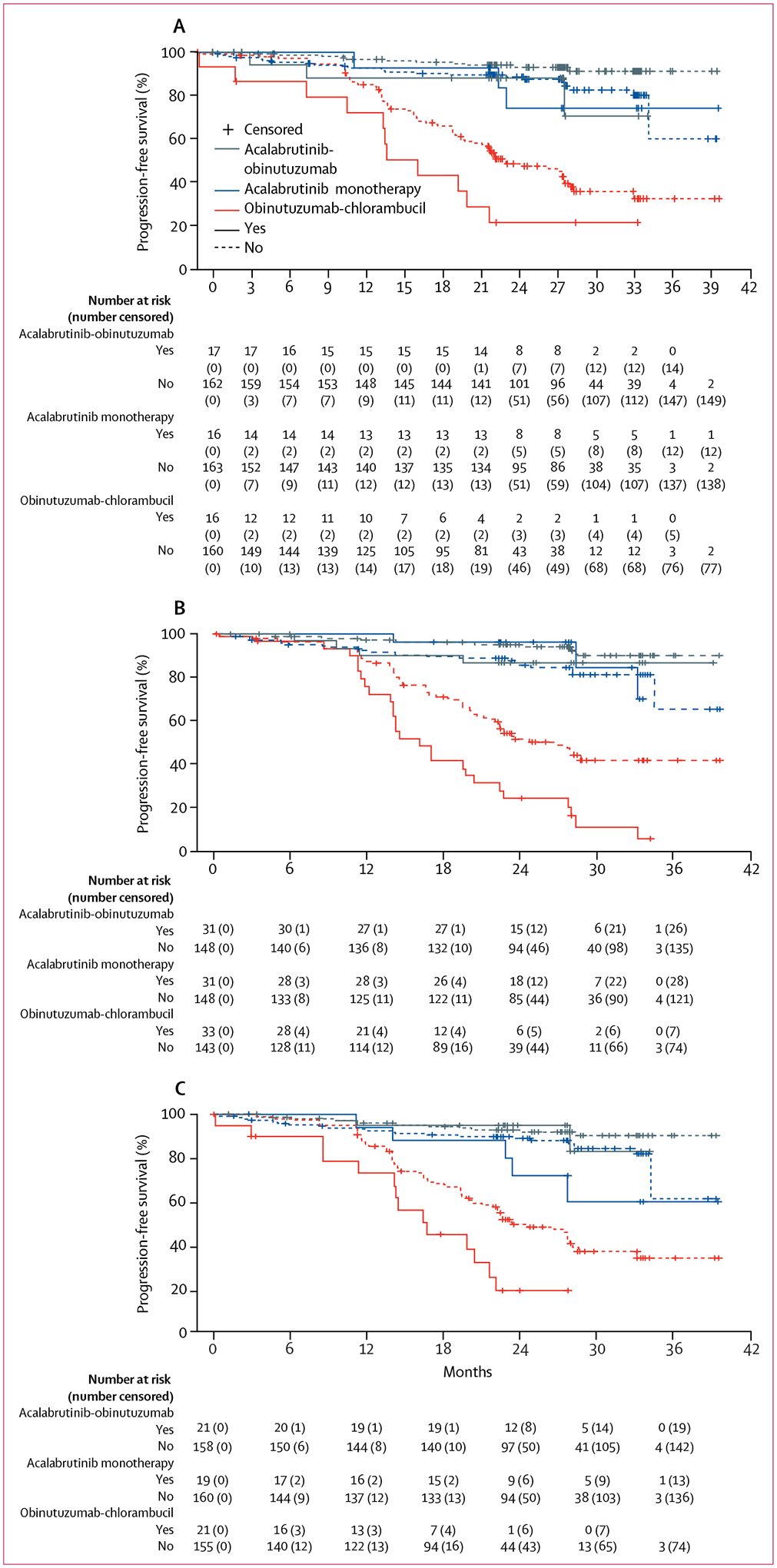
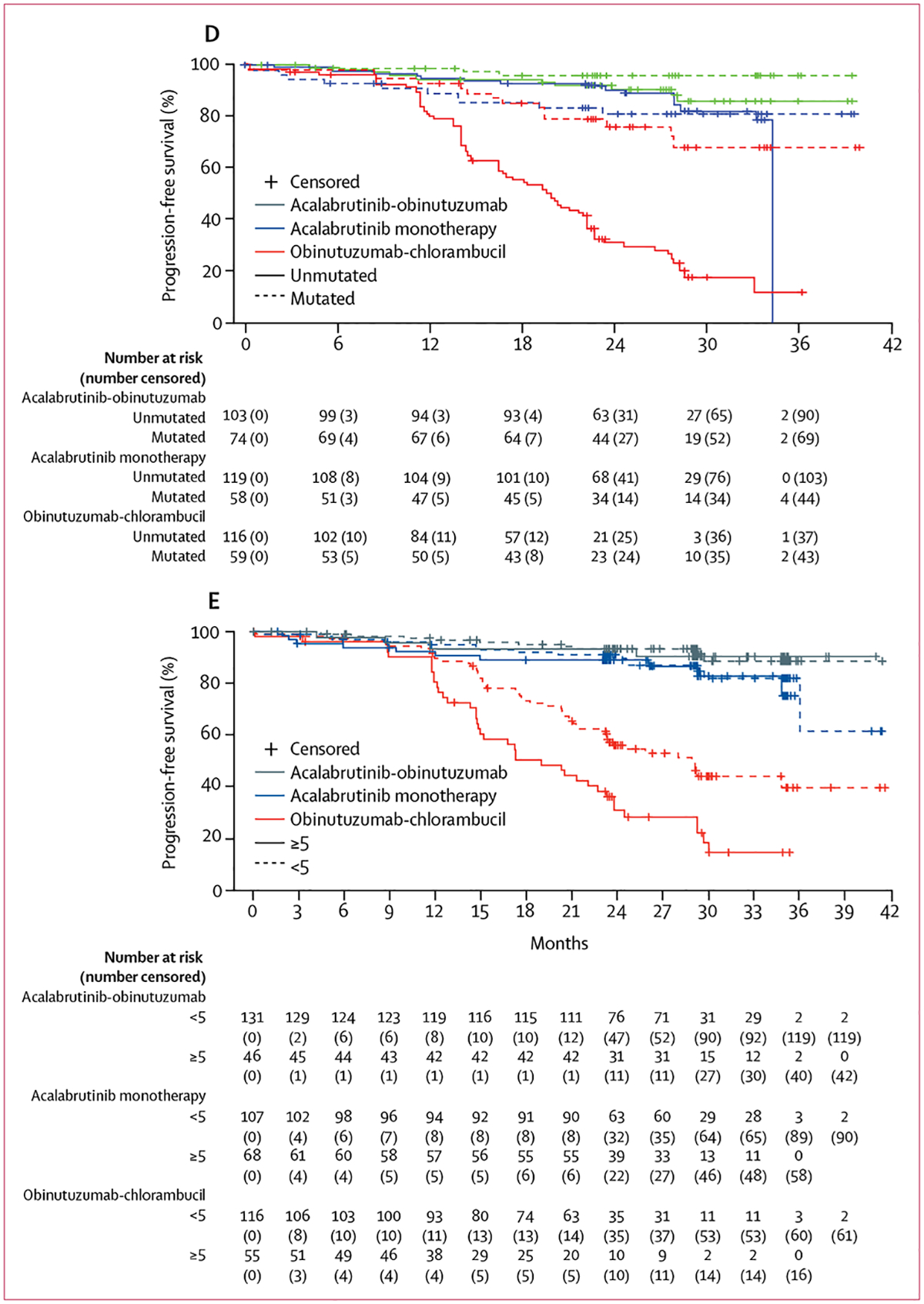
Findings: Between Sept 14, 2015, and Feb 8, 2017, we recruited 675 patients for assessment. 140 patients did not meet eligibility criteria, and 535 patients were randomly assigned to treatment. 179 patients were assigned to receive acalabrutinib-obinutuzumab, 179 patients were assigned to receive acalabrutinib monotherapy, and 177 patients were assigned to receive obinutuzumab-chlorambucil. At median follow-up of 28·3 months (IQR 25·6-33·1), median progression-free survival was longer with acalabrutinib-obinutuzumab and acalabrutinib monotherapy, compared with obinutuzumab-chlorambucil (median not reached with acalabrutinib and obinutuzumab vs 22·6 months with obinutuzumab, hazard ratio [HR] 0·1; 95% CI 0·06-0·17, p<0·0001; and not reached with acalabrutinib monotherapy vs 22·6 months with obinutuzumab, 0·20; 0·13-0·3, p<0·0001). Estimated progression-free survival at 24 months was 93% with acalabrutinib-obinutuzumab (95% CI 87-96%), 87% with acalabrutinib monotherapy (81-92%), and 47% with obinutuzumab-chlorambucil (39-55%). The most common grade 3 or higher adverse event across groups was neutropenia (53 [30%] of 178 patients in the acalabrutinib-obinutuzumab group, 17 [9%] of 179 patients in the acalabrutinib group, and 70 [41%] of 169 patients in the obinutuzumab-chlorambucil group). All-grade infusion reactions were less frequent with acalabrutinib-obinutuzumab (24 [13%] of 178 patients) than obinutuzumab-chlorambucil (67 [40%] of 169 patients). Grade 3 or higher infections occurred in 37 (21%) patients given acalabrutinib-obinutuzumab, 25 (14%) patients given acalabrutinib monotherapy, and 14 (8%) patients given obinutuzumab-chlorambucil. Deaths occurred in eight (4%) patients given acalabrutinib-obinutuzumab, 12 (7%) patients given acalabrutinib, and 15 (9%) patients given obinutuzumab-chlorambucil.
Interpretation: Acalabrutinib with or without obinutuzumab significantly improved progression-free survival over obinutuzumab-chlorambucil chemoimmunotherapy, providing a chemotherapy-free treatment option with an acceptable side-effect profile that was consistent with previous studies. These data support the use of acalabrutinib in combination with obinutuzumab or alone as a new treatment option for patients with treatment-naive symptomatic chronic lymphocytic leukaemia.
Funding: Acerta Pharma, a member of the AstraZeneca Group, and R35 CA198183 (to JCB).
Copyright © 2020 Elsevier Ltd. All rights reserved.
Figures


Comment in
-
Acalabrutinib for the initial treatment of chronic lymphocytic leukaemia.Lancet. 2020 Apr 18;395(10232):1234-1236. doi: 10.1016/S0140-6736(20)30372-X. Lancet. 2020. PMID: 32305083 No abstract available.
-
Acalabrutinib - a new option in CLL.Nat Rev Clin Oncol. 2020 Jul;17(7):390. doi: 10.1038/s41571-020-0381-3. Nat Rev Clin Oncol. 2020. PMID: 32358576 No abstract available.
References
-
- Eichhorst B, Fink AM, Bahlo J, et al. First-line chemoimmunotherapy with bendamustine and rituximab versus fludarabine, cyclophosphamide, and rituximab in patients with advanced chronic lymphocytic leukaemia (CLL10): an international, open-label, randomised, phase 3, non-inferiority trial. Lancet Oncol 2016; 17: 928–42. - PubMed
-
- Fischer K, Al-Sawaf O, Bahlo J, et al. Venetoclax and obinutuzumab in patients with CLL and coexisting conditions. N Engl J Med 2019; 380: 2225–36. - PubMed
-
- Fischer K, Bahlo J, Fink AM, et al. Long-term remissions after FCR chemoimmunotherapy in previously untreated patients with CLL: updated results of the CLL8 trial. Blood 2016; 127: 208–15. - PubMed
-
- Hallek M, Fischer K, Fingerle-Rowson G, et al. Addition of rituximab to fludarabine and cyclophosphamide in patients with chronic lymphocytic leukaemia: a randomised, open-label, phase 3 trial. Lancet 2010; 376: 1164–74. - PubMed
-
- Goede V, Fischer K, Busch R, et al. Obinutuzumab plus chlorambucil in patients with CLL and coexisting conditions. N Engl J Med 2014; 370: 1101–10. - PubMed
Publication types
MeSH terms
Substances
Associated data
Grants and funding
LinkOut - more resources
Full Text Sources
Other Literature Sources
Medical