. 2020 Dec;9(1):998-1007.
doi: 10.1080/22221751.2020.1756698.

Development of a reverse transcription-loop-mediated isothermal amplification as a rapid early-detection method for novel SARS-CoV-2

Affiliations

Development of a reverse transcription-loop-mediated isothermal amplification as a rapid early-detection method for novel SARS-CoV-2

Yun Hee Baek et al. Emerg Microbes Infect. 2020 Dec.

Abstract

The previous outbreaks of SARS-CoV and MERS-CoV have led researchers to study the role of diagnostics in impediment of further spread and transmission. With the recent emergence of the novel SARS-CoV-2, the availability of rapid, sensitive, and reliable diagnostic methods is essential for disease control. Hence, we have developed a reverse transcription loop-mediated isothermal amplification (RT-LAMP) assay for the specific detection of SARS-CoV-2. The primer sets for RT-LAMP assay were designed to target the nucleocapsid gene of the viral RNA, and displayed a detection limit of 102 RNA copies close to that of qRT-PCR. Notably, the assay has exhibited a rapid detection span of 30 min combined with the colorimetric visualization. This test can detect specifically viral RNAs of the SARS-CoV-2 with no cross-reactivity to related coronaviruses, such as HCoV-229E, HCoV-NL63, HCoV-OC43, and MERS-CoV as well as human infectious influenza viruses (type B, H1N1pdm, H3N2, H5N1, H5N6, H5N8, and H7N9), and other respiratory disease-causing viruses (RSVA, RSVB, ADV, PIV, MPV, and HRV). Furthermore, the developed RT-LAMP assay has been evaluated using specimens collected from COVID-19 patients that exhibited high agreement to the qRT-PCR. Our RT-LAMP assay is simple to perform, less expensive, time-efficient, and can be used in clinical laboratories for preliminary detection of SARS-CoV-2 in suspected patients. In addition to the high sensitivity and specificity, this isothermal amplification conjugated with a single-tube colorimetric detection method may contribute to the public health responses and disease control, especially in the areas with limited laboratory capacities.

Keywords: COVID-19; SARS-CoV-2; colorimetric detection; molecular diagnosis; novel coronavirus; reverse transcription-loop-mediated isothermal amplification.


Conflict of interest statement

No potential conflict of interest was reported by the author(s).

Figures
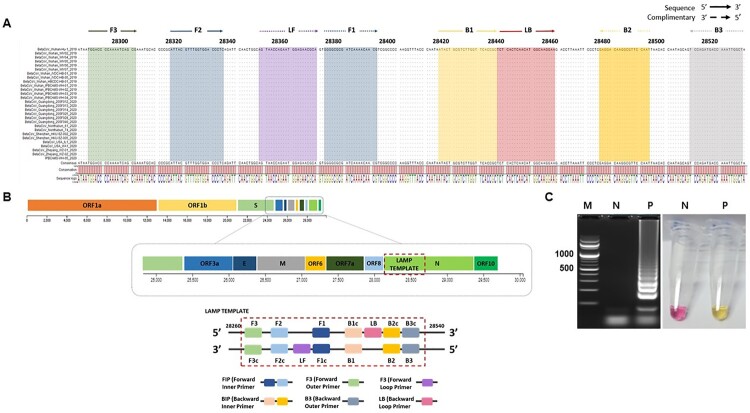
Figure 1.
Figure 1.
SARS-CoV-2 nucleocapsid (N) gene sequences and RT-LAMP primer designing. A. The sequences were downloaded from GISAID, the alignment of available sequences was done to design the primer sets which targets the N gene. LAMP primers F3, F2, F1, B1, B2, B3 and loop primers LF and LB locations were highlighted as shown. B. LAMP primer sets designed from the target sequences from position 28,285 to 28,529 have a Forward Inner Primer (FIP) and Backward Inner Primer (BIP), both containing sequence complementary (F1c, B1c) to F2 and B2, respectively. C. RT-LAMP optimized using the final selected primer set. The description and sources for each sequence have been indicated in the acknowledgment section. The positive RT-LAMP amplification was optimized using the Primer set enlisted in Table 1. Lane M: 100 bp DNA ladder; Lane N: negative control, lane P: results from the RT-LAMP amplification.
Figure 2.
Figure 2.
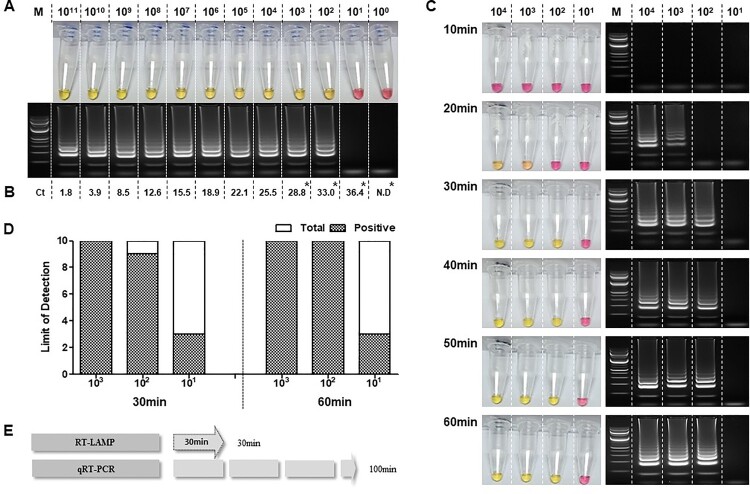
Verifying the sensitivity of the RT-LAMP for viral RNA. A. Sensitivity of the RT-LAMP using RNA ranging from 1 × 1011 to 1 × 100 copies as confirmed by the naked eye and 2% agarose gel electrophoresis. B. qRT-PCR positive amplification determined through its cycle threshold value in each RNA-dilution point. C. Determination of optimum reaction time of RT-LAMP for positive amplification that was assessed using the determined dilution limit of SARS-CoV-2 synthesized RNA. Observation of colour change from pink to yellow indicates positive nucleic acid amplification. The left panel shows the RT-LAMP reaction along with the electrophoresed RT-LAMP products for confirmation. (M, 100 bp ladder size marker and serially diluted viral RNA of 10–10,000 concentration of RNA copies). D. Limit of detection in ten repetitions using diluted RNAs (103, 102, and 101). E. Comparative evaluation of time efficiency of RT-LAMP versus qRT-PCR. Lane M: 1000 bp DNA ladder; N.C: negative control, *: Limit of detection of qRT-PCR was evaluated using 10 repeats of 103, 102, 101, and 100 diluted RNA and the results are shown in Supplementary Table 4.
Figure 3.
Figure 3.
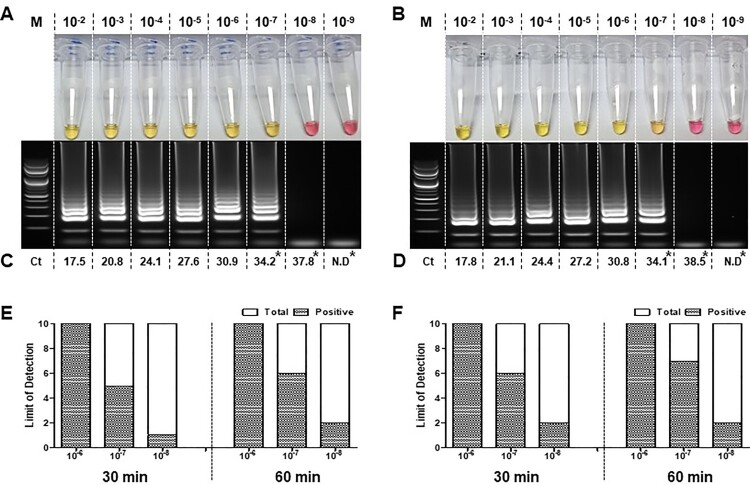
Sensitivity evaluation of the RT-LAMP using intact viral RNA of SARS-CoV-2. RT-LAMP was performed using RNA extracts from cell propagated viruses isolated from two patients diagnosed with COVID-19. Intact viral RNA extracts were ten-fold serially diluted (10−2 to 10−9) and processed for detection of SARS-CoV-2. RT-LAMP positive reaction results for each virus isolate 1 (A) and isolate 2 (B) were further confirmed through qRT-PCR (C and D). Limit of detection was assessed using 10−6, 10–7 and 10–8 dilutions in ten repetitions, carried out at 65°C for 30 and 60 min incubation (E and D). Change of colour from phenol red to yellow indicates a positive reaction. RT-LAMP products were electrophoresed at 2 % agarose gel for both RNAs. The ladder-like pattern indicates positive nucleic acid amplification. Cycle threshold (Ct) values were also indicated in each figure as a result of the qRT-PCR.; Lane M: 100 bp DNA ladder; N.D: No detection. *: Limit of detection of qRT-PCR was evaluated using ten repeats of 10−7, 10–8 and 10–9 diluted RNA and the results are shown in Supplementary Table 4.
Figure 4.
Figure 4.
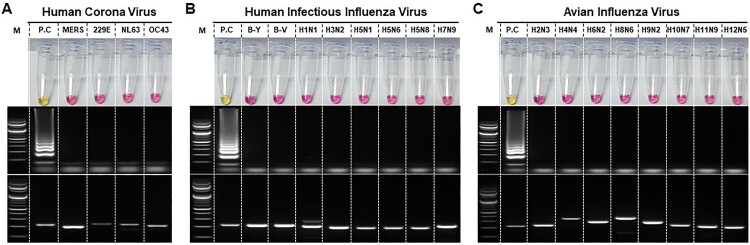
Determination of specificity of the RT-LAMP for SARS-CoV-2. RT-LAMP was performed against panels of A. related coronaviruses, such as human coronaviruses (OC43, NL63, and 229E), and MERS-CoV, B. human infectious influenza viruses, including highly pathogenic avian influenza viruses, and C. avian influenza viruses (low pathogenic). Each set of the panel includes Upper: RT-LAMP, Middle: RT-LAMP products electrophoresed and Lower: One-step RT-PCR Viral RNA confirmation of the samples used in the experiment. Specific primers used for confirmation of amplification of each viral RNA used from various respiratory disease-causing viruses have been indicated in Supplementary Table 2. MERS: Middle East respiratory syndrome coronavirus; B-Y: B/Phuket/3073/2013 (Yamagata lineage); B-V: B/Brisbane/60/2008 (Victoria lineage). Lane M: 1000 bp DNA ladder; PC: SARS-CoV-2 viral RNA (1ng/reaction); Lane N.C: negative control

References

    1. Cui J, Li F, Shi ZL.. Origin and evolution of pathogenic coronaviruses. Nat Rev Microbiol. 2019;17(3):181–192. doi: 10.1038/s41579-018-0118-9 - DOI - PMC - PubMed
    1. de Wit E, van Doremalen N, Falzarano D, et al. . SARS and MERS: recent insights into emerging coronaviruses. Nat Rev Microbiol. 2016;14(8):523–534. doi: 10.1038/nrmicro.2016.81 - DOI - PMC - PubMed
    1. Du Toit A. Outbreak of a novel coronavirus. Nat Rev Microbiol. 2020;18:123. doi: 10.1038/s41579-020-0332-0 - DOI - PMC - PubMed
    1. Fan Y, Zhao K, Shi ZL, et al. . Bat coronaviruses in China. Viruses. 2019;11(3):210. doi: 10.3390/v11030210 - DOI - PMC - PubMed
    1. Gralinski LE, Menachery VD.. Return of the coronavirus: 2019-nCoV. Viruses. 2020;12(2):135. doi: 10.3390/v12020135 - DOI - PMC - PubMed

MeSH terms

Substances