. 2020 Jun 8;375(1800):20190273.
doi: 10.1098/rstb.2019.0273. Epub 2020 Apr 20.

Limitations in odour simulation may originate from differential sensory embodiment

Affiliations

Limitations in odour simulation may originate from differential sensory embodiment

Artin Arshamian et al. Philos Trans R Soc Lond B Biol Sci. .

Abstract

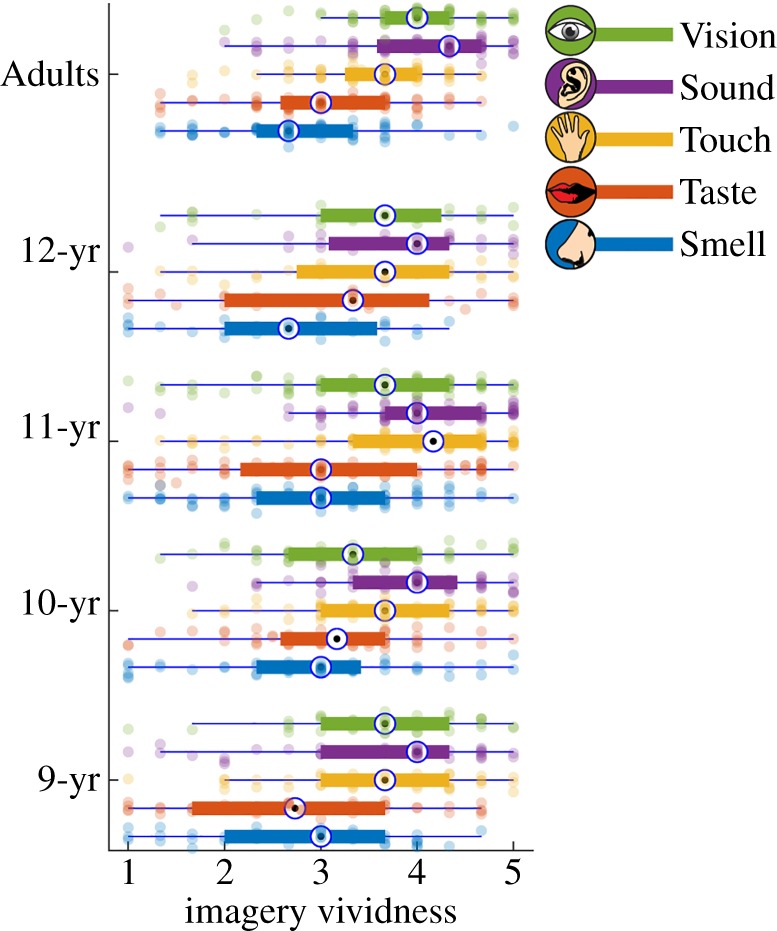
Across diverse lineages, animals communicate using chemosignals, but only humans communicate about chemical signals. Many studies have observed that compared with other sensory modalities, communication about smells is relatively rare and not always reliable. Recent cross-cultural studies, on the other hand, suggest some communities are more olfactorily oriented than previously supposed. Nevertheless, across the globe a general trend emerges where olfactory communication is relatively hard. We suggest here that this is in part because olfactory representations are different in kind: they have a low degree of embodiment, and are not easily expressed as primitives, thereby limiting the mental manipulations that can be performed with them. New exploratory data from Dutch children (9-12 year-olds) and adults support that mental imagery from olfaction is weak in comparison with vision and audition, and critically this is not affected by language development. Specifically, while visual and auditory imagery becomes more vivid with age, olfactory imagery shows no such development. This is consistent with the idea that olfactory representations are different in kind from representations from the other senses. This article is part of the Theo Murphy meeting issue 'Olfactory communication in humans'.

Keywords: cross-cultural; developmental; embodiment; language; mental imagery; olfaction.


Conflict of interest statement

We declare we have no competing interests.

Figures
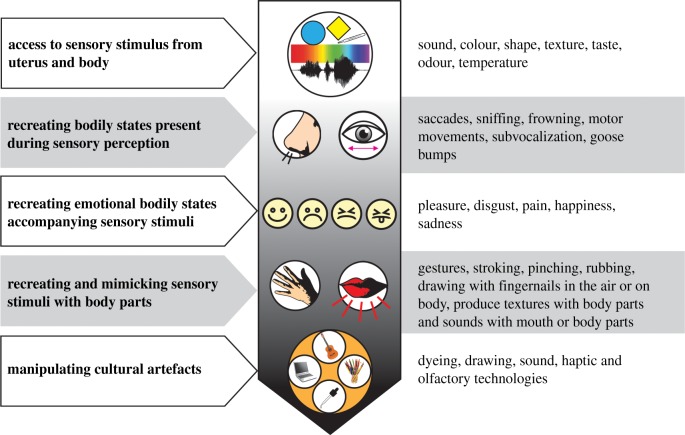
Figure 1.
Figure 1.
Degrees of embodiment of sensory stimuli. From top to bottom of the figure, there is increasing embodiment. Weak embodiment is exemplified by the re-creation of bodily states present during perception (e.g. sniffing). Strong embodiment, by contrast, involves direct simulation of the stimulus by the body—with or without tools. For example, it is possible to mimic visual objects by gestures, drawing in the air or literally on the skin by scratching with the fingernails or by using cultural artefacts like a pencil. It is also relatively easy to recreate auditory information using the vocal cords or by using other body parts to mimic a sound, or to create touch sensations, like pain, temperature and texture by pinching, stroking or rubbing.
Figure 2.
Figure 2.
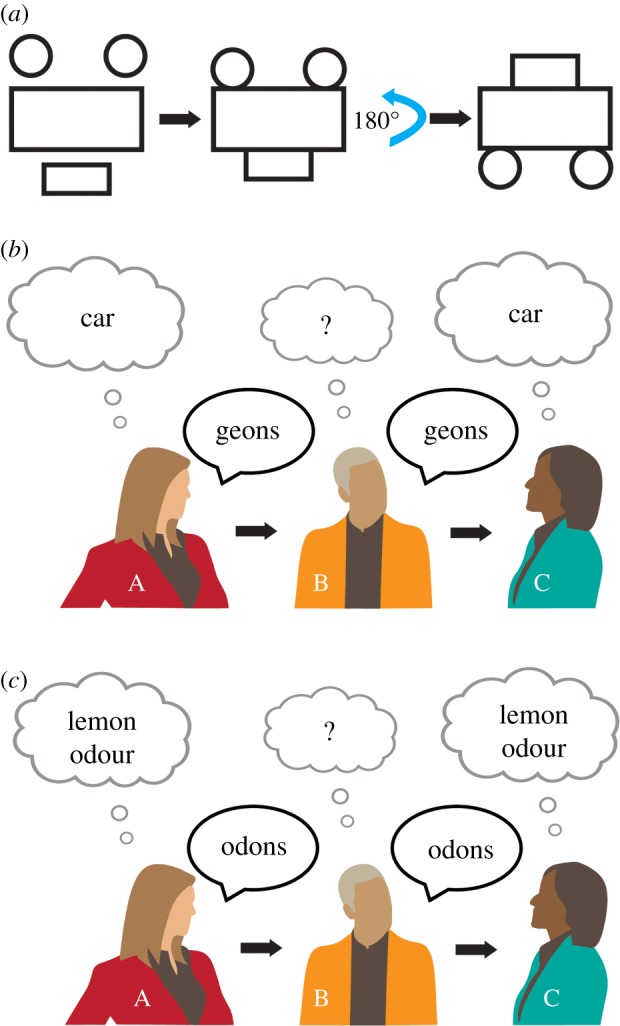
Directed communication and simulation. (a) Illustration of how the manipulation of primitives (in this case rotation) can shift an abstract mental image into a representation of a semantic object (e.g. when this thought exercise is run on undergraduate students informally in class by the first author, the majority of students imagine a car only after rotation). (b) In this scenario, person A has semantic knowledge of cars (i.e. including perceptual facts, ideas and beliefs about cars). Person A uses her knowledge about the visual representation of cars to decompose a car into visual primitives, such as geons, and expresses these and their spatial relationships to person B. Importantly, person B has knowledge only of the primitives, but no semantic knowledge of cars. However, person B can still simulate features of the object and communicate it to person C who has the appropriate primitives and semantic knowledge and thus can simulate and recreate the original object. (c) Can equivalent communication be envisaged for olfaction? If so what kind of odons would be required to do so? We believe this type of task would be difficult to conduct with olfaction.
Figure 3.
Figure 3.
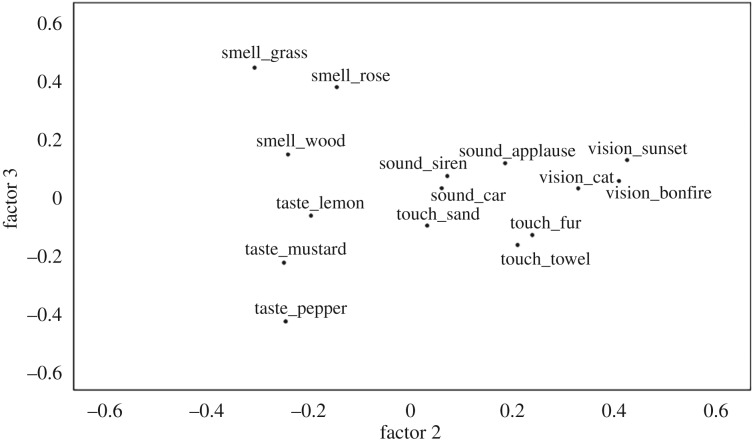
Factor analysis of imagery items. A plot of the second and third factors extracted from a factor analysis with maximum-likelihood extraction. Factor 2 distinguishes items loading on vision, touch and sound, and then smell and taste. Factor 3 distinguishes most sharply between smell and taste items.
Figure 4.
Figure 4.
Vividness of mental imagery across age groups, with 1 indicating 'cannot form an image' and 5 indicating 'can form an image as vivid as real life'. Boxes indicate the lower quartile (the left horizontal line), median (bullet circle) and upper quartile (the right horizontal line). Left whiskers indicate the maximum value of the variable located within a distance of 1.5 times the inter-quartile range below the 25th percentile; right whiskers indicate the corresponding distance to the 75th percentile value.

References

    1. Evans N. 2017. Sweat, spirit and place: the semantics of smell in Australian languages. Marysville, WA, Australia: Australian Languages Workshop.
    1. Evans N, Merlan F, Tukumba M. 2004. A first dictionary of Dalabon (Ngalkbon). Maningrida, NT, Australia: Bawinanga Aboriginal Corporation.
    1. Sperber D. 1975. Rethinking symbolism. (transl. AL Morton). Cambridge, UK: Cambridge University Press.
    1. Buck CD. 1949. A dictionary of selected synonyms in the principal Indo-European languages: a contribution to the history of ideas. Chicago, IL: University of Chicago Press.
    1. Levinson SC, Majid A. 2014. Differential ineffability and the senses. Mind Lang. 29, 407–427. (10.1111/mila.12057) - DOI

Publication types