


Effectiveness of the Healthy Start-Départ Santé approach on physical activity, healthy eating and fundamental movement skills of preschoolers attending childcare centres: a randomized controlled trial
- PMID: 32306943
- PMCID: PMC7169026
- DOI: 10.1186/s12889-020-08621-9
Effectiveness of the Healthy Start-Départ Santé approach on physical activity, healthy eating and fundamental movement skills of preschoolers attending childcare centres: a randomized controlled trial
Abstract
Background: Since young children spend approximately 30 h per week in early childcare centres (ECC), this setting is ideal to foster healthy behaviours. This study aimed to assess the effectiveness of the Healthy Start-Départ Santé (HSDS) randomized controlled trial in increasing physical activity (PA) levels and improving healthy eating and fundamental movement skills in preschoolers attending ECC.
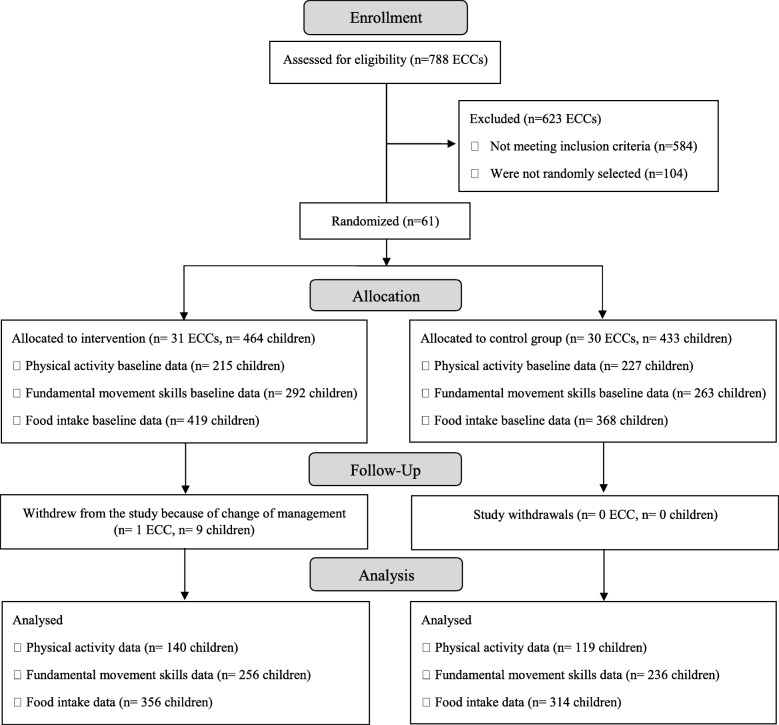
Methods: Sixty-one ECC were randomly selected and allocated to either the usual practice (n = 30; n = 433 children) or intervention group (n = 31; n = 464 children). The HSDS intervention group was provided a 3-h on-site training for childcare educators which aimed to increase their knowledge and self-efficacy in promoting healthy eating, PA and development of fundamental movement skills in preschoolers. PA was measured during childcare hours for five consecutive days using the Actical accelerometer. Preschoolers' fundamental movement skills were assessed using the standard TGMD-II protocol and POMP scores. Food intake was evaluated using digital photography-assisted weighted plate waste at lunch, over two consecutive days. All data were collected prior to the HSDS intervention and again 9 months later. Mixed-effect models were used to analyse the effectiveness of the HSDS intervention on all outcome measures.
Results: Total number of children who provided valid data at baseline and endpoint for PA, food intake and fundamental movement skills were 259, 670 and 492, respectively. Children in the HSDS intervention group had, on average, a 3.33 greater point increase in their locomotor motor skills scores than children in the control group (β = 3.33, p = 0.009). No significant differences in effects were observed for object control, PA and food intake. However, results demonstrated a marginal increase in portions of fruits and vegetables served in the intervention group compared to control group (β = 0.06, p = 0.05).
Conclusion: Of the 12 outcome variables investigated in this study, 10 were not different between the study groups and two of them (locomotor skills and vegetables and fruits servings) showed a significant improvement. This suggests that HSDS is an effective intervention for the promotion of some healthy behaviours among preschoolers attending ECC.
Trial registration: Clinical Trials NCT02375490. Registered on February 24, 2015; 77 retrospectively registered.
Keywords: Eating behaviours; Food intake; Fundamental movement skills; Physical activity; Population health intervention; Preschool.
Conflict of interest statement
The authors declare that they have no competing interests.
Figures
References
-
- Guyer B, Ma S, Grason H, Frick KD, Perry DF, Sharkey A, et al. Early childhood health promotion and its life course health consequences. Acad Pediatr. 2009. 10.1016/j.acap.2008.12.007. - PubMed
-
- Garriguet D, Carson V, Colley RC, Janssen I, Timmons BW, Tremblay MS. Physical activity and sedentary behaviour of Canadian children aged 3 to 5. Health Rep. 2016;27(9):14–23. - PubMed
-
- Roberts KC, Shields M, de Groh M, Aziz A, Gilbert J-A. Overweight and obesity in children and adolescents: results from the 2009 to 2011 Canadian health measures survey. Health Rep. 2012;23(3):37–41. - PubMed
-
- Larson N, Ward DS, Neelon SB, Story M. What role can child-care settings play in obesity prevention? A review of the evidence and call for research efforts. J Am Diet Assoc. 2011. 10.1016/j.jada.2011.06.007. - PubMed
