


Are immune-related adverse events associated with the efficacy of immune checkpoint inhibitors in patients with cancer? A systematic review and meta-analysis
- PMID: 32306958
- PMCID: PMC7169020
- DOI: 10.1186/s12916-020-01549-2
Are immune-related adverse events associated with the efficacy of immune checkpoint inhibitors in patients with cancer? A systematic review and meta-analysis
Abstract
Background: A number of studies have reported an association between the occurrence of immune-related adverse events (irAEs) and clinical efficacy in patients undergoing treatment with immune checkpoint inhibitors (ICIs), but the results remain controversial.
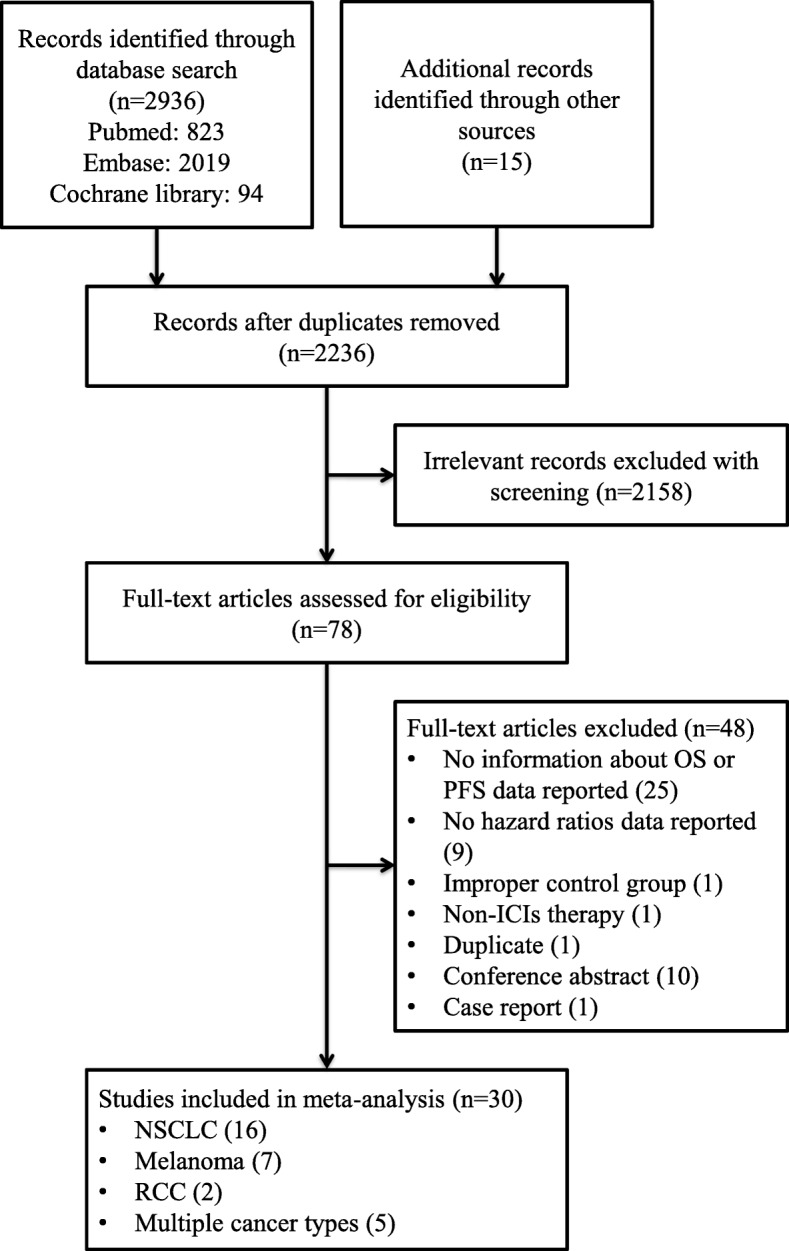
Methods: Under the guidance of a predefined protocol and Preferred Reporting Items for Systematic Reviews and Meta-analyses statement, this meta-analysis included cohort studies investigating the association of irAEs and efficacy of ICIs in patients with cancer. The primary outcome was overall survival (OS), and the secondary outcome was progression-free survival (PFS). Subgroup analyses involving the cancer type, class of ICIs, combination therapy, sample size, model, landmark analysis, and approach used to extract the data were performed. Specific analyses of the type and grade of irAEs were also performed.
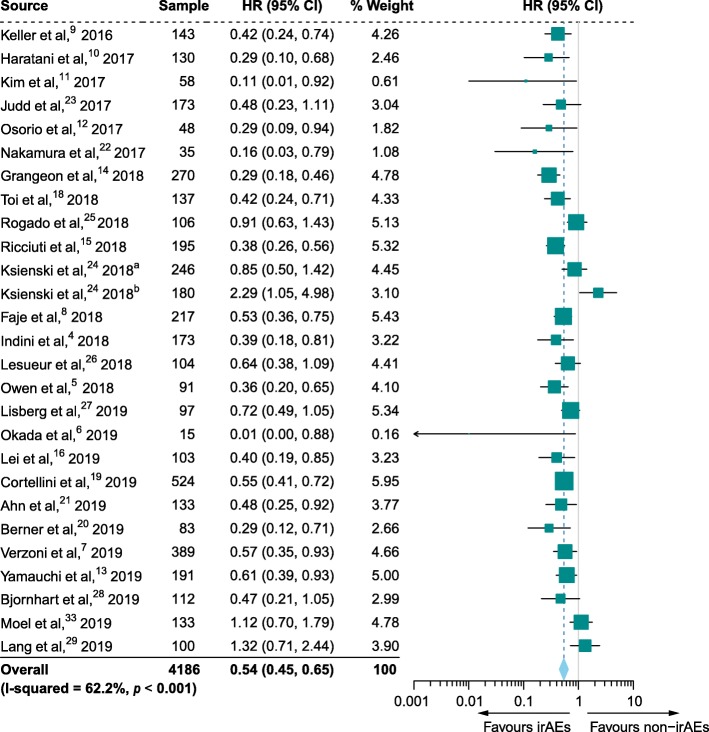
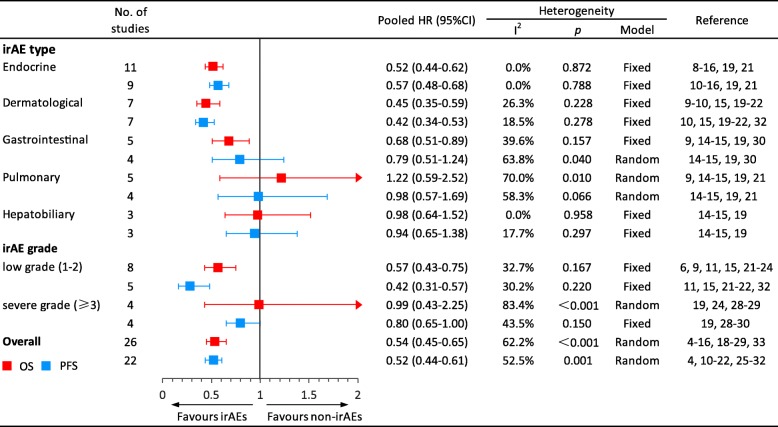
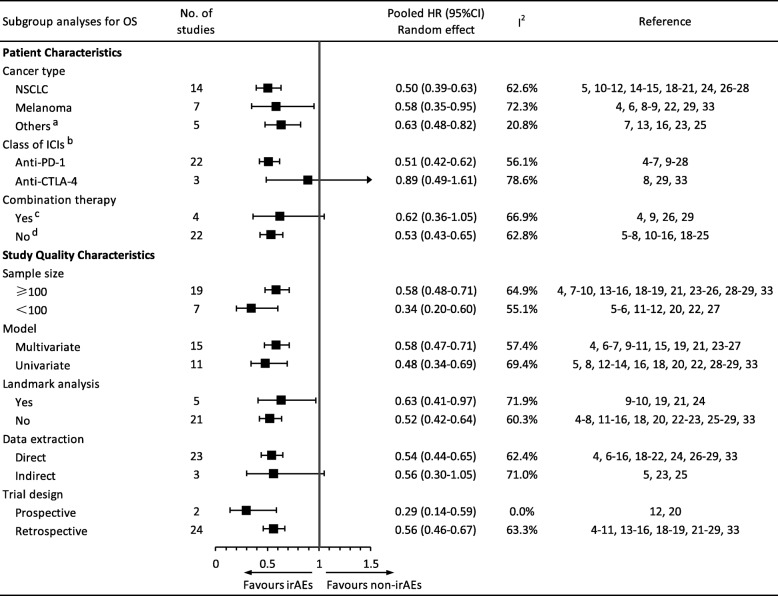
Results: This meta-analysis included 30 studies including 4971 individuals. Patients with cancer who developed irAEs experienced both an OS benefit and a PFS benefit from ICI therapy compared to patients who did not develop irAEs (OS: hazard ratio (HR), 0.54, 95% confidence interval (CI), 0.45-0.65; p < 0.001; PFS: HR, 0.52, 95% CI, 0.44-0.61, p < 0.001). Subgroup analyses of the study quality characteristics and cancer types recapitulated these findings. Specific analyses of endocrine irAEs (OS: HR, 0.52, 95% CI, 0.44-0.62, p < 0.001), dermatological irAEs (OS: HR, 0.45, 95% CI, 0.35-0.59, p < 0.001), and low-grade irAEs (OS: HR, 0.57, 95% CI, 0.43-0.75; p < 0.001) yielded similar results. The association between irAE development and a favorable benefit on survival was significant in patients with cancer who were undergoing treatment with programmed cell death-1 inhibitors (OS: HR, 0.51, 95% CI, 0.42-0.62; p < 0.001), but not cytotoxic T-lymphocyte antigen-4 inhibitors (OS: HR, 0.89, 95% CI, 0.49-1.61; p = 0.706). Additionally, the association was significant in patients with cancer who were treated with ICIs as a monotherapy (OS: HR, 0.53, 95% CI, 0.43-0.65; p < 0.001), but not as a combination therapy (OS: HR, 0.62, 95% CI, 0.36-1.05; p = 0.073).
Conclusions: The occurrence of irAEs was significantly associated with a better ICI efficacy in patients with cancer, particularly endocrine, dermatological, and low-grade irAEs. Further large-scale prospective studies are warranted to validate our findings.
Systematic review registration: PROSPERO CRD42019129310.
Keywords: Cancer; Efficacy; Immune checkpoint inhibitors; Immune-related adverse events.
Conflict of interest statement
The authors declare that they have no competing interests.
Figures
Comment in
-
Association of immune-related adverse events with immune checkpoint inhibitor efficacy: real or imaginary?BMC Med. 2020 Apr 21;18(1):111. doi: 10.1186/s12916-020-01583-0. BMC Med. 2020. PMID: 32312270 Free PMC article. No abstract available.
References
-
- Brahmer JR, Lacchetti C, Schneider BJ, Atkins MB, Brassil KJ, Caterino JM, Chau I, Ernstoff MS, Gardner JM, Ginex P, et al. Management of immune-related adverse events in patients treated with immune checkpoint inhibitor therapy: American Society of Clinical Oncology clinical practice guideline. J Clin Oncol. 2018;36(17):1714–1768. doi: 10.1200/JCO.2017.77.6385. - DOI - PMC - PubMed
-
- Indini A, Di Guardo L, Cimminiello C, Prisciandaro M, Randon G, De Braud F, Del Vecchio M. Immune-related adverse events correlate with improved survival in patients undergoing anti-PD1 immunotherapy for metastatic melanoma. J Cancer Res Clin Oncol. 2019;145(2):511–521. doi: 10.1007/s00432-018-2819-x. - DOI - PMC - PubMed
-
- Owen DH, Wei L, Bertino EM, Edd T, Villalona-Calero MA, He K, Shields PG, Carbone DP, Otterson GA. Incidence, risk factors, and effect on survival of immune-related adverse events in patients with non–small-cell lung cancer. Clin Lung Cancer. 2018;19(6):e893–e900. doi: 10.1016/j.cllc.2018.08.008. - DOI - PMC - PubMed
Publication types
MeSH terms
Substances
Grants and funding
- 81801633/National Natural Science Foundation of China (CN)/International
- 2018RC320005/Chinese Academy of Medical Sciences Young Medical Talent Award Fund/International
- 7182132/Beijing Natural Science Foundation/International
- Z171100002017013/Major projects of the Beijing Municipal Science and Technology Commission/International
- Z151100004015157/Capital Special Project for Featured Clinical Application/International
LinkOut - more resources
Full Text Sources
Other Literature Sources
Medical
