


Diet complexity and l-threonine supplementation: effects on growth performance, immune response, intestinal barrier function, and microbial metabolites in nursery pigs
- PMID: 32307528
- PMCID: PMC7229884
- DOI: 10.1093/jas/skaa125
Diet complexity and l-threonine supplementation: effects on growth performance, immune response, intestinal barrier function, and microbial metabolites in nursery pigs
Abstract
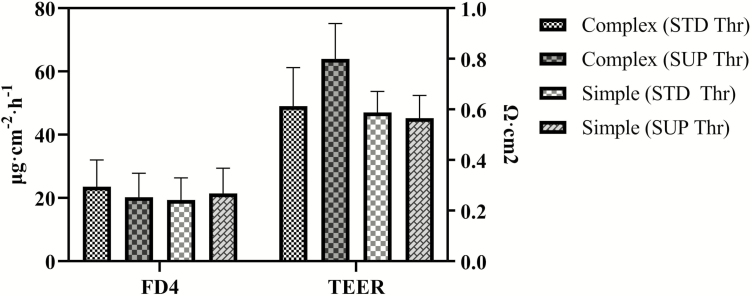
The aim of this study was to investigate the effects of diet complexity and l-Thr supplementation level on the growth performance, immune response, intestinal barrier function, and microbial metabolites in nursery pigs. Thirty-two weaned pigs (body weight 7.23 ± 0.48 kg) were randomly assigned to dietary treatments in a 2 × 2 factorial arrangement based on diet complexity (complex or simple) and dietary Thr content. The complex diet contained fish meal, plasma protein, and dried whey to mimic a conventional nursery diet. The simple diet was formulated with corn, wheat, and soybean meal and did not contain any animal products. l-Thr was supplemented to each diet to supply either 100% (STD Thr) or 115% (SUP Thr) of the NRC (2012) requirement for standardized ileal digestible Thr. Pigs were individually housed and fed experimental diets ad libitum for 14 d. Diet complexity, dietary Thr content, and their interactions were considered the main effects. Pigs fed the simple diet had greater (P < 0.05) plasma interleukin (IL)-10 and IL-6 concentrations compared with those fed the complex diet on days 7 and 14, respectively. Simple diet-fed pigs tended to show greater (P < 0.10) expression of genes encoding for tumor necrosis factor-α, claudin-1, and zonula occludens-1 in the jejunum compared with complex diet-fed pigs. The simple diet-fed pigs had greater (P < 0.05) concentrations of NH3-N in the jejunum digesta than did complex diet-fed pigs. The SUP Thr increased (P < 0.05) villus height and goblet cell (GC) density in villi and crypts in the jejunum and deepened (P < 0.05) crypts in the proximal colon. The SUP Thr resulted in the upregulation (P < 0.05) of occludin gene expression and a tendency toward the downregulation (P = 0.10) of IL-6 gene expression in the jejunum. Interactions (P < 0.05) between diet complexity and l-Thr supplementation level were observed in GC density in the crypt, NH3-N concentration in the jejunum, and the contents of acetate, propionate, and total volatile fatty acids in the colon. In conclusion, feeding a simple diet to nursery pigs resulted in systemic and intestinal inflammation. The SUP Thr diet did not normalize the simple diet-induced inflammation but improved gut integrity. SUP Thr seems to have greater benefits with a simple diet than with a complex diet. Therefore, SUP Thr in a simple diet could be a beneficial nutritional strategy for enhancing gut health.
Keywords: diet complexity; immune response; intestinal barrier function; nursery pigs; threonine.
© The Author(s) 2020. Published by Oxford University Press on behalf of the American Society of Animal Science. All rights reserved. For permissions, please e-mail: journals.permissions@oup.com.
Figures
References
-
- Barrett K. E. 2014. Gastrointestinal physiology. 2nd ed. New York (NY): McGraw-Hill Education.
-
- CCAC. 2009. CCAC guidelines on: the care and use of farm animals in research, teaching and testing. vol. II Ottawa (ON, Canada): Canadian Council on Animal Care; p. 103–125.
-
- Chen Y. P., Cheng Y. F., Li X. H., Yang W. L., Wen C., Zhuang S., and Zhou Y. M.. . 2017. Effects of threonine supplementation on the growth performance, immunity, oxidative status, intestinal integrity, and barrier function of broilers at the early age. Poult. Sci. 96:405–413. doi: 10.3382/ps/pew240 - DOI - PubMed
-
- Chen Y., Zhang H., Cheng Y., Li Y., Wen C., and Zhou Y.. . 2018. Dietary l-threonine supplementation attenuates lipopolysaccharide-induced inflammatory responses and intestinal barrier damage of broiler chickens at an early age. Br. J. Nutr. 119:1254–1262. doi: 10.1017/S0007114518000740 - DOI - PubMed
MeSH terms
Substances
LinkOut - more resources
Full Text Sources
Medical
Research Materials
Miscellaneous
