. 2020 Nov;25(6):857-868.
doi: 10.1007/s12192-020-01110-3. Epub 2020 Apr 19.

Cold-inducible RNA-binding protein Cirp, but not Rbm3, may regulate transcript processing and protection in tissues of the hibernating ground squirrel

Affiliations

Cold-inducible RNA-binding protein Cirp, but not Rbm3, may regulate transcript processing and protection in tissues of the hibernating ground squirrel

Samantha M Logan et al. Cell Stress Chaperones. 2020 Nov.

Abstract

RNA-binding proteins (RBPs) have important roles in transcription, pre-mRNA processing/transport, mRNA degradation, translation, and non-coding RNA processing, among others. RBPs that are expressed in response to cold stress, such as Cirp and Rbm3, could regulate RNA stability and translation in hibernating mammals that reduce their body temperatures from 37 °C to as low as 0-5 °C during torpor bouts. RBPs including Cirp, Rbm3, and stress-inducible HuR translocate from the nucleus to stabilize mRNAs in the cytoplasm, and thereby could regulate which mRNA transcripts are protected from degradation and are translated, versus stored, for future protein synthesis or degraded by nucleases during cell stress associated with metabolic rate depression. This is the first study to explore the transcriptional/translational regulation, and subcellular localization of cold-inducible RBPs in a model hibernator, the 13-lined ground squirrel (Ictidomys tridecemlineatus). Cirp protein levels were upregulated in liver, skeletal muscle, and brown adipose tissue throughout the torpor-arousal cycle whereas Rbm3 protein levels stayed constant or decreased, suggesting an important role for Cirp, but likely not Rbm3, in the hibernator stress response. Increased cytoplasmic localization of Cirp in liver and muscle and HuR in liver during torpor, but no changes in the relative levels of Rbm3 in the cytoplasm, emphasizes a role for Cirp and possibly HuR in regulating mRNA processing during torpor. This study informs our understanding of the natural adaptations that extreme animals use in the face of stress, and highlight natural stress response mediators that could be used to bolster cryoprotection of human organs donated for transplant.

Keywords: Cold shock protein; Cold-inducible RNA-binding protein; Human antigen R; Ictidomys tridecemlineatus; RNA-binding motif 3; Torpor-arousal cycle.


Figures
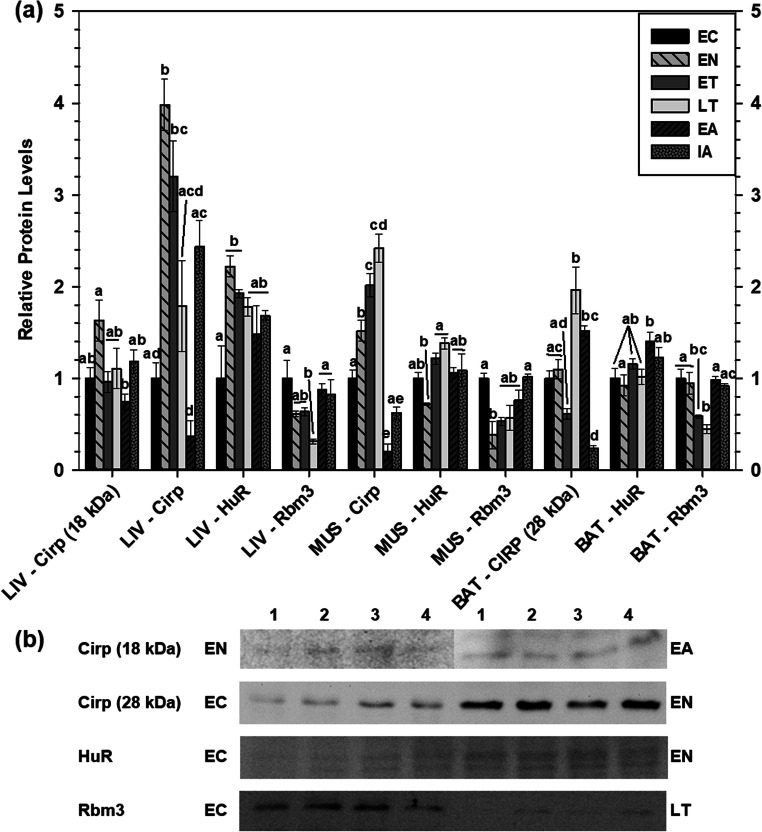
Fig. 1
Fig. 1
Relative cold-inducible RNA-binding protein levels in liver (LIV), muscle (MUS), and brown adipose tissue (BAT) of 13-lined ground squirrels. a Histogram showing mean standardized expression levels of Cirp (18 kDa and 28 kDa), HuR, and Rbm3 (± S.E.M., n = 4 independent protein isolations from different animals). b Representative Western blots for certain torpor-arousal time points in liver. Data were analyzed using ANOVA with a Tukey post hoc test. Shared letters indicate data that are not significantly different from each other and different letters indicate statistically significant differences between sample points (p < 0.05). Flat lines across multiple histogram bars denote multiple time points that share the same letter(s)
Fig. 2
Fig. 2
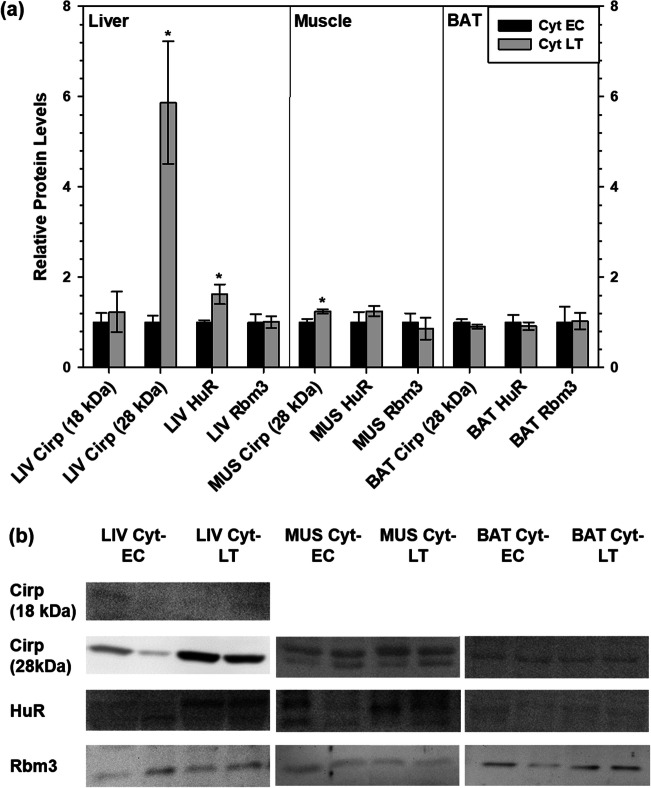
Relative cold-inducible RNA-binding protein levels in cytoplasmic (cyt) fractions of liver (LIV), muscle (MUS), and brown adipose tissue (BAT), comparing euthermic (EC) and torpid (LT) 13-lined ground squirrels. a Histogram shows mean standardized expression levels of Cirp (18 kDa and 28 kDa), HuR, and Rbm3 (± S.E.M., n = 4 independent protein isolations from different animals). Cirp (18 kDa) was only detected in liver samples. b Representative Western blots show two different samples (n = 2) of the total n = 4 for each time point. Data were analyzed using Student’s t test. An asterisk above the LT time point indicates a significant difference from the EC value (p < 0.05)
Fig. 3
Fig. 3
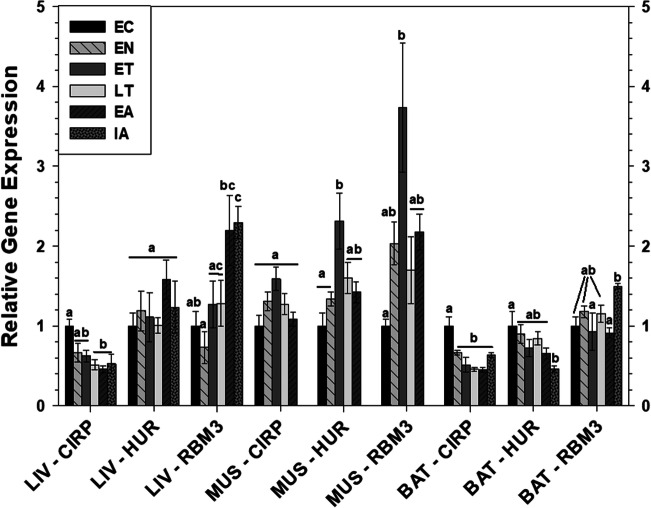
Expression of mRNAs in liver (LIV), muscle (MUS), and brown adipose tissue (BAT) tissue samples evaluated by RT-qPCR for 6 time points over the torpor-arousal cycle. Relative expression of the indicated mRNAs was standardized to the expression of gamma actin mRNA (in liver and muscle) or TATA-binding protein (TBP) mRNA (in BAT) amplified from the same sample. Relative mRNA expression levels were then expressed relative to that of the EC value, which was set as 1.0. Data are mean ± SEM (n = 3–4 independent trials from different animals). Data were analyzed using a one-way ANOVA with a Tukey post hoc test. Shared letters indicate data that are not significantly different from each other and different letters indicate statistically significant differences between sample points (at least p < 0.05). Flat lines across multiple histogram bars denote multiple time points that share the same letter(s)

References

    1. Aoki K, Ishii Y, Matsumoto K, Tsujimoto M. Methylation of Xenopus CIRP2 regulates its arginine- and glycine-rich region-mediated nucleocytoplasmic distribution. Nucleic Acids Res. 2002;30:5182–5192. doi: 10.1093/nar/gkf638. - DOI - PMC - PubMed
    1. Aoki K, Matsumoto K, Tsujimoto M. Xenopus cold-inducible RNA-binding protein 2 interacts with ElrA, the Xenopus homolog of HuR, and inhibits deadenylation of specific mRNAs. J Biol Chem. 2003;278:48491–48497. doi: 10.1074/jbc.M308328200. - DOI - PubMed
    1. Atasoy U, Watson J, Patel D, Keene JD. ELAV protein HuA (HuR) can redistribute between nucleus and cytoplasm and is upregulated during serum stimulation and T cell activation. J Cell Sci. 1998;111:3145–3156. - PubMed
    1. Ballinger MA, Andrews MT. Nature’s fat-burning machine: brown adipose tissue in a hibernating mammal. J Exp Biol. 2018;221:jeb162586. doi: 10.1242/jeb.162586. - DOI - PMC - PubMed
    1. Barreau C, Paillard L, Osborne HB. AU-rich elements and associated factors: are there unifying principles? Nucleic Acids Res. 2005;33:7138–7150. doi: 10.1093/nar/gki1012. - DOI - PMC - PubMed

Publication types