Review
. 2020 Jun;16(3):434-440.
doi: 10.1007/s12015-020-09976-7.

CD147 as a Target for COVID-19 Treatment: Suggested Effects of Azithromycin and Stem Cell Engagement

Affiliations
Review

CD147 as a Target for COVID-19 Treatment: Suggested Effects of Azithromycin and Stem Cell Engagement

Henning Ulrich et al. Stem Cell Rev Rep. 2020 Jun.

Abstract

The expressive number of deaths and confirmed cases of SARS-CoV-2 call for an urgent demand of effective and available drugs for COVID-19 treatment. CD147, a receptor on host cells, is a novel route for SARS-CoV-2 invasion. Thus, drugs that interfere in the spike protein/CD147 interaction or CD147 expression may inhibit viral invasion and dissemination among other cells, including in progenitor/stem cells. Studies suggest beneficial effects of azithromycin in reducing viral load of hospitalized patients, possibly interfering with ligand/CD147 receptor interactions; however, its possible effects on SARS-CoV-2 invasion has not yet been evaluated. In addition to the possible effect in invasion, azithromycin decreases the expression of some metalloproteinases (downstream to CD147), induces anti-viral responses in primary human bronchial epithelial infected with rhinovirus, decreasing viral replication and release. Moreover, resident lung progenitor/stem are extensively differentiated into myofibroblasts during pulmonary fibrosis, a complication observed in COVID-19 patients. This process, and the possible direct viral invasion of progenitor/stem cells via CD147 or ACE2, could result in the decline of these cellular stocks and failing lung repair. Clinical tests with allogeneic MSCs from healthy individuals are underway to enhance endogenous lung repair and suppress inflammation.

Keywords: Anti-viral responses; Asthma; Basigin; Cellular therapy; Coronavirus; Diabetes mellitus; EMMPRIN; Invasion; Lung stem cells; SARS-CoV-2.


Conflict of interest statement

The authors declare that there are no conflicts of interest regarding the publication of this paper.

Figures
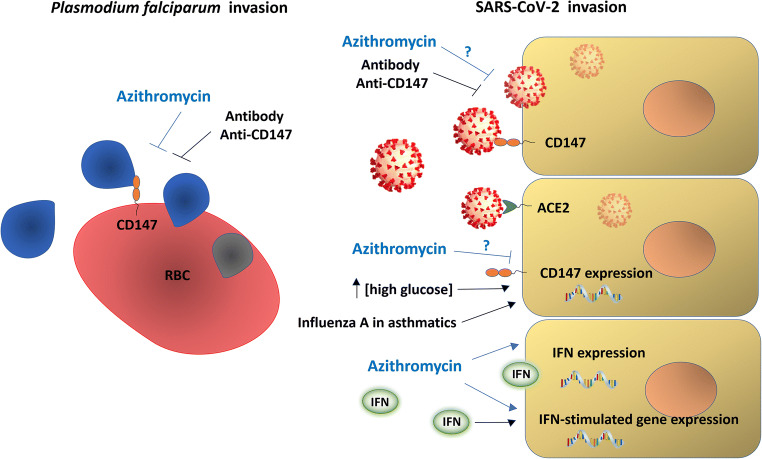
Fig. 1
Fig. 1
Targets and possible treatments for COVID-19. CD147 acts as receptor for Plasmodium falciparum (protozoan that causes Malaria) invasion on red blood cells (RBCs). CD147, in addition to ACE2 (angiotensin-converting enzyme 2), also acts as receptor of host cells for SARS-CoV-2 invasion. Treatment with anti-CD147 antibodies prevents invasion of host cells by Plasmodium falciparum and SARS-CoV-2 (in vitro and phase 2 clinical trial). Azithromycin also rapidly prevents Plasmodium falciparum invasion, possibly interfering with vital ligand/receptor interactions and also SARS-CoV-2 infection. However, the effect of azithromycin on SARS-CoV-2 has not yet been evaluated. Azithromycin induces anti-viral responses in epithelial cells by increasing levels of interferons and interferon-stimulated proteins and decreasing viral replication and virus release. This drug decreases expression of metalloproteinases (MMPs; molecules closely related to CD147). Both, influenza A virus in cells of Asthma patients as well as high glucose concentration in vitro increase CD147 expression, suggesting possible correlations within asthma, diabetes mellitus and CD147 levels in clinical complications due to SARS-CoV-2 infection
Fig. 2
Fig. 2
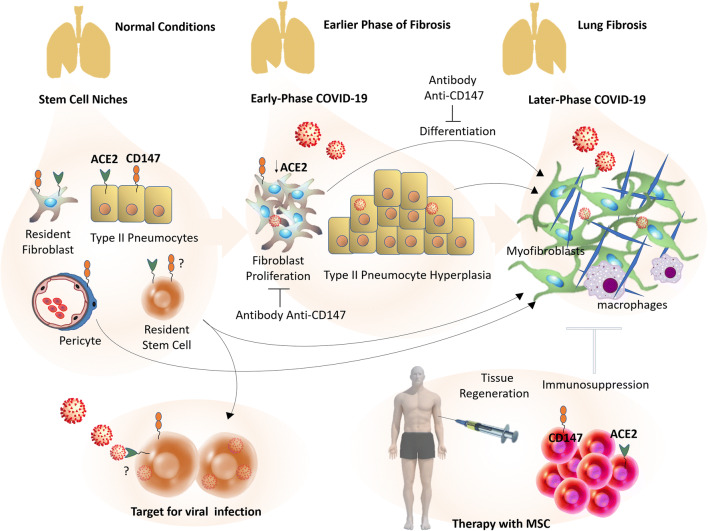
Stem cells in COVID-19: from a target for viral infection to therapy with mesenchymal stem cells (MSC). The continuous injury to the alveolar zone caused by SARS-CoV-2 infections, possibly origins a pro-inflammatory microenvironment, triggering an aberrant response with partial replacement of normal tissue by fibrous tissue. Pulmonary fibrosis is heavily populated by myofibroblasts. These cells seem to be originated from several types of cells, mainly resident stem cells/MSC-like cells. Early-phase COVID-19 pneumonia can show type II pneumocytes hyperplasia and fibroblast proliferation/fibroblast focias initial step of pulmonary fibrosis, while later COVID-19 phases can present fibrosis and fibrous stripes. Anti-CD147 antibodies inhibit TGF- β1-induced proliferation and differentiation of normal human lung fibroblasts in vitro. In addition to extensive differentiation, possible direct viral invasion of progenitor/stem cells via CD147 or ACE2 could result in the decline of these cellular stocks and failing lung repair. Benefits of cellular therapy with allogeneic MSC transplantation from healthy donators are being investigated. These cells can induce immunosuppression and tissue regeneration

References

    1. Coronavirus Resource Center. (2020). Johns Hopkins University - Medicine, https://coronavirus.jhu.edu/. Accessed on: 3/31/2020.
    1. Gautret P, Lagier JC, Parola P, et al. Hydroxychloroquine and azithromycin as a treatment of COVID-19: results of an open‐label non‐randomized clinical trial. International Journal of Antimicrobial Agents. 2020 doi: 10.1016/j.ijantimicag.2020.105949. - DOI - PMC - PubMed
    1. Liu J, Cao R, Xu M, et al. Hydroxychloroquine, a less toxic derivative of chloroquine, is effective in inhibiting SARS-CoV-2 infection in vitro. Cell Discovery. 2020;6:16. doi: 10.1038/s41421-020-0156-0. - DOI - PMC - PubMed
    1. Devaux CA, Rolain JM, Colson P, et al. New insights on the antiviral effects of chloroquine against coronavirus: what to expect for COVID-19? International Journal of Antimicrobial Agents. 2020 doi: 10.1016/j.ijantimicag.2020.105938. - DOI - PMC - PubMed
    1. Retallack Hanna, Di Lullo Elizabeth, Arias Carolina, Knopp Kristeene A., Laurie Matthew T., Sandoval-Espinosa Carmen, Mancia Leon Walter R., Krencik Robert, Ullian Erik M., Spatazza Julien, Pollen Alex A., Mandel-Brehm Caleigh, Nowakowski Tomasz J., Kriegstein Arnold R., DeRisi Joseph L. Zika virus cell tropism in the developing human brain and inhibition by azithromycin. Proceedings of the National Academy of Sciences. 2016;113(50):14408–14413. doi: 10.1073/pnas.1618029113. - DOI - PMC - PubMed

MeSH terms