. 2020 Jul 13;59(29):12035-12040.
doi: 10.1002/anie.202002479. Epub 2020 May 18.

Semisynthesis of Functional Glycosylphosphatidylinositol-Anchored Proteins

Affiliations

Semisynthesis of Functional Glycosylphosphatidylinositol-Anchored Proteins

Renée F Roller et al. Angew Chem Int Ed Engl. .

Abstract

Glypiation is a common posttranslational modification of eukaryotic proteins involving the attachment of a glycosylphosphatidylinositol (GPI) glycolipid. GPIs contain a conserved phosphoglycan that is modified in a cell- and tissue-specific manner. GPI complexity suggests roles in biological processes and effects on the attached protein, but the difficulties to get homogeneous material have hindered studies. We disclose a one-pot intein-mediated ligation (OPL) to obtain GPI-anchored proteins. The strategy enables the glypiation of folded and denatured proteins with a natural linkage to the glycolipid. Using the strategy, glypiated eGFP, Thy1, and the Plasmodium berghei protein MSP119 were prepared. Glypiation did not alter the structure of eGFP and MSP119 proteins in solution, but it induced a strong pro-inflammatory response in vitro. The strategy provides access to glypiated proteins to elucidate the activity of this modification and for use as vaccine candidates against parasitic infections.

Keywords: GPI anchor; glycoproteins; glypiation; protein modifications; protein semisynthesis.


Conflict of interest statement

The authors declare no conflict of interest.

Figures
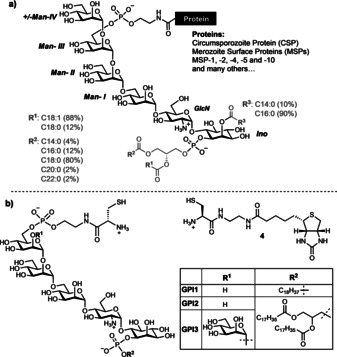
Figure 1
Figure 1
a) Lipid and glycan variability of GPIs anchoring Plasmodium spp. proteins. b) Structure of the cysteine‐containing GPIs and biotin used in this study.
Figure 2
Figure 2
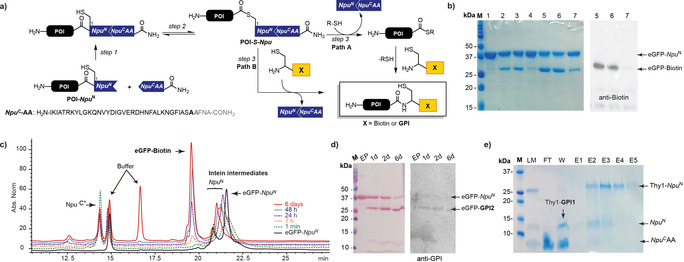
One‐pot ligation of eGFP with biotin. a) Scheme of the OPL reaction. b) Comparison of OPL with MESNA, MMP, and MMBA by SDS‐PAGE and western blot (eGFP‐Biotin detected with anti‐biotin antibody). M=Molecular weight marker; 1) GFP‐Npu N; 2) OPL with MESNa, 1 h; 3) OPL with MMP, 1 h; 4) OPL with MMBA, 1 h; 5) OPL with MESNa, 1 d; 6) OPL with MMP, 1 d; 7) OPL with MMBA, 1 d. c) Kinetic study of OPL, monitored by RP‐HPLC (C4). d) SDS‐PAGE and western blot of the OPL of eGFP with GPI2; detection with Ponceau S staining and anti‐GPI antibody after 1,2 and 6 days. M=Molecular weight marker, EP=eGFP‐Npu N. e) SDS‐PAGE of OPL between Thy1 and GPI1; purification by His‐Trap. M=Marker; LM=ligation mixture 6 d; FT=flow‐through; W=wash; E=elution fractions. MESNa=sodium 2‐mercaptoethanesulfonate, MMP=methyl 3‐mercaptopropionate.
Scheme 1
Scheme 1
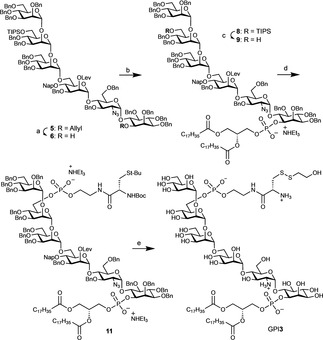
Synthesis of lipidated GPIs containing a cysteine residue. Conditions and reagents: a) PdCl2, AcOH, H2O, AcONa, 70 %. b) i. 7,16 PivCl, pyridine; ii. I2, H2O 75 %. c) Sc(OTf)3, H2O, CH2Cl2/acetonitrile, 68 %. d) i. 10,13b PivCl, pyridine; ii. I2, H2O, 70 %. e) i. H2N‐NH2‐AcOH, AcOH, pyridine, CH2Cl2; ii. Pd(OH)2/C, H2, CHCl3, MeOH, H2O; iii. TFA, anisole, Hg(OTFA)2, 0 °C, iv. β‐mercaptoethanol, H2O, 43 % (over 4 steps). Piv=pivaloyl, TfO=trifluoromethanesulfonate, TFA=trifluoroacetic acid.
Figure 3
Figure 3
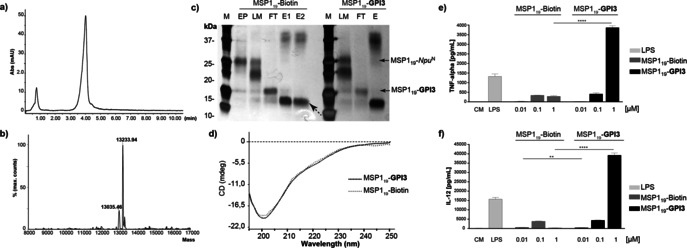
Characterization of GPI‐anchored proteins. a) RP‐HPLC chromatogram of purified MSP119GPI3. b) Deconvoluted ESI‐MS spectrum of MSP119GPI3. c) SDS‐PAGE after His‐Trap purification of the preparative synthesis of MSP119‐Biotin and MSP119GPI3. M=molecular weight standard, FT=flow through; EP=MSP119Npu N, LM=ligation mixture; E=elution fractions; dotted arrow shows the intein. d) CD spectra of MSP119‐Biotin and MSP119GPI3, e, f) Production of TNF‐α (e) and IL‐12 (f) by BMDCs stimulated with the MSP119‐Biotin and MSP119GPI3. CM=Culture medium.

References

    1. Ferguson M. A., J. Cell Sci. 1999, 112, 2799–2809. - PubMed
    1. Tsai Y. H., Liu X. Y., Seeberger P. H., Angew. Chem. Int. Ed. 2012, 51, 11438–11456; - PubMed
    2. Angew. Chem. 2012, 124, 11604–11623.
    1. None
    1. Ferguson M. A. J., Williams A. F., Annu. Rev. Biochem. 1988, 57, 285–320; - PubMed
    1. Ikezawa H., Biol. Pharm. Bull. 2002, 25, 409–417. - PubMed

Publication types

LinkOut - more resources