. 2020 Apr 2:13:2771-2781.
doi: 10.2147/OTT.S241816. eCollection 2020.

Mannose Suppresses the Proliferation and Metastasis of Lung Cancer by Targeting the ERK/GSK-3β/β-Catenin/SNAIL Axis

Affiliations

Mannose Suppresses the Proliferation and Metastasis of Lung Cancer by Targeting the ERK/GSK-3β/β-Catenin/SNAIL Axis

Qingsong Luo et al. Onco Targets Ther. .

Retraction in

Abstract

Introduction: It has been found that mannose exerts antitumoural properties in vitro and in animal models. Whether mannose has potential anti-proliferative and anti-metastatic properties against non-small-cell lung cancer (NSCLC) is still unclear.

Methods: Here, we performed ex vivo experiments and established a nude mouse model to evaluate the anticancer effects of mannose on NSCLC cells and its effects on the ERK/GSK-3β/β-catenin/SNAIL axis. A CCK-8 assay was conducted to evaluate the effects of mannose on lung cancer cells (A549 and HCC827) and normal lung cells (HPAEpiC). Transwells were used to examine the motility of cancer cells. qRT-PCR was used to evaluate the effects of mannose on the mRNA expression of β-catenin. Western blotting was conducted to explore the effects of mannose on the ERK/GSK-3β/β-catenin/SNAIL axis and nuclear accumulation of β-catenin. An animal model was established to evaluate the antitumoural effect of mannose on hepatic metastasis in vivo.

Results: In this study, we found that mannose inhibited the proliferation of A549 and HCC827 cells in vitro both time- and dose-dependently. However, it exerted only a slight influence on the viability of normal lung cells in vitro. Moreover, mannose also inhibited the migrating and invading capacity of NSCLC cells in vitro. Using Western blotting, we observed that mannose reduced SNAIL and β-catenin expression and ERK activation and promoted phospho-GSK-3β expression. The ERK agonist LM22B-10 promoted the metastatic ability of NSCLC cells and increased SNAIL and β-catenin expression in cancer cells, which could be reversed by mannose. Furthermore, ERK-mediated phosphorylation of the β-catenin-Tyr654 residue might participate in the nuclear accumulation of β-catenin and its transcriptional function. The results from animal experiments showed that mannose effectively reduced hepatic metastasis of A549 cells in vivo. Furthermore, mannose inhibited ERK/GSK-3β/β-catenin/SNAIL in tumour tissues obtained from nude mice.

Discussion: Collectively, these findings suggest that mannose exerts anti-metastatic activity against NSCLC by inhibiting the activation of the ERK/GSK-3β/β-catenin/SNAIL axis, which indicates the potential anticancer effects of mannose.

Keywords: mannose; metastasis; non-small-cell lung cancer; β-catenin.


Conflict of interest statement

The authors declare that they have no competing interests in this work.

Figures
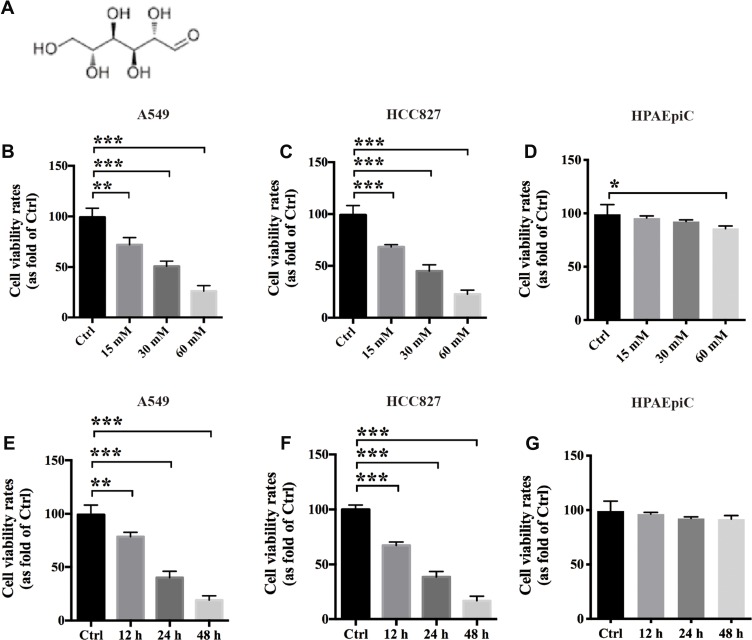
Figure 1
Figure 1
Mannose inhibits the proliferative ability of non-small-cell lung cancer cells in vitro. The chemical structure of mannose (A). The results from the CCK-8 assay showed that mannose exerts anticancer effects on A549 and HCC827 cells in vitro both dose-dependently (B, C) and time-dependently (E, F). However, mannose did not exert an anti-proliferative effect on HPAEpiC cells in vitro (D, G). Data are represented as the means ± SD. *, p-value<0.05; **, p-value<0.01; ***, p-value<0.001. One-way ANOVA was used in Figure 1.
Figure 2
Figure 2
Mannose reduces the migration and invasion ability of NSCLC cells in vitro. The results from Transwell assays showed that 30 mM mannose significantly inhibited the migration (A, B) and invasion (C, D) of NSCLC cells in vitro. Data are represented as the means ± SD. **, p-value<0.01; ***, p-value<0.001.
Figure 3
Figure 3
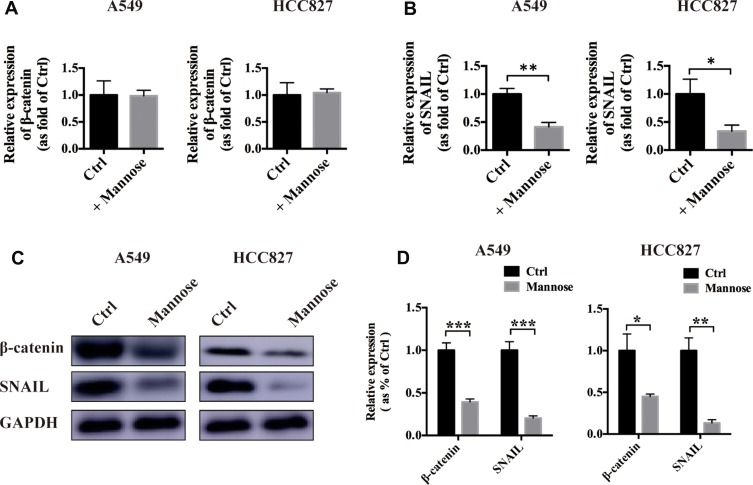
Mannose inhibits β-catenin and SNAIL expression in NSCLC cells. Real-time PCR was used to evaluate the effects of mannose on the mRNA expression of β-catenin and SNAIL in A549 and HCC827 cells (A, B). Western blotting was conducted to evaluate the effects of mannose on the protein expression of β-catenin and SNAIL in A549 and HCC827 cells (C, D). Data are represented as the means ± SD. *, p-value<0.05; **, p-value<0.01; ***, p-value<0.001.
Figure 4
Figure 4
Mannose regulates the phosphorylation levels of β-catenin, ERK and GSK-3β. Western blotting was conducted to evaluate the effects of mannose on the phosphorylation levels of β-catenin (Tyr654), ERK, and phospho-GSK-3β in NSCLC cells (A). The statistical analysis of Western blotting data is shown in (B). Data are represented as the means ± SD. **, p-value<0.01; ***, p-value<0.001.
Figure 5
Figure 5
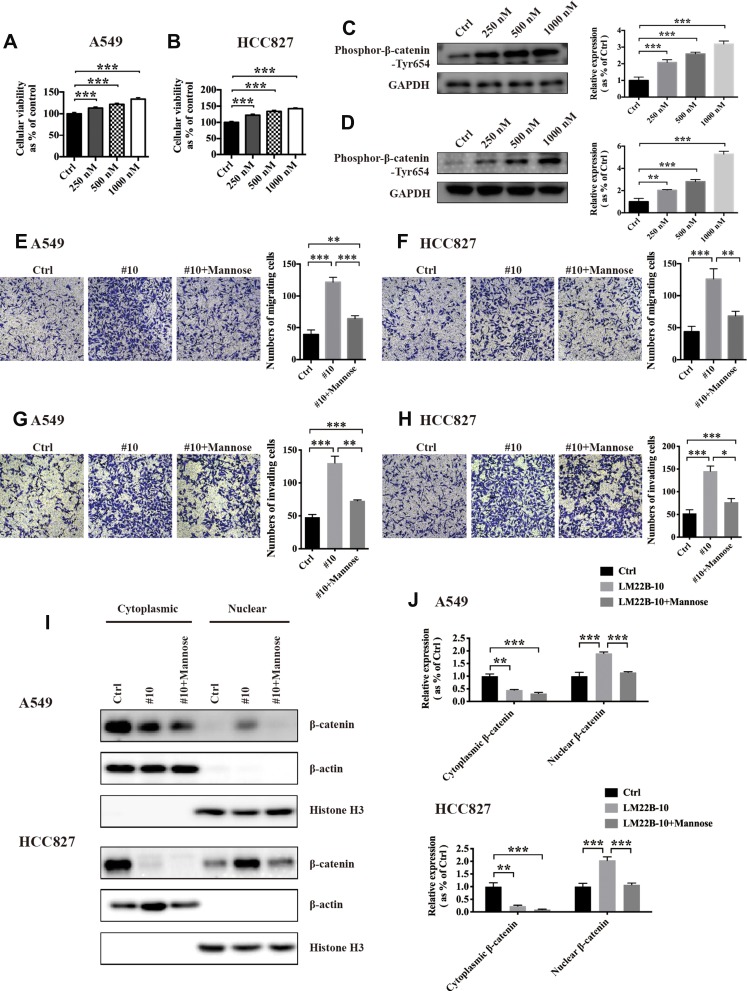
The ERK agonist LM22B-10 facilitates the migration and invasion of NSCLC cells and promotes the nuclear translocation of β-catenin, which is reversed by mannose. A CCK-8 assay was used to test the effects of LM22B-10 on the viability of NSCLC cells in vitro (A, B). Western blotting was conducted to test the effects of #10 on the expression of phospho-β-catenin-Tyr654 (C, D). Transwell assays were used to evaluate whether mannose can reverse the LM22B-10-induced pro-migration (E, F) and pro-invasion (G, H) effects on NSCLC cells in vitro. Western blotting was used to examine whether mannose can reverse LM22B-10-mediated nuclear translocation of β-catenin in NSCLC cells (I, J). Data are represented as the means ± SD. *, p-value<0.05; **, p-value<0.01; ***, p-value<0.001.
Figure 6
Figure 6
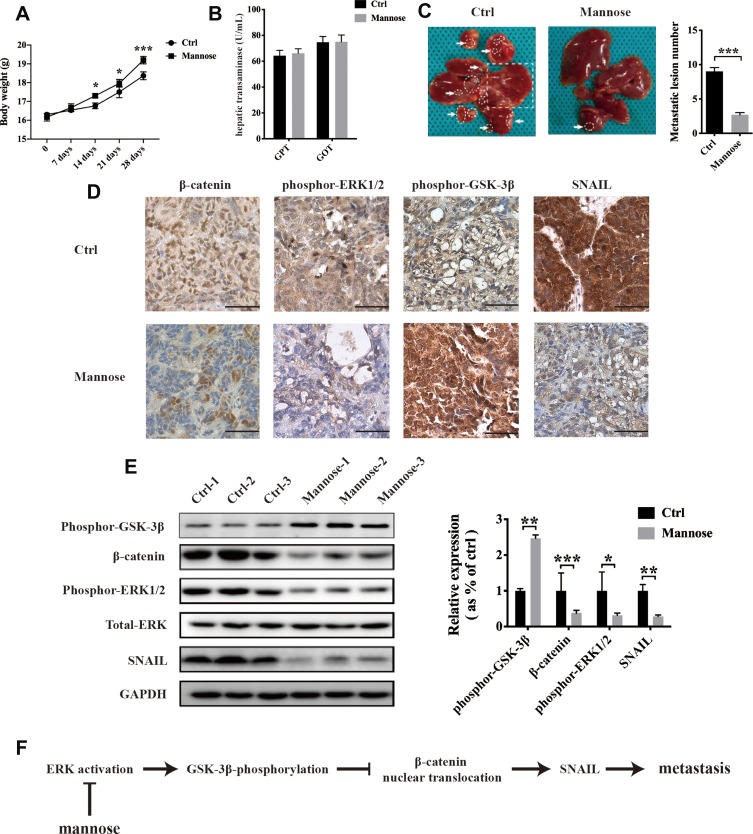
Mannose inhibits hepatic metastasis of A549 cells in vivo via downregulation of the ERK/GSK-3β/β-catenin/SNAIL axis. Mannose increased the body weight of tumour-bearing nude mice (A). Mannose did not affect the liver function of tumour-bearing nude mice, as demonstrated by evaluating hepatic transaminases (GPT and GOT) in serum samples (B). Mannose significantly reduced hepatic metastasis of A549 cells in a nude mouse model (C). The metastatic lesions in mouse livers are labelled by arrows, circles and squares. Immunohistochemistry was used to explore the effects of mannose on the expression of β-catenin, phospho-ERK1/2, phospho-GSK-3β and SNAIL in tumour tissues obtained from a tumour-bearing nude mouse model (D). Western blotting was conducted to evaluate the expression of β-catenin, phospho-ERK1/2, phospho-GSK-3β, and SNAIL in tumour tissues (E). Schematic diagram of the inhibitory effects of mannose on lung cancer metastasis (F). Data are represented as the means ± SD. *, p-value<0.05; **, p-value<0.01; ***, p-value<0.001. Scale bar, 200 μM.

References

    1. Hirsch FR, Scagliotti GV, Mulshine JL, et al. Lung cancer: current therapies and new targeted treatments. Lancet. 2017;389(10066):299–311. doi:10.1016/S0140-6736(16)30958-8 - DOI - PubMed
    1. Zhao Y, Adjei AA. New strategies to develop new medications for lung cancer and metastasis. Cancer Metastasis Rev. 2015;34(2):265–275. doi:10.1007/s10555-015-9553-5 - DOI - PubMed
    1. Gonzalez PS, O’Prey J, Cardaci S, et al. Mannose impairs tumour growth and enhances chemotherapy. Nature. 2018;563(7733):719–723. doi:10.1038/s41586-018-0729-3 - DOI - PubMed
    1. Shukla S, Sinha S, Khan S, et al. Cucurbitacin B inhibits the stemness and metastatic abilities of NSCLC via downregulation of canonical Wnt/beta-catenin signaling axis. Sci Rep. 2016;6(1):21860. doi:10.1038/srep21860 - DOI - PMC - PubMed
    1. Li K, Mo C, Gong D, et al. DDX17 nucleocytoplasmic shuttling promotes acquired gefitinib resistance in non-small cell lung cancer cells via activation of beta-catenin. Cancer Lett. 2017;400:194–202. doi:10.1016/j.canlet.2017.02.029 - DOI - PubMed

Publication types