


Epidemiology of Dermatophyte and Non-Dermatophyte Fungi Infection in Ethiopia
- PMID: 32308463
- PMCID: PMC7152551
- DOI: 10.2147/CCID.S246183
Epidemiology of Dermatophyte and Non-Dermatophyte Fungi Infection in Ethiopia
Abstract
Background: Dermatophytosis represents one of the common infectious diseases worldwide and it is a major public health problem around the globe. The disease causes considerable morbidity and still continues to increase especially in developing countries.
Objective: This study was undertaken to determine the prevalence of dermatophytes and the spectrum of fungal agents in patients attending Rank Higher Specialized Dermatology Clinic.
Methods: A cross-sectional study has been conducted, in which 318 samples from 318 suspected patients were collected. Samples include hair, nail, and skin. A portion of each sample was examined microscopically and the remaining portion of each sample was cultured onto plates of Sabouraud's dextrose agar containing chloramphenicol with and without cycloheximide. Isolates were identified by studying the macroscopic and microscopic characteristics of the colonies.
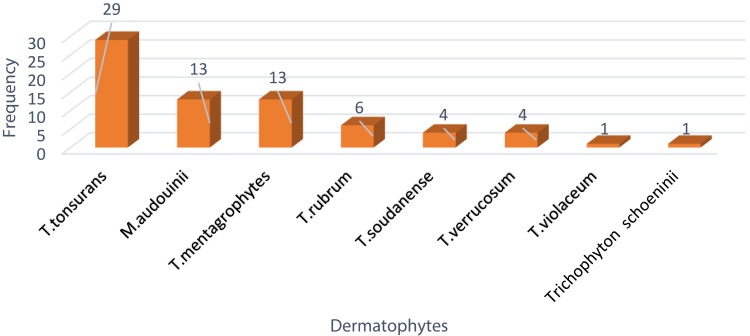
Results: Tinea capitis was the predominant clinical manifestation accounting for 53.4% of the cases. Patients with age group 1-14 years were more affected. Of 318 samples, fungi were detected in 133 (54.4%) by direct wet mount while 148/315 (46.5%) of them were culture positive. From these 72/148 (46.8%) were dermatophytes. T. tonsurans was the most common pathogen in tinea capitis, whereas T. mentagrophytes was the most common pathogen in tinea corporis. Among dermatophyte isolates, T. tonsurans 29/72 (40.2%) was the most common cause of infection. Among non-dermatophyte molds, Cladosporiumspp. 21/63 (33.3%) was predominant isolate followed by Neoscytalidim dimidatum 11/63 (17.4%) and Alternariaspp. 9/63 (14.2%), respectively. Yeasts also account for 13 (8.7%) of the total suspects of dermatophytosis.
Conclusion: In this study, the prevalence of dermatophytes was higher in tinea capitis 46/72 (63.8%) and T. tonsurans 29/72 (40%) was the dominant-isolated dermatophyte. Recovery of a large number of dermatophytes and non-dermatophyte fungi in our study showed that non-dermatophyte fungi are emerging as important causes of dermatophytosis warranting further intensive epidemiological studies that have public health significance are needed.
Keywords: dermatophytes; dermatophytosis; fungi; infection; non-dermatophytes.
© 2020 Araya et al.
Conflict of interest statement
The authors declare that they have no financial or non-financial competing interests.
Figures

References
-
- Ramaraj V, Vijayaraman RS, Rangarajan S, Kindo AJ. Incidence and prevalence of dermatophytosis in and around Chennai, Tamilnadu, India. Int J Res Med Sci. 2016;4(3):695700. doi: 10.18203/2320-6012.ijrms20160483 - DOI
-
- Fentaw S, Gentachew T, Assefa M. A five-year retrospective study of dermatophytosis and dermatomycoses at the Mycology Referral Laboratory of EHNRI, Addis Ababa, Ethiopia. Ciencias Biol. 2010;41:1–7.
LinkOut - more resources
Full Text Sources
