


Etiology and Risk Factors for Infectious Keratitis in South Texas
- PMID: 32308946
- PMCID: PMC7151511
- DOI: 10.18502/jovr.v15i2.6729
Etiology and Risk Factors for Infectious Keratitis in South Texas
Abstract
Purpose: To determine the causative organisms and associated risk factors for infectious keratitis in South Texas.
Methods: This retrospective study was performed at a tertiary teaching hospital system in South Texas. Medical records of all patients who presented with infectious keratitis from 2012 to 2018 were reviewed. Only patients with culture-proven bacterial, fungal, and Acanthamoeba keratitis were included.
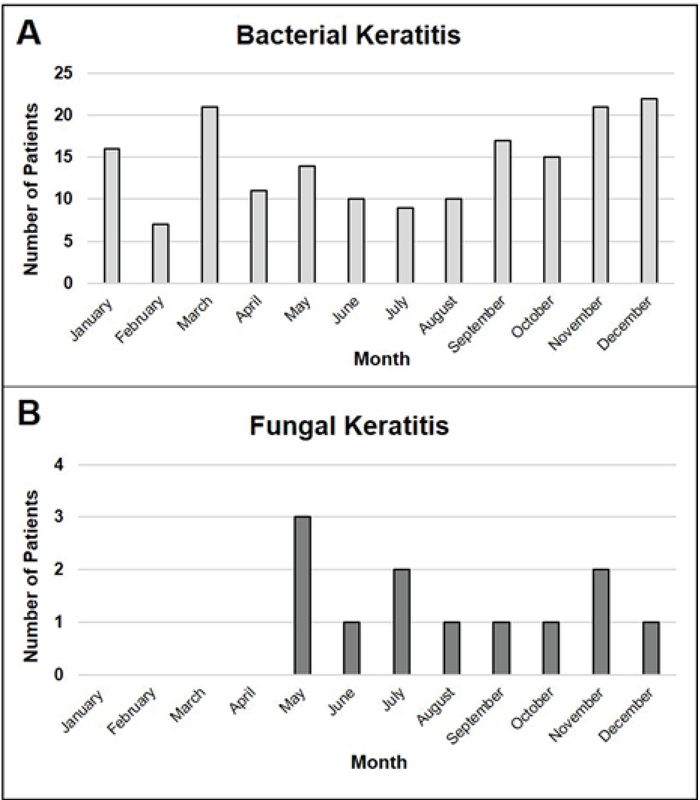
Results: In total, 182 eyes of 181 patients had culture-proven bacterial, fungal, or Acanthamoeba keratitis. The age of patients ranged from 3 to 93 years, with a mean of 48.3 20.8 years. The most common etiologic agent was bacteria, with 173 bacterial cultures (95.1%) recovered, followed by 13 fungal cultures (7.1%), and 3 Acanthamoeba cultures (1.6%). Of the 218 bacterial isolates, coagulase-negative Staphylococcus was the most common (25.7%), followed by Pseudomonas aeruginosa (23.4%), Staphylococcus aureus (11.0%), and Moraxella (7.8%). Fusarium was the most common fungal isolate (46.2%). The most common risk factors for infectious keratitis included contact lens wear (32.4%), underlying corneal disease (17.6%), trauma (14.3%), and ocular surface disease (13.7%).
Conclusions: Bacteria are the most common cause of infectious keratitis in this patient population, with coagulase-negative Staphylococcus and Pseudomonas as the most common isolates. The prevalence of culture-positive fungal keratitis is significantly lower than that of bacterial keratitis. Contact lens wear is the most common risk factor associated with infectious keratitis in South Texas.
Keywords: Bacteria; Corneal Ulcer; Fungus; Keratitis; Acanthamoeba.
Copyright © 2020 Puig et al.
Conflict of interest statement
There are no conflicts of interest.
Figures
References
-
- Mcleod Stephen D., Kolahdouz-Isfahani Amir, Rostamian Khodam, Flowers Charles W., Lee Paul P., Mcdonnell Peter J. The Role of Smears, Cultures, and Antibiotic Sensitivity Testing in the Management of Suspected Infectious Keratitis. Ophthalmology. 1996;103(1):23–28. doi: 10.1016/s0161-6420(96)30738-0. - DOI - PubMed
-
- Rk Forster. Conrad Berens Lecture. The management of infectious keratitis as we approach the 21st century. CLAO J 1998;24:175–180. - PubMed
Publication types
LinkOut - more resources
Full Text Sources