. 2020 Feb 24:9:136.
doi: 10.12688/f1000research.18236.1. eCollection 2020.

BioHackathon 2015: Semantics of data for life sciences and reproducible research

Rutger A Vos  1   2 Toshiaki Katayama  3 Hiroyuki Mishima  4 Shin Kawano  3 Shuichi Kawashima  3 Jin-Dong Kim  3 Yuki Moriya  3 Toshiaki Tokimatsu  5 Atsuko Yamaguchi  3 Yasunori Yamamoto  3 Hongyan Wu  6 Peter Amstutz  7 Erick Antezana  8 Nobuyuki P Aoki  9 Kazuharu Arakawa  10 Jerven T Bolleman  11 Evan Bolton  12 Raoul J P Bonnal  13 Hidemasa Bono  3 Kees Burger  14 Hirokazu Chiba  15 Kevin B Cohen  16   17 Eric W Deutsch  18 Jesualdo T Fernández-Breis  19 Gang Fu  12 Takatomo Fujisawa  20 Atsushi Fukushima  21 Alexander García  22 Naohisa Goto  23 Tudor Groza  24   25 Colin Hercus  26 Robert Hoehndorf  27 Kotone Itaya  10 Nick Juty  28 Takeshi Kawashima  20 Jee-Hyub Kim  28 Akira R Kinjo  29 Masaaki Kotera  30 Kouji Kozaki  31 Sadahiro Kumagai  32 Tatsuya Kushida  33 Thomas Lütteke  34   35 Masaaki Matsubara  36 Joe Miyamoto  37 Attayeb Mohsen  38 Hiroshi Mori  39 Yuki Naito  3 Takeru Nakazato  3 Jeremy Nguyen-Xuan  40 Kozo Nishida  41 Naoki Nishida  42 Hiroyo Nishide  15 Soichi Ogishima  43 Tazro Ohta  3 Shujiro Okuda  44 Benedict Paten  45 Jean-Luc Perret  46 Philip Prathipati  38 Pjotr Prins  47   48 Núria Queralt-Rosinach  49 Daisuke Shinmachi  9 Shinya Suzuki  30 Tsuyosi Tabata  50 Terue Takatsuki  51 Kieron Taylor  28 Mark Thompson  52 Ikuo Uchiyama  15 Bruno Vieira  53 Chih-Hsuan Wei  12 Mark Wilkinson  54 Issaku Yamada  36 Ryota Yamanaka  55 Kazutoshi Yoshitake  56 Akiyasu C Yoshizawa  50 Michel Dumontier  57 Kenjiro Kosaki  58 Toshihisa Takagi  33   59
Affiliations

BioHackathon 2015: Semantics of data for life sciences and reproducible research

Rutger A Vos et al. F1000Res. .

Abstract

We report on the activities of the 2015 edition of the BioHackathon, an annual event that brings together researchers and developers from around the world to develop tools and technologies that promote the reusability of biological data. We discuss issues surrounding the representation, publication, integration, mining and reuse of biological data and metadata across a wide range of biomedical data types of relevance for the life sciences, including chemistry, genotypes and phenotypes, orthology and phylogeny, proteomics, genomics, glycomics, and metabolomics. We describe our progress to address ongoing challenges to the reusability and reproducibility of research results, and identify outstanding issues that continue to impede the progress of bioinformatics research. We share our perspective on the state of the art, continued challenges, and goals for future research and development for the life sciences Semantic Web.

Keywords: BioHackathon; Bioinformatics; Databases; Linked Open Data; Metadata; Ontology; Semantic Web; Visualization; Web Services; Workflows.


Conflict of interest statement

No competing interests were disclosed.

Figures
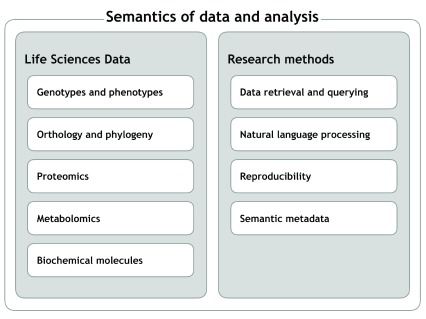
Figure 1.
Figure 1.. Main themes and topics of the BioHackathon 2015.
Figure 2.
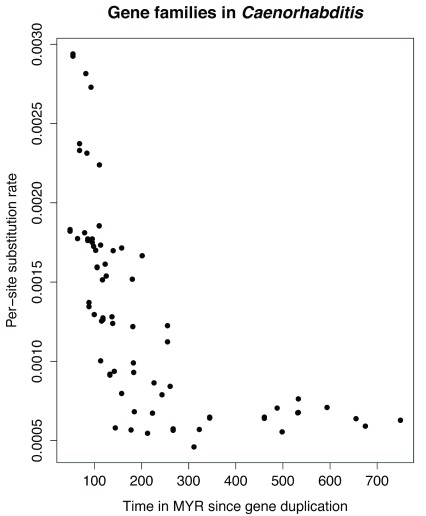
Figure 2.. Substitution rates as a function of evolutionary distance since the age of the most recent gene duplication observed in Caenorhabditis genomes.
Figure 3.
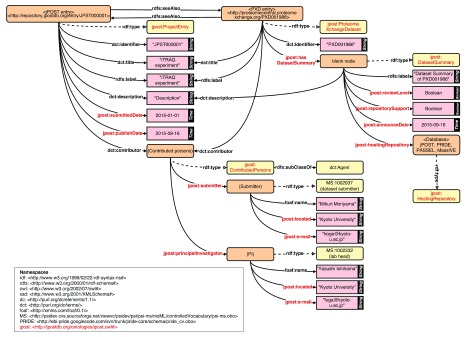
Figure 3.. RDF schema for jPOST metadata.
Figure 4.
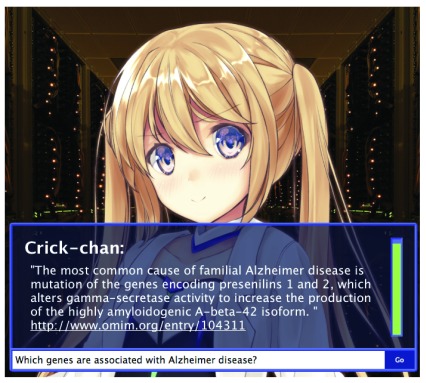
Figure 4.. The graphical interface of Crick-chan as it answers which genes are associated with Alzheimer’s disease.
Figure 5.
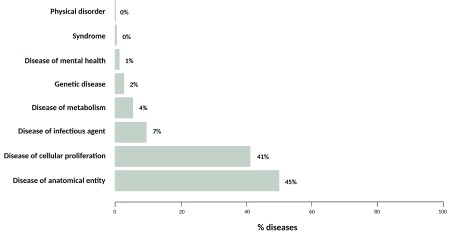
Figure 5.. Disease coverage for top-level categories in DO of the diseases only annotated in the Hoehndorf2015 DPA dataset in comparison to the HPO2015 annotation.
Figure 6.
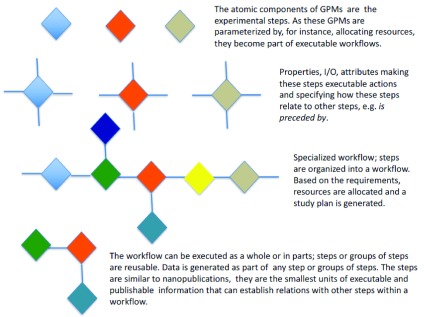
Figure 6.. From a General Process Model to an executable workflow.

References

    1. Triple Pattern Fragments. [cited 2018 May 8]. Reference Source

    1. Antezana E, Kuiper M, Mironov V: Biological knowledge management: the emerging role of the Semantic Web technologies. Brief Bioinform. 2009[cited 2016 Dec 6];10(4):392–407. 10.1093/bib/bbp024 - DOI - PubMed
    1. Katayama T, Arakawa K, Nakao M, et al. : The DBCLS BioHackathon: standardization and interoperability for bioinformatics web services and workflows. The DBCLS BioHackathon Consortium*. J Biomed Semantics. 2010;1(1):8. 10.1186/2041-1480-1-8 - DOI - PMC - PubMed
    1. Katayama T, Wilkinson MD, Aoki-Kinoshita KF, et al. : BioHackathon series in 2011 and 2012: penetration of ontology and linked data in life science domains. J Biomed Semantics. 2014[cited 2016 Apr 15];5(1):5. 10.1186/2041-1480-5-5 - DOI - PMC - PubMed
    1. Katayama T, Wilkinson MD, Micklem G, et al. : The 3rd DBCLS BioHackathon: improving life science data integration with Semantic Web technologies. J Biomed Semantics. 2013[cited 2014 Apr 29];4(1):6. 10.1186/2041-1480-4-6 - DOI - PMC - PubMed

Publication types