


Machine learning as a diagnostic decision aid for patients with transient loss of consciousness
- PMID: 32309027
- PMCID: PMC7156196
- DOI: 10.1212/CPJ.0000000000000726
Machine learning as a diagnostic decision aid for patients with transient loss of consciousness
Abstract
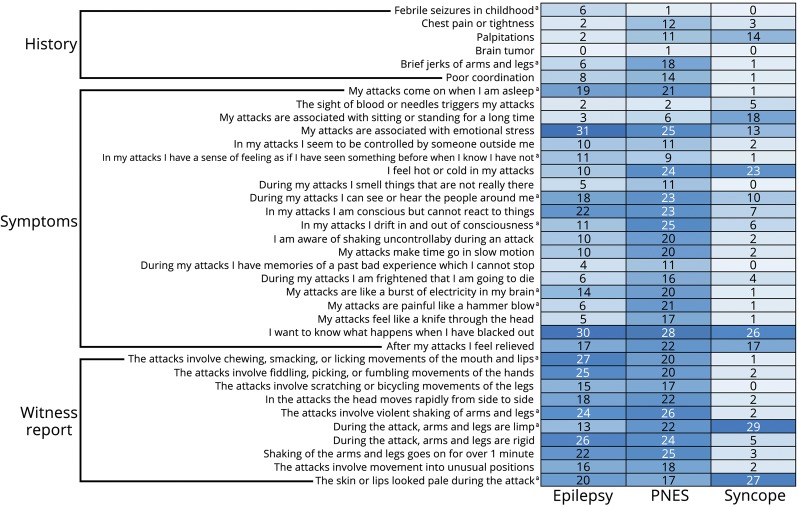
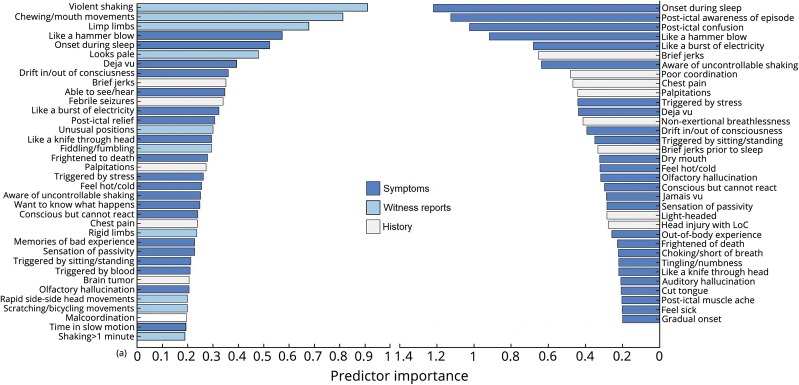
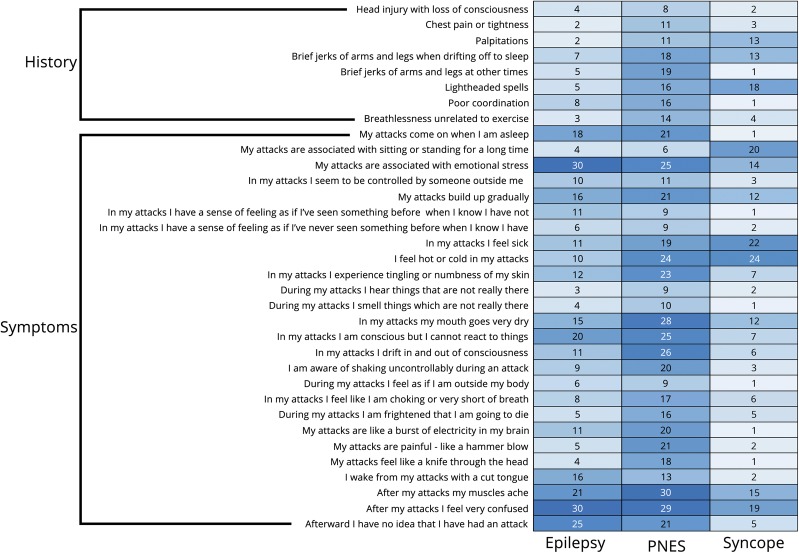
Background: Transient loss of consciousness (TLOC) is a common reason for presentation to primary/emergency care; over 90% are because of epilepsy, syncope, or psychogenic non-epileptic seizures (PNES). Misdiagnoses are common, and there are currently no validated decision rules to aid diagnosis and management. We seek to explore the utility of machine-learning techniques to develop a short diagnostic instrument by extracting features with optimal discriminatory values from responses to detailed questionnaires about TLOC manifestations and comorbidities (86 questions to patients, 31 to TLOC witnesses).
Methods: Multi-center retrospective self- and witness-report questionnaire study in secondary care settings. Feature selection was performed by an iterative algorithm based on random forest analysis. Data were randomly divided in a 2:1 ratio into training and validation sets (163:86 for all data; 208:92 for analysis excluding witness reports).
Results: Three hundred patients with proven diagnoses (100 each: epilepsy, syncope and PNES) were recruited from epilepsy and syncope services. Two hundred forty-nine completed patient and witness questionnaires: 86 epilepsy (64 female), 84 PNES (61 female), and 79 syncope (59 female). Responses to 36 questions optimally predicted diagnoses. A classifier trained on these features classified 74/86 (86.0% [95% confidence interval 76.9%-92.6%]) of patients correctly in validation (100 [86.7%-100%] syncope, 85.7 [67.3%-96.0%] epilepsy, 75.0 [56.6%-88.5%] PNES). Excluding witness reports, 34 features provided optimal prediction (classifier accuracy of 72/92 [78.3 (68.4%-86.2%)] in validation, 83.8 [68.0%-93.8%] syncope, 81.5 [61.9%-93.7%] epilepsy, 67.9 [47.7%-84.1%] PNES).
Conclusions: A tool based on patient symptoms/comorbidities and witness reports separates well between syncope and other common causes of TLOC. It can help to differentiate epilepsy and PNES. Validated decision rules may improve diagnostic processes and reduce misdiagnosis rates.
Classification of evidence: This study provides Class III evidence that for patients with TLOC, patient and witness questionnaires discriminate between syncope, epilepsy and PNES.
© 2019 American Academy of Neurology.
Figures
Comment in
- Neurol Clin Pract. 10(2):94.
References
-
- O'Callaghan P. Transient loss of consciousness. Medicine (Baltimore) 2012;40:427–430.
-
- Brignole M, Moya A, Lange D, et al. . 2018 ESC guidelines for the diagnosis and management of syncope. Eur Heart J 2018;39:1883–1948. - PubMed
-
- NICE CG109. Transient Loss of Consciousness (“blackouts”) in over 16s: National Institute for Health and Clinical Excellence; 2010. Available at nice.org.uk/guidance/cg109/. Accessed January 26, 2017.
-
- Angus-Leppan H. Diagnosing epilepsy in neurology clinics: a prospective study. Seizure 2008;17:431–436. - PubMed
LinkOut - more resources
Full Text Sources
Research Materials