


FDA approved antibacterial drugs: 2018-2019
- PMID: 32309620
- PMCID: PMC7086080
- DOI: 10.15190/d.2019.15
FDA approved antibacterial drugs: 2018-2019
Abstract
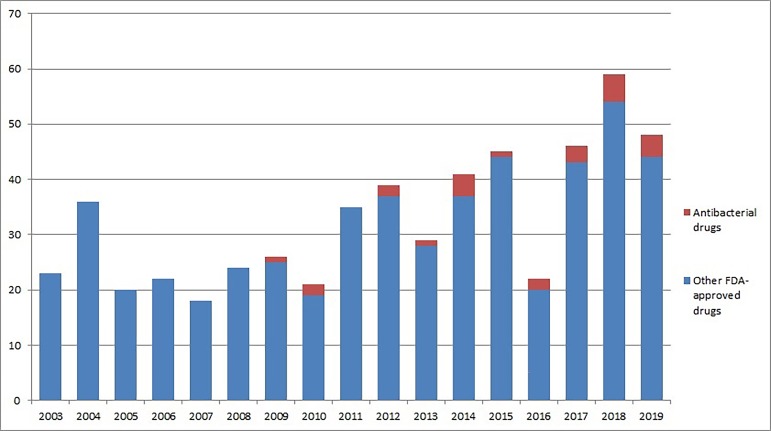
Bacterial resistance to existent antibiotherapy is a perpetual internationally-recognized problem. Year after year, there is a continuous need for novel antibacterial drugs and this research and development efforts recently resulted in few new drugs or combination of drugs proposed for the use into the clinic. This review focuses on the novel US FDA approved antibacterial agents in the last two years (2018-2019). Plazomicin, eravacycline, sarecycline, omadacycline, rifamycin (2018) and imipenem, cilastatin and relebactam combination, pretomanid, lefamulin, cefiderocol (2019) are new therapeutic options. Plazomicin aminoglycoside antibiotic targets Enterobacteriaceae infections, being mainly used for the complicated urinary tract infections. The fully synthetic fluorocycline eravacycline gained approval for the complicated intra-abdominal infections. The tetracycline-derived antibiotic sarecycline might be a useful strategy for the management of non-nodular moderate to severe acne, while the other tetracycline-derived antibiotic approved, omadacycline, may be used for the patients with acute bacterial skin and skin structure infections and community-acquired bacterial pneumonia. The already-known RNA-synthesis suppressor rifamycin is now also approved for noninvasive Escherichia Coli-caused travelers' diarrhea. Two combinatorial strategies were approved for complicated urinary tract infections, complicated intra-abdominal infections (imipenem, cilastatin and relebactam) and lung tuberculosis (pretomanid in combination with bedaquiline and linezolid). Lefamulin is a semisynthetic pleuromutilin antibiotic for community-acquired bacterial pneumonia, while cefiderocol, a cephalosporin antibiotic is the last antibacterial drug approved in 2019, for the use in complicated urinary tract infections. Despite of these new developments, there is an ongoing need and urgency to develop novel antibiotic strategies and drugs to overrun the bacterial resistance to antibiotics.
Keywords: 2018; 2019.; Cefiderocol; Cilastatin and Relebactam; Eravacycline; FDA approved drugs; Imipenem; Lefamulin; Omadacycline. Rifamycin; Plazomicin; Pretomanid; Sarecycline.
Copyright: © 2019, Andrei et al. and Applied Systems.
Conflict of interest statement
Conflict of interests: The authors declare no conflicts of interest.
Figures
References
-
- Bacterial pathogens and resistance causing community acquired paediatric bloodstream infections in low- and middle-income countries: a systematic review and meta-analysis. Droz Nina, Hsia Yingfen, Ellis Sally, Dramowski Angela, Sharland Mike, Basmaci Romain. Antimicrobial resistance and infection control. 2019;8:207. - PMC - PubMed
-
- Plasmid evolution in carbapenemase-producing Enterobacteriaceae: a review. Kopotsa Katlego, Osei Sekyere John, Mbelle Nontombi Marylucy. Annals of the New York Academy of Sciences. 2019;1457(1):61–91. - PubMed
-
- Molecular Epidemiology, Diagnostics and Mechanisms of Antibiotic Resistance in Mycobacterium tuberculosis complex in Africa: A Systematic Review of Current Reports. Osei Sekyere John, Reta Melese Abate, Maningi Nontuthuko Excellent, Fourie Petrus Bernard. J Infect. 2019 - PubMed
-
- Strategies to reduce curative antibiotic therapy in intensive care units (adult and paediatric). Bretonnière Cédric, Leone Marc, Milési Christophe, Allaouchiche Bernard, Armand-Lefevre Laurence, Baldesi Olivier, Bouadma Lila, Decré Dominique, Figueiredo Samy, Gauzit Rémy, Guery Benoît, Joram Nicolas, Jung Boris, Lasocki Sigismond, Lepape Alain, Lesage Fabrice, Pajot Olivier, Philippart François, Souweine Bertrand, Tattevin Pierre, Timsit Jean-François, Vialet Renaud, Zahar Jean Ralph, Misset Benoît, Bedos Jean-Pierre. Intensive care medicine. 2015;41(7):1181–96. - PubMed
-
- Interventions to reduce colonisation and transmission of antimicrobial-resistant bacteria in intensive care units: an interrupted time series study and cluster randomised trial. Derde Lennie P G, Cooper Ben S, Goossens Herman, Malhotra-Kumar Surbhi, Willems Rob J L, Gniadkowski Marek, Hryniewicz Waleria, Empel Joanna, Dautzenberg Mirjam J D, Annane Djillali, Aragão Irene, Chalfine Annie, Dumpis Uga, Esteves Francisco, Giamarellou Helen, Muzlovic Igor, Nardi Giuseppe, Petrikkos George L, Tomic Viktorija, Martí Antonio Torres, Stammet Pascal, Brun-Buisson Christian, Bonten Marc J M. The Lancet. Infectious diseases. 2014;14(1):31–39. - PMC - PubMed
Publication types
LinkOut - more resources
Full Text Sources