Effect of a Mammography Screening Decision Aid for Women 75 Years and Older: A Cluster Randomized Clinical Trial
- PMID: 32310288
- PMCID: PMC7171581
- DOI: 10.1001/jamainternmed.2020.0440
Effect of a Mammography Screening Decision Aid for Women 75 Years and Older: A Cluster Randomized Clinical Trial
Abstract
Importance: Guidelines recommend that women 75 years and older be informed of the benefits and harms of mammography before screening.
Objective: To test the effects of receipt of a paper-based mammography screening decision aid (DA) for women 75 years and older on their screening decisions.
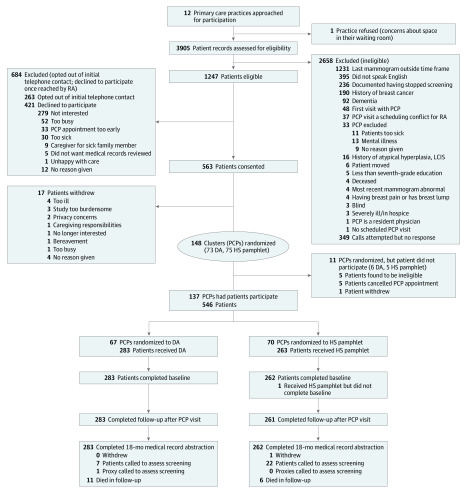
Design, setting, and participants: A cluster randomized clinical trial with clinician as the unit of randomization. All analyses were completed on an intent-to-treat basis. The setting was 11 primary care practices in Massachusetts or North Carolina. Of 1247 eligible women reached, 546 aged 75 to 89 years without breast cancer or dementia who had a mammogram within 24 months but not within 6 months and saw 1 of 137 clinicians (herein referred to as PCPs) from November 3, 2014, to January 26, 2017, participated. A research assistant (RA) administered a previsit questionnaire on each participant's health, breast cancer risk factors, sociodemographic characteristics, and screening intentions. After the visit, the RA administered a postvisit questionnaire on screening intentions and knowledge.
Interventions: Receipt of the DA (DA arm) or a home safety (HS) pamphlet (control arm) before a PCP visit.
Main outcomes and measures: Participants were followed up for 18 months for receipt of mammography screening (primary outcome). To examine the effects of the DA, marginal logistic regression models were fit using generalized estimating equations to allow for clustering by PCP. Adjusted probabilities and risk differences were estimated to account for clustering by PCP.
Results: Of 546 women in the study, 283 (51.8%) received the DA. Patients in each arm were well matched; their mean (SD) age was 79.8 (3.7) years, 428 (78.4%) were non-Hispanic white, 321 (of 543 [59.1%]) had completed college, and 192 (35.2%) had less than a 10-year life expectancy. After 18 months, 9.1% (95% CI, 1.2%-16.9%) fewer women in the DA arm than in the control arm had undergone mammography screening (51.3% vs 60.4%; adjusted risk ratio, 0.84; 95% CI, 0.75-0.95; P = .006). Women in the DA arm were more likely than those in the control arm to rate their screening intentions lower from previsit to postvisit (69 of 283 [adjusted %, 24.5%] vs 47 of 263 [adjusted %, 15.3%]), to be more knowledgeable about the benefits and harms of screening (86 [adjusted %, 25.5%] vs 32 [adjusted %, 11.7%]), and to have a documented discussion about mammography with their PCP (146 [adjusted %, 47.4%] vs 111 [adjusted %, 38.9%]). Almost all women in the DA arm (94.9%) would recommend the DA.
Conclusions and relevance: Providing women 75 years and older with a mammography screening DA before a PCP visit helps them make more informed screening decisions and leads to fewer women choosing to be screened, suggesting that the DA may help reduce overscreening.
Trial registration: ClinicalTrials.gov Identifier: NCT02198690.
Conflict of interest statement
Figures
Comment in
-
The Life and Death of Mammograms in Patients 75 Years and Older-To Screen or Not to Screen?JAMA Intern Med. 2020 Jun 1;180(6):843-844. doi: 10.1001/jamainternmed.2020.0431. JAMA Intern Med. 2020. PMID: 32310253 No abstract available.
-
Decision Aids and the Absence of Expected Longevity Benefits of Mammography Screening in Women 75 Years and Older.JAMA Intern Med. 2020 Dec 1;180(12):1714. doi: 10.1001/jamainternmed.2020.3620. JAMA Intern Med. 2020. PMID: 32926142 No abstract available.
-
Decision Aids and the Absence of Expected Longevity Benefits of Mammography Screening in Women 75 Years and Older-Reply.JAMA Intern Med. 2020 Dec 1;180(12):1714-1715. doi: 10.1001/jamainternmed.2020.3617. JAMA Intern Med. 2020. PMID: 32926157 No abstract available.
References
-
- Cancer Query System SEER incidence statistics. Accessed September 8, 2019. https://seer.cancer.gov/canques/incidence.html
-
- Vincent GK, Velkoff VA The next four decades: the older population in the United States: 2010 to 2050. US Dept of Commerce, Economics and Statistics Administration, US Census Bureau; 2010. Appendix Table A-3. Projections of the older population by selected age group and sex, and sex ratios for the United States: 2010 to 2050. Published May 2010. Accessed March 9, 2020. https://www.census.gov/prod/2010pubs/p25-1138.pdf