


Long-term efficacy and safety of dapagliflozin in patients with inadequately controlled type 1 diabetes (the DEPICT-2 study): 52-week results from a randomized controlled trial
- PMID: 32311204
- PMCID: PMC7496089
- DOI: 10.1111/dom.14060
Long-term efficacy and safety of dapagliflozin in patients with inadequately controlled type 1 diabetes (the DEPICT-2 study): 52-week results from a randomized controlled trial
Abstract
Aim: To investigate the long-term efficacy and safety of dapagliflozin as an adjunct to adjustable insulin in adults with type 1 diabetes (T1D) and inadequate glycaemic control.
Materials and methods: Dapagliflozin Evaluation in Patients with Inadequately Controlled Type 1 Diabetes (DEPICT-2) was a placebo-controlled, double-blind, multicentre, phase III study of adults with T1D (HbA1c 7.5%-10.5%) randomized (1:1:1) to receive dapagliflozin 5, 10 mg, or placebo. The efficacy and safety of dapagliflozin over 52 weeks were exploratory endpoints in this extension to DEPICT-2.
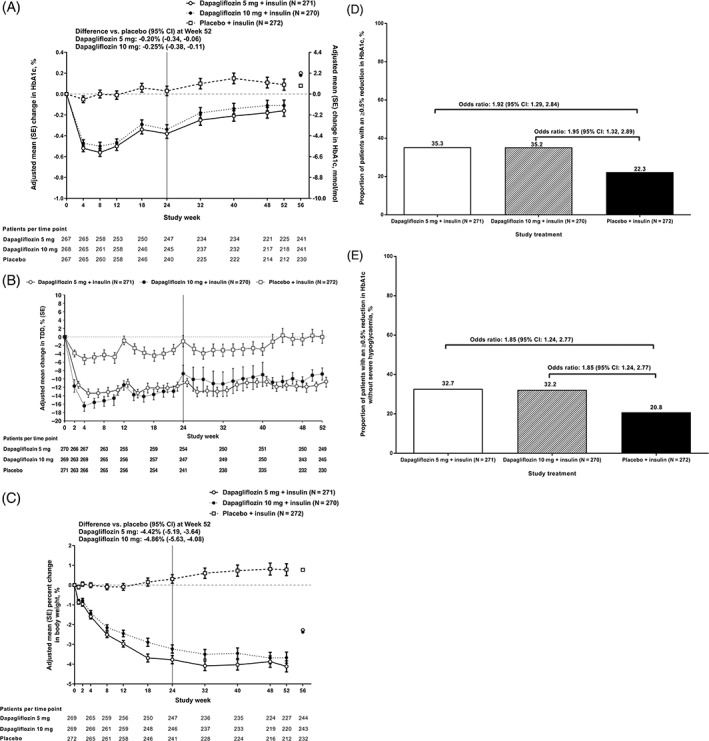
Results: Of 813 participants randomized, 88.2% completed the study. From baseline to 52 weeks, dapagliflozin 5 and 10 mg were associated with reduction in HbA1c (difference [95% CI] vs. placebo: -0.20% [-0.34, -0.06] and -0.25% [-0.38, -0.11], respectively) and adjusted mean percentage change in body weight (difference [95% CI] vs. placebo: -4.42% [-5.19, -3.64] and -4.86% [-5.63, -4.08], respectively). Serious adverse events were reported in the dapagliflozin 5, 10 mg, and placebo groups (32 [11.8%], 19 [7.0%] and 16 [5.9%], respectively). The proportion of hypoglycaemic events was similar across groups; severe hypoglycaemia was uncommon. More participants with events adjudicated as definite diabetic ketoacidosis (DKA) were in the dapagliflozin 5 and 10 mg groups versus placebo (11 [4.1%], 10 [3.7%] and 1 [0.4%], respectively); the majority of events were mild or moderate in severity and all were resolved with treatment.
Conclusions: Dapagliflozin led to long-term reductions in HbA1c and body weight in adults with T1D, but increased DKA risk compared with placebo.
Keywords: dapagliflozin, DEPICT-2, SGLT2 inhibitor, type 1 diabetes.
© 2020 The Authors. Diabetes, Obesity and Metabolism published by John Wiley & Sons Ltd.
Conflict of interest statement
C.M. has served as a consultant or advisory board member for ActoBio Therapeutics, AstraZeneca, Boehringher Ingelheim, Eli Lily and Company, Merck Sharp and Dohme Ltd., Novo Nordisk, Roche and Sanofi, and has also received honorarium from AstraZeneca, Boehringer Ingelheim, Eli Lilly and Company, Novartis, Novo Nordisk and Sanofi. G.R. received honorarium for conducting this clinical trial, as well as from AstraZeneca, Eli Lilly, Novo Nordisk, and Merck Sharp and Dohme, and participated in advisory boards for Merck Sharp and Dohme, AstraZeneca, Eli Lilly and Novo Nordisk. E.A. has participated on advisory panels for Alcon, Astellas Pharma, AstraZeneca, Eli Lilly, Kowa Pharmaceutical, Nippon Boehringer Ingelheim, Novo Nordisk Pharma, Sanofi and Terumo Corporation, has received honoraria for lectures from Astellas Pharma, MSD, Ono Pharmaceutical, Novo Nordisk Pharma, and Sanofi, and scholarship grants from Astellas Pharma, Daiichi Sankyo, Mitsubishi Tanabe Pharma, Nippon Boehringer Ingelheim, Novo Nordisk Pharma, Ono Pharmaceutical, Sanofi, Shionogi, Sumitomo Dainippon Pharma and Takeda Pharmaceutical. M.L. has received research grants from AstraZeneca, DexCom, Novo Nordisk and Pfizer, and has been a consultant for or received honoraria from AstraZeneca, DexCom, Eli Lilly, Medtronic, MSD, Novo Nordisk and Rubin Medical. P.D. serves on the advisory boards of AstraZeneca, Novo Nordisk, Sanofi, Boehringer Ingelheim, Merck, Intarcia and AbbVie, and has received research grants from all of these companies, apart from Intarcia. M.P. serves on the advisory boards of Sanofi, Medtronic, Novo Nordisk, Eli Lilly and Pfizer, has received research grants from Medtronic, Novo Nordisk, Roche, Eli Lilly, Merck, Sanofi, Pfizer, Bristol‐Myers Squibb, OPKO, Dexcom, Insulet and Lexicon, and honorarium, consultation and speaker bureau from Sanofi, Medtronic, Novo Nordisk, Eli Lilly, Pfizer, RSP Systems, Qulab Medical, AstraZeneca, Lilly and Insulet, and, in addition, is a stockholder for DreaMed Diabetes, NG Solutions and NutriTeen Professionals. N.A., N.I. and F.T. are employees of AstraZeneca. M.F.S. is an employee of Bayer. At the time of the study, M.F.S. was an employee of AstraZeneca. No other conflicts of interest relevant to this article were reported.
Figures
References
-
- EMC. Forxiga 5 mg film‐coated tablets: European Summary of Product Characteristics. https://www.medicines.org.uk/emc/product/2865/smpc. Accessed August 28, 2019.
-
- Japanese Ministry of Health Labour and Welfare. Forxiga 5 and 10 mg product label. 2019; https://www.info.pmda.go.jp/go/pack/3969019F1027_2_10/?view=frame&style=.... Accessed December 20, 2019.
-
- European Medicines Agency. New add‐on treatment to insulin for treatment of certain patients with type 1 diabetes. 2019. https://www.ema.europa.eu/en/news/new-add-treatment-insulin-treatment-ce.... Accessed April 30, 2020.
Publication types
MeSH terms
Substances
Grants and funding
LinkOut - more resources
Full Text Sources
Medical
