


Innovations in research and clinical care using patient-generated health data
- PMID: 32311776
- PMCID: PMC7488179
- DOI: 10.3322/caac.21608
Innovations in research and clinical care using patient-generated health data
Abstract
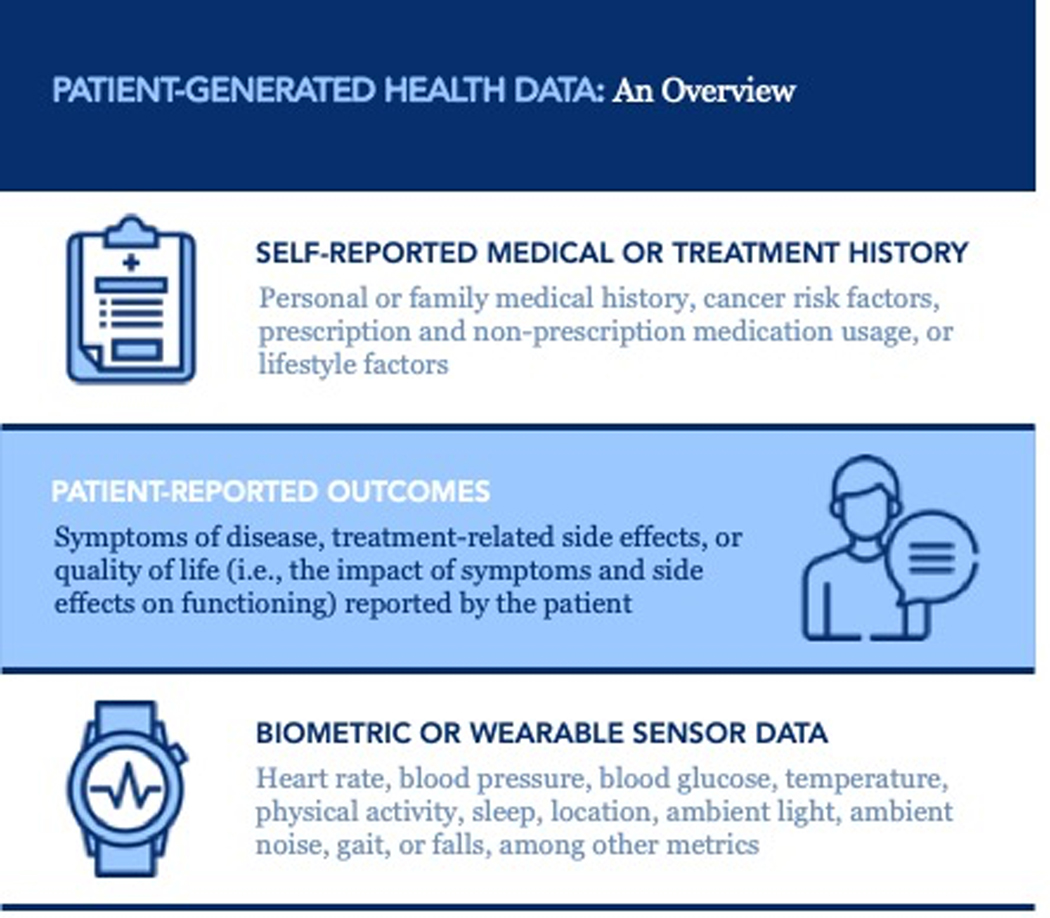
Patient-generated health data (PGHD), or health-related data gathered from patients to help address a health concern, are used increasingly in oncology to make regulatory decisions and evaluate quality of care. PGHD include self-reported health and treatment histories, patient-reported outcomes (PROs), and biometric sensor data. Advances in wireless technology, smartphones, and the Internet of Things have facilitated new ways to collect PGHD during clinic visits and in daily life. The goal of the current review was to provide an overview of the current clinical, regulatory, technological, and analytic landscape as it relates to PGHD in oncology research and care. The review begins with a rationale for PGHD as described by the US Food and Drug Administration, the Institute of Medicine, and other regulatory and scientific organizations. The evidence base for clinic-based and remote symptom monitoring using PGHD is described, with an emphasis on PROs. An overview is presented of current approaches to digital phenotyping or device-based, real-time assessment of biometric, behavioral, self-report, and performance data. Analytic opportunities regarding PGHD are envisioned in the context of big data and artificial intelligence in medicine. Finally, challenges and solutions for the integration of PGHD into clinical care are presented. The challenges include electronic medical record integration of PROs and biometric data, analysis of large and complex biometric data sets, and potential clinic workflow redesign. In addition, there is currently more limited evidence for the use of biometric data relative to PROs. Despite these challenges, the potential benefits of PGHD make them increasingly likely to be integrated into oncology research and clinical care.
Keywords: neoplasms; patient-generated health data; quality of life; telemedicine.
© 2020 American Cancer Society.
Figures
References
-
- U. S. Department of Health Human Services. What are patient-generated health data? https://www.healthit.gov/topic/otherhot-topics/what-are-patient-generate.... Published 2019. Accessed October 15, 2019.
-
- Shapiro M, Johnston D, Wald J, Mon D Patient-generated health data. White paper. In: Research Triangle Park, NC: RTI International. Prepared for Office of Policy and Planning, Office of the National Coordinator for Health Information Technology; 2012: https://www.rti.org/publication/patient-generated-health-data-white-paper.
-
- U.S. Department of Health and Human Services. Guidance for Industry Patient Reported Outcomes Measures: Use in Medical Product Development to Support Labeling Claims. https://www.fda.gov/media/77832/download. Published 2009. Accessed October 19, 2018.
-
- Kluetz PG SA, Papadopoulos EJ, Johnson LL, Donoghue M, Kwitkowski VE, Chen WH, Sridhara R, Farrell AT, Keegan P, Kim G, Pazdur R. Focusing on Core Patient-Reported Outcomes in Cancer Clinical Trials: Symptomatic Adverse Events, Physical Function, and Disease-Related Symptoms. Clinical Cancer Research. 2016;22(7):1553–1558. - PubMed
-
- Grossman C Patient reported outcomes: Design with the end in mind. Millken Institute; http://milkeninstitute.org/reports/patient-reported-outcomes-design-end-.... Published 2018. Accessed Oct. 19, 2018.
Publication types
MeSH terms
Grants and funding
LinkOut - more resources
Full Text Sources
Medical
Miscellaneous
