Review
. 2020 Oct 1;37(19):2045-2056.
doi: 10.1089/neu.2020.6990. Epub 2020 Jun 2.

Clinical Applications of Extracellular Vesicles in the Diagnosis and Treatment of Traumatic Brain Injury

Affiliations
Review

Clinical Applications of Extracellular Vesicles in the Diagnosis and Treatment of Traumatic Brain Injury

Kryshawna Beard et al. J Neurotrauma. .

Abstract

Extracellular vesicles (EVs) have emerged as key mediators of cell-cell communication during homeostasis and in pathology. Central nervous system (CNS)-derived EVs contain cell type-specific surface markers and intralumenal protein, RNA, DNA, and metabolite cargo that can be used to assess the biochemical and molecular state of neurons and glia during neurological injury and disease. The development of EV isolation strategies coupled with analysis of multi-plexed biomarker and clinical data have the potential to improve our ability to classify and treat traumatic brain injury (TBI) and resulting sequelae. Additionally, their ability to cross the blood-brain barrier (BBB) has implications for both EV-based diagnostic strategies and for potential EV-based therapeutics. In the present review, we discuss encouraging data for EV-based diagnostic, prognostic, and therapeutic strategies in the context of TBI monitoring and management.

Keywords: biomarkers; diagnostics; exosomes; extracellular vesicles; inflammation; outcome; prognostics; traumatic brain injury.


Conflict of interest statement

David Issadore is a founder and holds equity in Chip Diagnostics, a start-up company spun out of his lab.

Figures
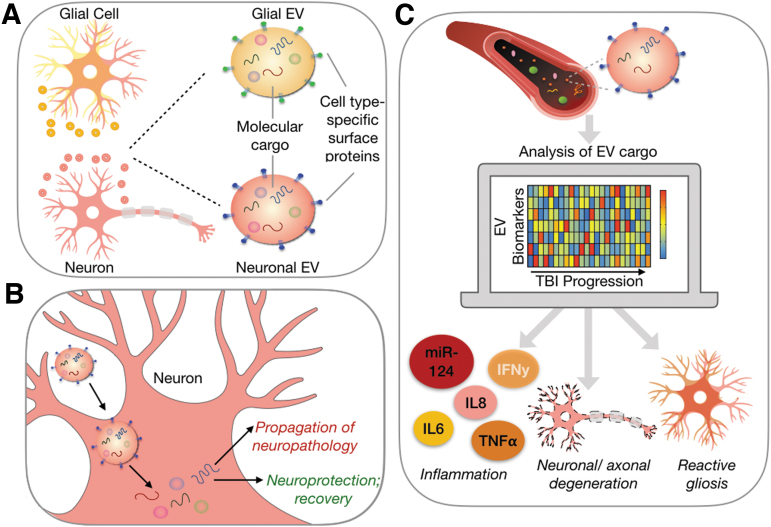
FIG. 1.
FIG. 1.
EVs are promising biomarkers of traumatic brain injury. (A) EVs are nanoscale mediators of cell-cell communication possessing cell-type specific surface markers and a wide variety of molecular cargo. (B) EVs have been indicated in both processes of disease progression and recovery after TBI through their effects on target cells. (C) EVs are released by cells of the brain into the interstitial fluid where they can gain access to circulation allowing for a non-invasive assessment of the injured brain. A multi-dimensional, dynamic assessment of EV cargo isolated from multiple brain cell types could increase granularity of TBI monitoring by identifying underlying mechanisms of pathology. EV, extracellular vesicle; TBI, traumatic brain injury.
FIG. 2.
FIG. 2.
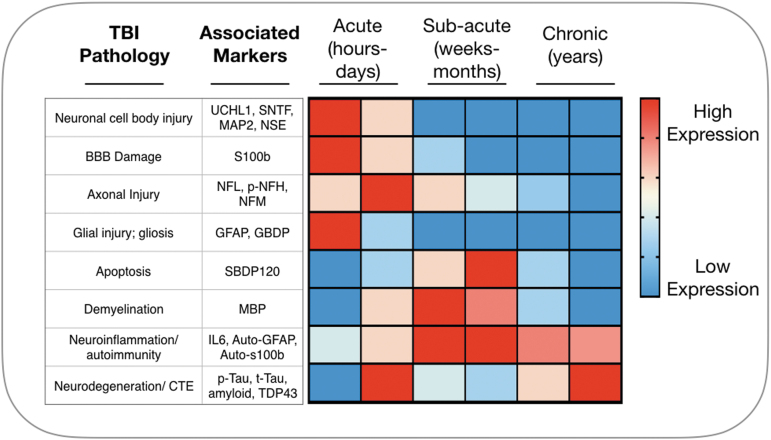
The current gold standard in blood-based biomarkers of TBI are brain-derived markers of acute neuronal and glial cell injury. The release of brain-derived proteins into systemic circulation is dependent on BBB disruption and the extent of cell injury and death. These markers are thus more indicative of injury severity than of specific underlying mechanisms of TBI progression. BBB, blood–brain barrier; TBI, traumatic brain injury.
FIG. 3.
FIG. 3.
CNS-derived EVs express molecular cargo involved in a wide variety of cellular functions. Proteomic analysis of microvesicles isolated from the CSF of patients with TBI revealed differential expression of proteins involved in a wide variety of signaling pathways. These data provide rationale for the analysis of multiple types of EV cargo for assessment of underlying mechanisms of TBI pathology. CSF, cerebrospinal fluid; CNS, central nervous system; EV, extracellular vesicle; TBI, traumatic brain injury.
FIG. 4.
FIG. 4.
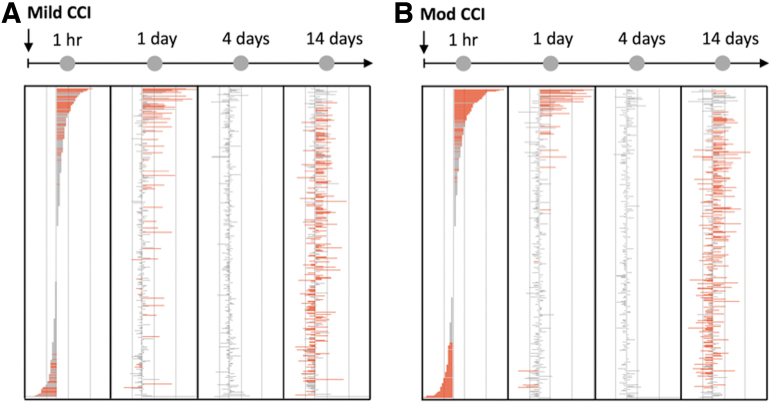
Brain-derived EVs exhibit dynamic changes in miRNA in a mouse model of injury. Brain-derived EVs isolated from the plasma of mice undergoing both (A) mild CCI and (B) moderate CCI exhibited differential expression of miRNAs compared with sham injured mice. These data further demonstrate the potential of brain-derived EVs for monitoring the course of TBI progression. CCI, controlled cortical impact; EV, extracellular vesicle; miRNA, microRNA; TBI, traumatic brain injury.

References

    1. Dewan M.C., Rattani A., Gupta S., Baticulon R.E., Hung YC., Punchak M., Agrawal A., Adeleye A.O., Shrime M.G., Rubiano A.M., Rosenfield J.V., and Park K.B. (2019). Estimating the global incidence of traumatic brain injury. J. Neurosurg. 130, 1080–1097 - PubMed
    1. Werner C., and Engelhard K. (2007). Pathophysiology of traumatic brain injury. Br. J. Anaesth. 99, 4–9 - PubMed
    1. Kaur P., and Sharma S. (2018). Recent advances in pathophysiology of traumatic brain injury. Curr. Neuropharmacol. 16, 1224–1238 - PMC - PubMed
    1. Prins M., Greco T., Alexander D., and Giza C.C. (2013). The pathophysiology of traumatic brain injury at a glance. Dis. Model Mech. 6, 1307–1315 - PMC - PubMed
    1. Sardar Sinha M., Ansell-Schultz A., Civitelli L., Hildesjö C., Larsson M., Lannfelt L., Ingelsson M., and Hallbeck M. (2018). Alzheimer's disease pathology propagation by exosomes containing toxic amyloid-beta oligomers. Acta Neuropathol. 136, 41–56 - PMC - PubMed

Publication types

MeSH terms