. 2020 Dec;9(1):928-939.
doi: 10.1080/22221751.2020.1757998.

Key mutations in the C-terminus of the HBV surface glycoprotein correlate with lower HBsAg levels in vivo, hinder HBsAg secretion in vitro and reduce HBsAg structural stability in the setting of HBeAg-negative chronic HBV genotype-D infection

Affiliations

Key mutations in the C-terminus of the HBV surface glycoprotein correlate with lower HBsAg levels in vivo, hinder HBsAg secretion in vitro and reduce HBsAg structural stability in the setting of HBeAg-negative chronic HBV genotype-D infection

Romina Salpini et al. Emerg Microbes Infect. 2020 Dec.

Abstract

Increasing evidences suggest that HBsAg-production varies across HBV-genotypes. HBsAg C-terminus plays a crucial role for HBsAg-secretion. Here, we evaluate HBsAg-levels in different HBV-genotypes in HBeAg-negative chronic infection, the correlation of specific mutations in HBsAg C-terminus with HBsAg-levels in-vivo, their impact on HBsAg-secretion in-vitro and on structural stability in-silico.HBsAg-levels were investigated in 323 drug-naïve HBeAg-negative patients chronically infected with HBV genotype-D(N = 228), -A(N = 65) and -E(N = 30). Genotype-D was characterized by HBsAg-levels lower than genotype-A and -E (3.3[2.7-3.8]IU/ml; 3.8[3.5-4.2]IU/ml and 3.9[3.7-4.2]IU/ml, P < 0.001). Results confirmed by multivariable analysis correcting for patients'demographics, HBV-DNA, ALT and infection-status.In genotype-D, specific C-terminus mutations (V190A-S204N-Y206C-Y206F-S210N) significantly correlate with HBsAg<1000IU/ml(P-value from <0.001 to 0.04). These mutations lie in divergent pathways involving other HBsAg C-terminus mutations: V190A + F220L (Phi = 0.41, P = 0.003), S204N + L205P (Phi = 0.36, P = 0.005), Y206F + S210R (Phi = 0.47, P < 0.001) and S210N + F220L (Phi = 0.40, P = 0.006). Notably, patients with these mutational pairs present HBsAg-levels 1log lower than patients without them(P-value from 0.003 to 0.02). In-vitro, the above-mentioned mutational pairs determined a significant decrease in HBsAg secretion-efficiency compared to wt(P-value from <0.001 to 0.02). Structurally, these mutational pairs reduced HBsAg C-terminus stability and determined a rearrangement of this domain.In conclusion, HBsAg-levels in genotype-D are significantly lower than in genotype-A and -E in HBeAg-negative patients. In genotype-D, specific mutational clusters in HBsAg C-terminus correlate with lower HBsAg-levels in-vivo, hamper HBsAg-release in-vitro and affect its structural stability, supporting their detrimental role on HBsAg-secretion. In this light, genotypic-testing can be a valuable tool to optimize the clinical interpretation of HBsAg in genotype-D and to provide information on HBV-pathogenicity and disease-progression.

Keywords: HBV genotypes; HBeAg-negative infection; HBsAg C-terminus; HBsAg levels; HBsAg mutations.


Conflict of interest statement

No potential conflict of interest was reported by the author(s).

Figures
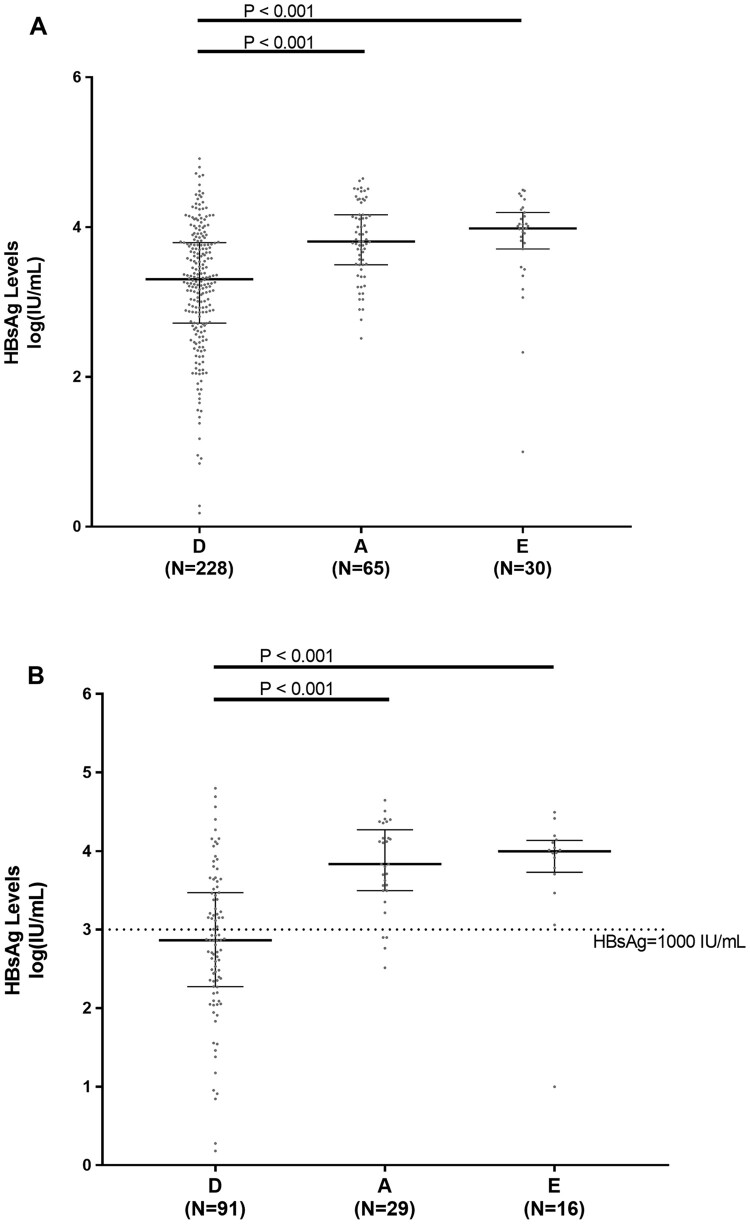
Figure 1.
Figure 1.
HBsAg levels in HBV genotypes D, A and E. Scatter plots report the distribution of HBsAg levels in the overall population of HBeAg-negative patients (N=228 for genotype D, N=65 for A and N=30 for E) (A) and in patients with persistent serum HBV-DNA<2,000IU/ml and normal ALT (N=91 for D, N=29 for A and N=16 for E) (B). Statistically significant differences were assessed by Mann-Whitney test. Bars represent median, 25th and 75th percentile.
Figure 2.
Figure 2.
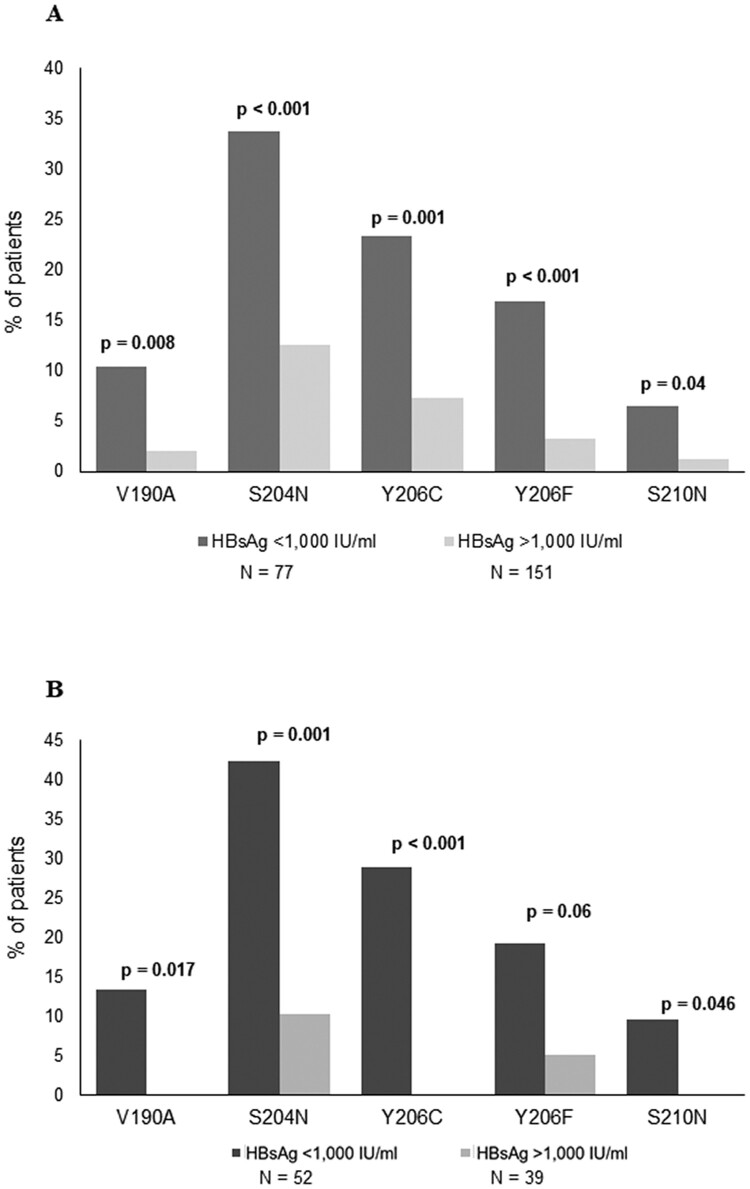
Mutations in HBsAg C-terminus associated with HBsAg<1,000IU/ml. The prevalence of each mutation in HBsAg C-terminus (amino acids: 170-226) was calculated in 228 HBV genotype-D infected patients stratified according to HBsAg levels (N=77 with HBsAg <1,000IU/ml and N=151 with HBsAg >1,000IU/ml) (A) and in 91 patients with HBeAg-negative genotype-D infection (N=52 with HBsAg<1,000IU/ml and N=39 with HBsAg>1,000IU/ml) (B). Statistically significant differences were assessed by Fisher Exact Test. In (A) Benjamini-Hochberg Method was used for multiple comparison correction. Statistically significant differences were confirmed after correction for multiple comparison for all mutations with the exception of S210N.
Figure 3.
Figure 3.
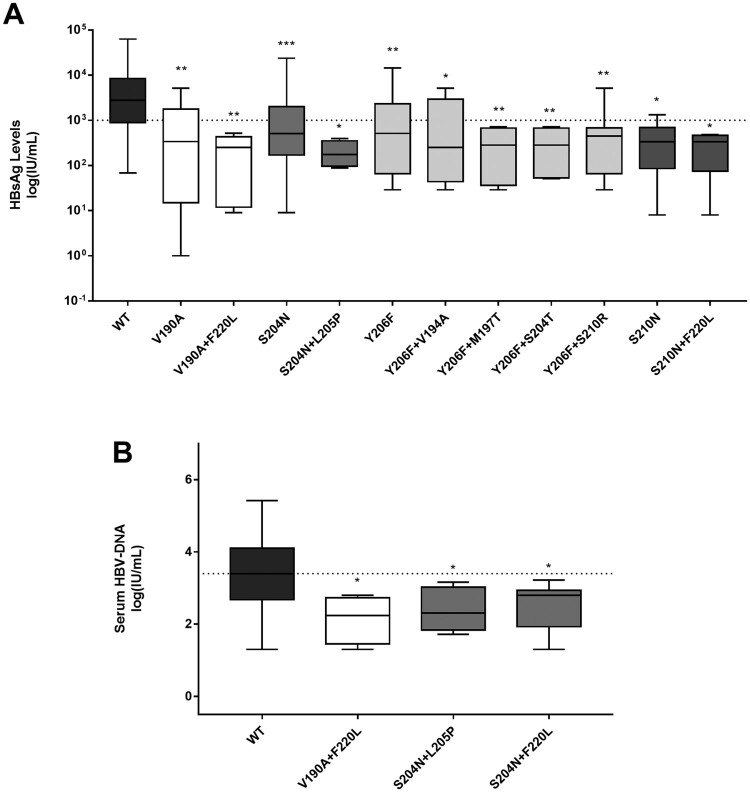
Serum HBsAg and HBV-DNA in presence of HBsAg C-terminus mutations associated with HBsAg<1,000IU/ml. Box plots report the distribution of serum HBsAg (A) and HBV-DNA (B) observed in presence of mutations (single or in pair) associated with HBsAg<1,000IU/ml in 228 HBeAg-negative genotype D infected patients. Statistically significant differences were assessed by Mann-Whitney Test. Wild-type (wt) indicates a virus without any mutation associated with HBsAg<1,000IU/ml. *indicates a P value ranging from 0.05 to 0.01, **indicates a P value from 0.001 to 0.01, and ***indicates P<0.001.
Figure 4.
Figure 4.
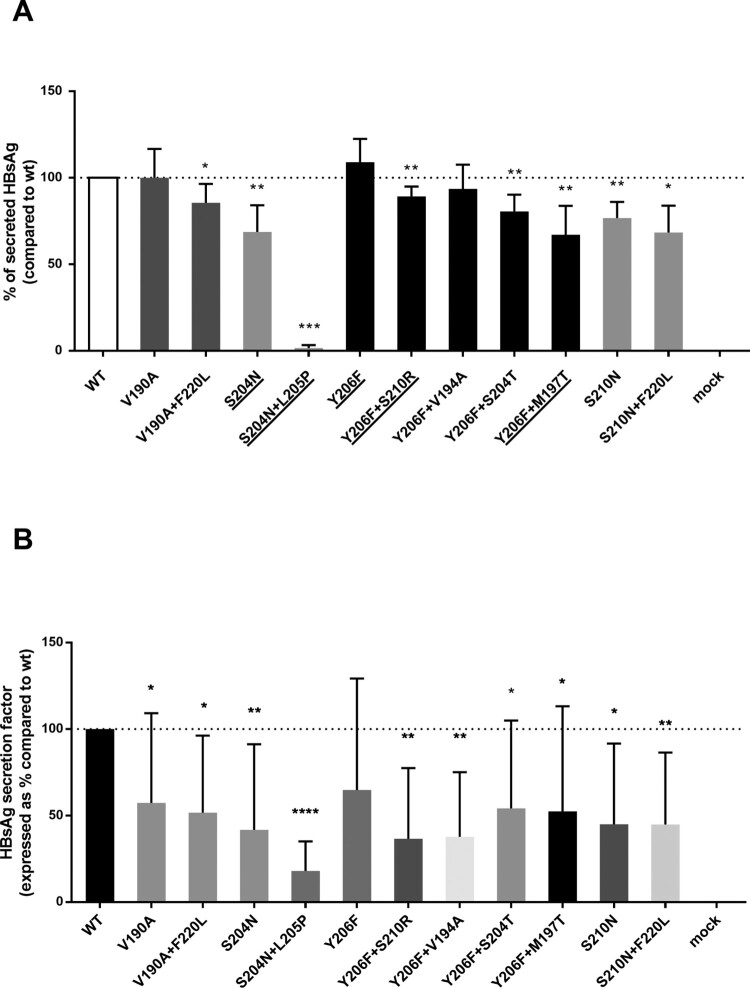
In vitro impact of HBsAg C-terminus mutations on HBsAg quantification. A plasmid encoding the small HBsAg linked to a streptavidin-tag version II at N-terminus was used to transfect the HepG2 cells. (A) The amount of strep-tagged HBsAg released in culture supernatants was then quantified using a specifically-designed ELISA capable to recognize the Strep-tag linked to the HBsAg. For each mutant, the amount of strep-tagged HBsAg released in supernatants of HepG2 cell cultures was expressed as percentage, considering the amount of the wild-type strep-tagged HBsAg as 100%. Results represent the mean values (+/- standard deviation) of 3 independent experiments, each led in duplicate. * indicates P values ranging from 0.05 to 0.01, ** P values from 0.01 to 0.001 and *** P values <0.001 compared to wild-type. For the underlined pairs of mutations HBsAg release was significant also compared to the corresponding single mutation S204N (P<0.001) or Y206F (P=0.007, P=0.001 and <0.0001, respectively). (B) For each mutant, the HBsAg secretion factor was measured as the ratio between extracellular and intracellular strep-tagged HBsAg in HepG2 cells. The amount of extracellular and intracellular strep-tagged HBsAg was measured by the LIAISON® XL murex HBsAg Quant assay (DiaSorin, Italy). HBsAg secretion factor of mutants was expressed as percentage, considering the amount of the wild-type strep-tagged HBsAg as 100%. Results represent the mean values (+/- standard deviation) of 3 independent experiments, each led in duplicate. * indicates P values ranging from 0.05 to 0.01, ** P values from 0.01 to 0.001, *** P values from 0.001 to 0.0001 and **** P values <0.0001 compared to wild-type.
Figure 5.
Figure 5.
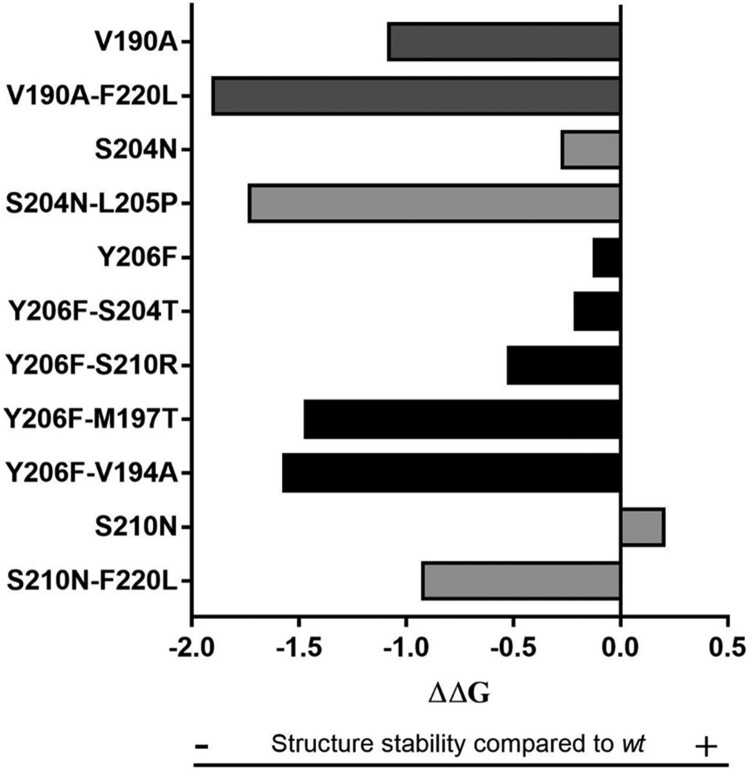
HBsAg structure stability in presence of C-terminus mutations associated with HBsAg <1,000IU/ml. The histogram shows the variation of HBsAg C-terminus stability in presence of mutations (single or in pairs) associated with lower HBsAg levels. HBsAg C-terminus stability was measured by calculating ΔΔG by STRUM (Quan et al., Bioinformatics, 2016). ΔΔG [wt-mutated] < 0 indicates a reduced stability in presence of the mutations.

References

    1. WHO. Global Hepatitis Report, 2017 . (2017). http://apps.who.int/iris/bitstream/handle/10665/255016/9789241565455-eng... (accessed 30 Aug 2018).
    1. Lampertico P, Agarwal K, Berg T, et al. . EASL 2017 Clinical Practice Guidelines on the management of hepatitis B virus infection. J Hepatol. 2017;67:370–398. doi: 10.1016/j.jhep.2017.03.021 - DOI - PubMed
    1. Brunetto MR, Oliveri F, Colombatto P, et al. . Hepatitis B surface antigen serum levels help to distinguish active from inactive hepatitis B virus genotype D carriers. Gastroenterology. 2010;139:483–490. doi: 10.1053/j.gastro.2010.04.052 - DOI - PubMed
    1. Riveiro-Barciela M, Bes M, Rodríguez-Frías F, et al. . Serum hepatitis B core-related antigen is more accurate than hepatitis B surface antigen to identify inactive carriers, regardless of hepatitis B virus genotype. Clin Microbiol Infect. 2017;23:860–867. doi: 10.1016/j.cmi.2017.03.003 - DOI - PubMed
    1. Lin CL, Kao JH.. Hepatitis B virus genotypes and variants. Cold Spring Harb Perspect Med 2015. doi:10.1101/cshperspect.a021436. - DOI - PMC - PubMed

Substances