. 2020 Apr 20;8(1):55.
doi: 10.1186/s40168-020-00827-8.

Disentangling the mechanisms shaping the surface ocean microbiota

Affiliations

Disentangling the mechanisms shaping the surface ocean microbiota

Ramiro Logares et al. Microbiome. .

Abstract

Background: The ocean microbiota modulates global biogeochemical cycles and changes in its configuration may have large-scale consequences. Yet, the underlying ecological mechanisms structuring it are unclear. Here, we investigate how fundamental ecological mechanisms (selection, dispersal and ecological drift) shape the smallest members of the tropical and subtropical surface-ocean microbiota: prokaryotes and minute eukaryotes (picoeukaryotes). Furthermore, we investigate the agents exerting abiotic selection on this assemblage as well as the spatial patterns emerging from the action of ecological mechanisms. To explore this, we analysed the composition of surface-ocean prokaryotic and picoeukaryotic communities using DNA-sequence data (16S- and 18S-rRNA genes) collected during the circumglobal expeditions Malaspina-2010 and TARA-Oceans.

Results: We found that the two main components of the tropical and subtropical surface-ocean microbiota, prokaryotes and picoeukaryotes, appear to be structured by different ecological mechanisms. Picoeukaryotic communities were predominantly structured by dispersal-limitation, while prokaryotic counterparts appeared to be shaped by the combined action of dispersal-limitation, selection and drift. Temperature-driven selection appeared as a major factor, out of a few selected factors, influencing species co-occurrence networks in prokaryotes but not in picoeukaryotes, indicating that association patterns may contribute to understand ocean microbiota structure and response to selection. Other measured abiotic variables seemed to have limited selective effects on community structure in the tropical and subtropical ocean. Picoeukaryotes displayed a higher spatial differentiation between communities and a higher distance decay when compared to prokaryotes, consistent with a scenario of higher dispersal limitation in the former after considering environmental heterogeneity. Lastly, random dynamics or drift seemed to have a more important role in structuring prokaryotic communities than picoeukaryotic counterparts.

Conclusions: The differential action of ecological mechanisms seems to cause contrasting biogeography, in the tropical and subtropical ocean, among the smallest surface plankton, prokaryotes and picoeukaryotes. This suggests that the idiosyncrasy of the main constituents of the ocean microbiota should be considered in order to understand its current and future configuration, which is especially relevant in a context of global change, where the reaction of surface ocean plankton to temperature increase is still unclear. Video Abstract.

Keywords: Community structure; Dispersal; Drift; Ecological processes; Microbiota; Ocean; Picoeukaryotes; Plankton; Prokaryotes; Selection.


Conflict of interest statement

The authors declare that they have no competing interests.

Figures
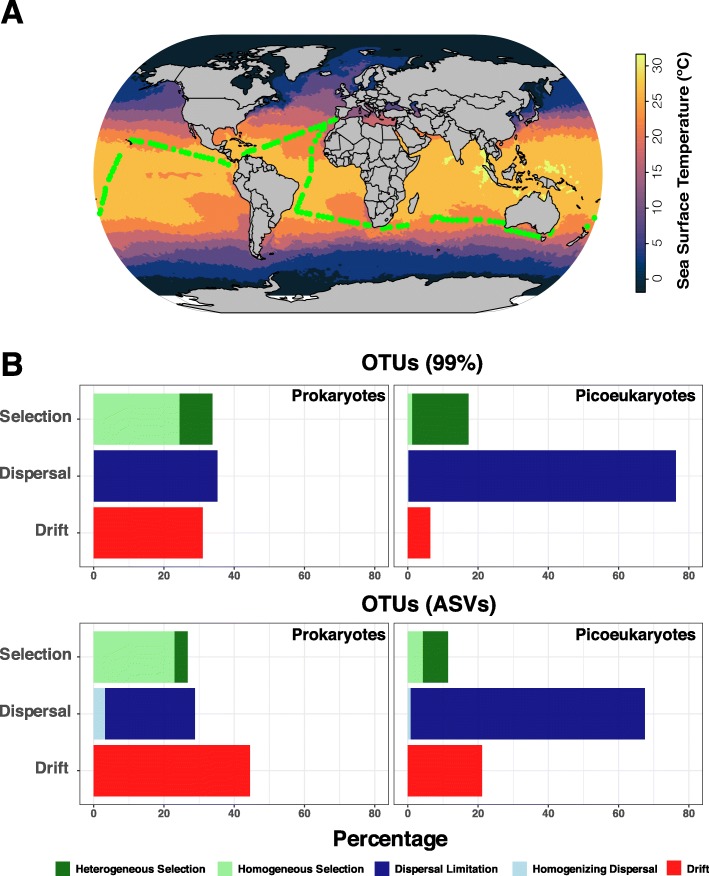
Fig. 1
Fig. 1
Ecological mechanisms shaping the tropical and subtropical surface-ocean picoplankton. a Position of the 120 stations included in this work that were sampled as part of the Malaspina-2010 expedition (green dots) in the tropical and subtropical ocean. A snapshot of the global sea surface temperature, a main environmental driver affecting microbial distributions, is shown as a general representation of the temperature gradients in the surface ocean (as inferred using the ‘optimum interpolation sea surface temperature’ dataset from the NOAA corresponding to the 17 of March of 2018). Note that temperatures measured in situ were used in all analyses, not the ones displayed here. b Percentage of the community turnover associated to different ecological processes in prokaryotes and picoeukaryotes in the tropical and subtropical upper ocean as calculated using OTUs-99% and OTUs-ASVs. Note that percentage refers to the percentage of pairs of communities that appear to be driven by a given process
Fig. 2
Fig. 2
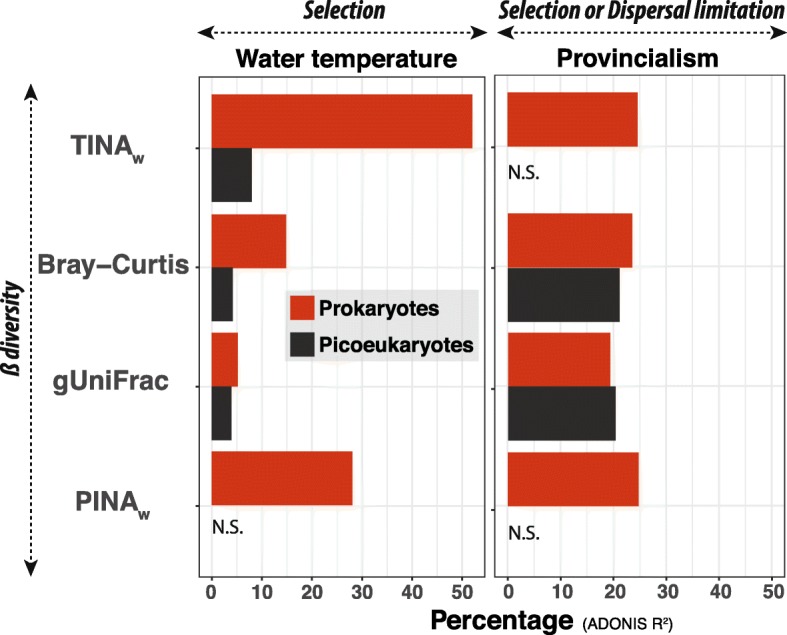
Main variables influencing the structure of the surface-ocean microbiota as captured by different β-diversity metrics. Percentage of variance in picoeukaryotic and prokaryotic community composition (ADONIS R2) explained by water temperature and Longhurst Provinces when using different β-diversity metrics. Figure based on the Malaspina Meta-119 dataset (see ‘Methods’ section). TINAw TINA weighted, gUniFrac generalized Unifrac, PINAw PINA weighted, N.S. non-significant. Note that TINAw, which considers species association networks, captures a significantly higher proportion of community variance associated to temperature than Bray-Curtis, a compositional index, in prokaryotes
Fig. 3
Fig. 3
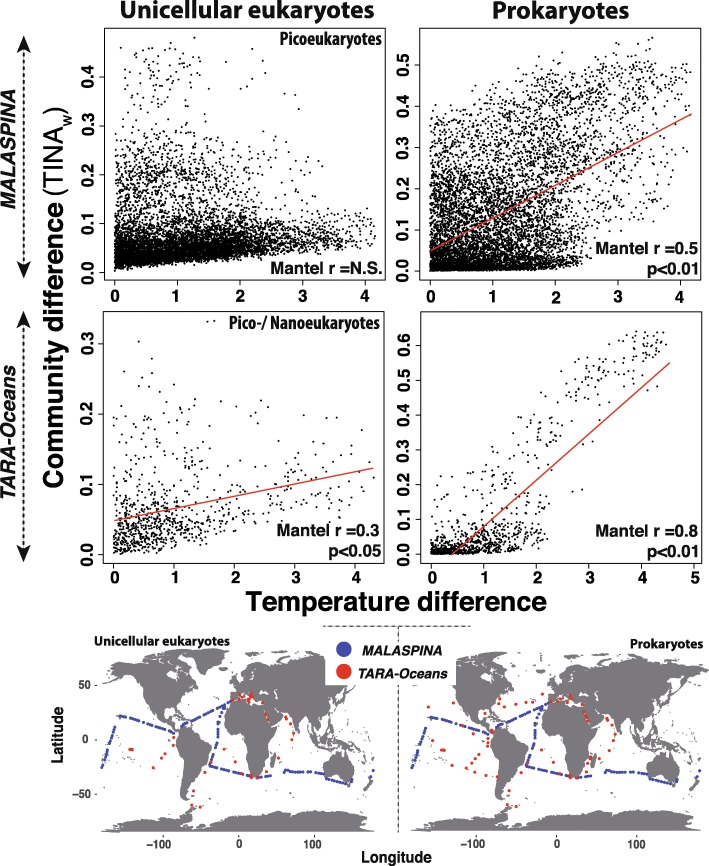
Temperature-driven selection seems to affect species association networks in prokaryotes but not in pico-/nano-eukaryotes. Differences in community composition (as 1-[TINA-weighted] = TINAw dissimilarities) vs. temperature differences (as Euclidean distances based on dimensionless z-scores) for both small unicellular eukaryotes and prokaryotes sampled during the Malaspina and TARA Oceans expeditions. Note that, in contrast to other indices, TINAw considers species-association patterns (i.e. co-occurrences and co-exclusions ) when estimating β-diversity [26]. NB: While only picoeukaryotes were included in Malaspina (cell sizes < 3 μm), TARA Oceans data included pico- and nano-eukaryotes (cell sizes < 5 μm). Pico- and nanoeukaryotes from both expeditions (left panels) displayed low or no correlations between TINAw distances and temperature differences (Mantel test results included in the panels). On the contrary, prokaryotes (right panels) displayed high to moderate correlations between TINAw distances and temperature differences. These differences in the correlations are likely due to the wider temperature ranges covered by TARA Oceans compared to Malaspina (see Discussion). The regression line is shown in red (Malaspina microbial eukaryotes N.S., Malaspina Prokaryotes R2 = 0.3, TARA Oceans microbial eukaryotes R2 = 0.1, TARA Oceans Prokaryotes R2 = 0.7; p < 0.05). The maps at the bottom indicate the surface stations from the expeditions Malaspina (119 stations for both prokaryotes and picoeukaryotes) and TARA Oceans (63 stations for prokaryotes and 40 stations for small unicellular eukaryotes) that were used to calculate TINAw
Fig. 4
Fig. 4
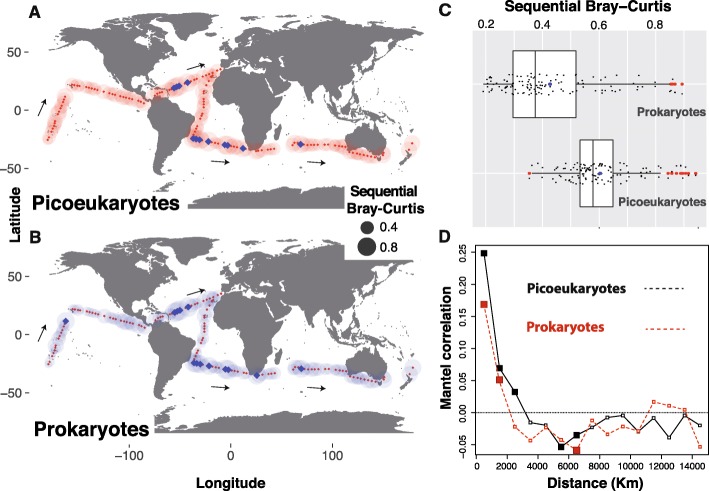
Picoeukaryotic communities display a higher spatial differentiation than prokaryotic counterparts in the tropical-subtropical surface-ocean. ac Sequential change in community composition across space (sequential β-diversity). Communities were sampled along the Malaspina expedition (a, b black arrows), and the composition of each community was compared against its immediate predecessor. In panels a, b, the size of each bubble represents the Bray-Curtis dissimilarity between a given community and the community sampled previously. Blue squares in panels a, b represent the stations where β-diversity displayed abrupt changes (Bray-Curtis values > 0.8 for picoeukaryotes and > 0.7 for prokaryotes). Abrupt changes coincided in a total of 11 out of 14 stations for both picoeukaryotes and prokaryotes, while one station displayed marked changes only for picoeukaryotes and two only for prokaryotes. Panel c summarizes the sequential Bray-Curtis values for prokaryotes and picoeukaryotes (Means were significantly different between domains [Wilcoxon text, p < 0.05]). Panel d indicates the differences in distance-decay between prokaryotes and picoeukaryotes in the tropical and subtropical surface-ocean. Mantel correlograms between geographic distance and β-diversity featuring distance classes of 1000 km for both picoeukaryotes and prokaryotes are shown. Coloured squares indicate statistically significant correlations (p < 0.05). Note that β-diversity in picoeukaryotes displayed positive correlations with increasing distances up to ≈ 3000 km, while prokaryotes had positive correlations with distances up to ≈ 2000 km. Correlations tended to be smaller in prokaryotes than in picoeukaryotes, indicating smaller distance decay in the former compared to the latter

References

    1. Falkowski P. The power of plankton. Nature. 2012;483(7387):S17–S20. doi: 10.1038/483S17a. - DOI - PubMed
    1. Falkowski PG, Fenchel T, Delong EF. The microbial engines that drive Earth's biogeochemical cycles. Science. 2008;320(5879):1034–1039. doi: 10.1126/science.1153213. - DOI - PubMed
    1. Jardillier L, Zubkov MV, Pearman J, Scanlan DJ. Significant CO2 fixation by small prymnesiophytes in the subtropical and tropical northeast Atlantic Ocean. ISME J. 2010;4(9):1180–1192. doi: 10.1038/ismej.2010.36. - DOI - PubMed
    1. Li WKW. Primary production of prochlorophytes, cyanobacteria, and eucaryotic ultraphytoplankton: Measurements from flow cytometric sorting. Limnol Oceanography. 1994;39(1):169–175. doi: 10.4319/lo.1994.39.1.0169. - DOI
    1. Worden AZ, Follows MJ, Giovannoni SJ, Wilken S, Zimmerman AE, Keeling PJ. Rethinking the marine carbon cycle: factoring in the multifarious lifestyles of microbes. Science. 2015;347(6223):1257594. doi: 10.1126/science.1257594. - DOI - PubMed

Publication types

LinkOut - more resources