


Comment
doi: 10.1128/AAC.00754-20.
Print 2020 May 21.
Nafamostat Mesylate Blocks Activation of SARS-CoV-2: New Treatment Option for COVID-19
Affiliations
- PMID: 32312781
- PMCID: PMC7269515
- DOI: 10.1128/AAC.00754-20
Item in Clipboard
Comment
Nafamostat Mesylate Blocks Activation of SARS-CoV-2: New Treatment Option for COVID-19
Antimicrob Agents Chemother.
.
No abstract available
Keywords: COVID-19; SARS-CoV-2; TMPRSS2; coronavirus.
Figures
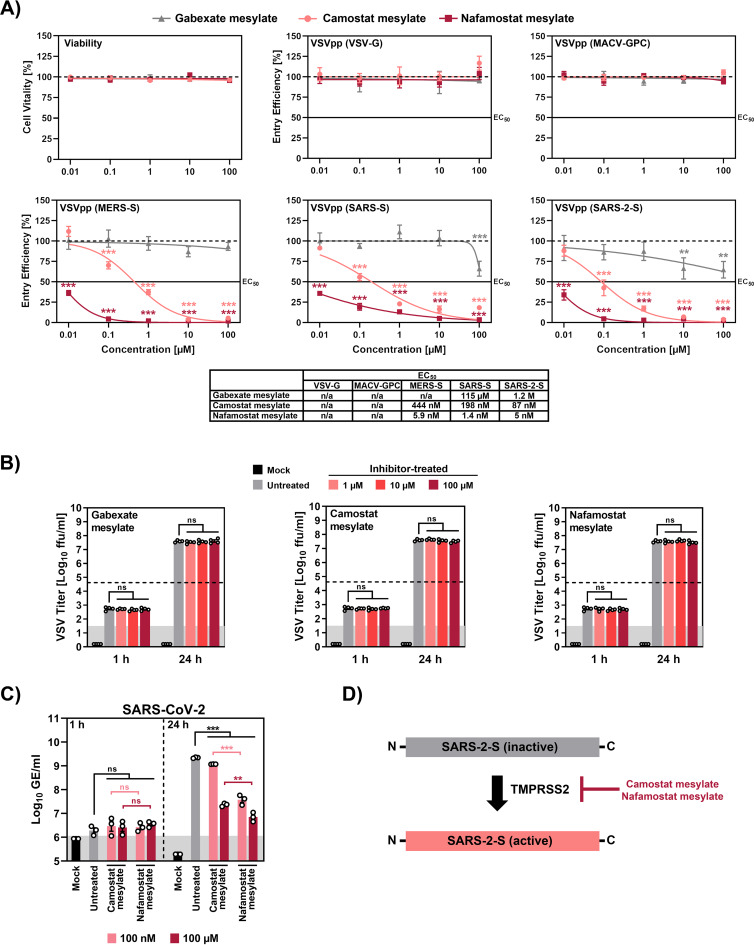
Nafamostat mesylate inhibits SARS-CoV-2 infection of lung cells in the nanomolar range. The lung-derived human cell line Calu-3 was incubated with the indicated concentrations of the indicated serine protease inhibitors, and (A) either cell viability was measured or the cells were inoculated with vesicular stomatitis virus reporter particles pseudotyped with the indicated viral glycoproteins. The efficiency of viral entry was determined at 16 h postinoculation by measuring luciferase activity in cell lysates. The 50% effective dose values are indicated below the graphs. In parallel, cells exposed to serine protease inhibitors were infected with replication-competent vesicular stomatitis virus encoding green fluorescent protein (B) or infected with SARS-CoV-2 (C), and infection efficiency was quantified by focus formation assay and by measuring genome copies via quantitative RT-PCR, respectively. A scheme of how camostat and nafamostat mesylate block activation of SARS-2-S is shown in panel D. The average from three independent experiments is shown in panels A and C while the average from four independent experiments is presented in panel B. For panels A to C, statistical significance was tested by two-way analysis of variance with Dunnett’s posttest. In addition, statistical significance of differences between SARS-CoV-2 genome equivalents at identical concentrations of camostat or nafamostat mesylate was tested by one-way analysis of variance with Sidak’s posttest. Abbreviations: VSV-G, vesicular stomatitis virus glycoprotein, MACV-GPC, Machupo virus glycoprotein complex; MERS-S, Middle East respiratory syndrome coronavirus spike glycoprotein; SARS-S, severe acute respiratory syndrome coronavirus spike glycoprotein; SARS-2-S, severe acute respiratory syndrome coronavirus 2 spike glycoprotein.
Comment on
-
SARS-CoV-2 Cell Entry Depends on ACE2 and TMPRSS2 and Is Blocked by a Clinically Proven Protease Inhibitor.Cell. 2020 Apr 16;181(2):271-280.e8. doi: 10.1016/j.cell.2020.02.052. Epub 2020 Mar 5. Cell. 2020. PMID: 32142651 Free PMC article.
References
-
- Hoffmann M, Kleine-Weber H, Schroeder S, Krüger N, Herrler T, Erichsen S, Schiergens TS, Herrler G, Wu N-H, Nitsche A, Müller MA, Drosten C, Pöhlmann S. 2020. SARS-CoV-2 cell entry depends on ACE2 and TMPRSS2 and is blocked by a clinically proven protease inhibitor. Cell 181:271–280.e8. doi: 10.1016/j.cell.2020.02.052. - DOI - PMC - PubMed
-
- Glowacka I, Bertram S, Müller MA, Allen P, Soilleux E, Pfefferle S, Steffen I, Tsegaye TS, He Y, Gnirss K, Niemeyer D, Schneider H, Drosten C, Pöhlmann S. 2011. Evidence that TMPRSS2 activates the severe acute respiratory syndrome coronavirus spike protein for membrane fusion and reduces viral control by the humoral immune response. J Virol 85:4122–4134. doi: 10.1128/JVI.02232-10. - DOI - PMC - PubMed
Publication types
MeSH terms
Substances
LinkOut - more resources
Full Text Sources
Other Literature Sources
Medical
Miscellaneous
