Review
. 2020 Jun;34(6):1512-1523.
doi: 10.1038/s41375-020-0827-8. Epub 2020 Apr 20.

The Nlrp3 inflammasome as a "rising star" in studies of normal and malignant hematopoiesis

Affiliations
Review

The Nlrp3 inflammasome as a "rising star" in studies of normal and malignant hematopoiesis

Mariusz Z Ratajczak et al. Leukemia. 2020 Jun.

Abstract

Recent investigations indicate that hematopoiesis is coregulated by innate immunity signals and by pathways characteristic of the activation of innate immunity cells that also operate in normal hematopoietic stem progenitor cells (HSPCs). This should not be surprising because of the common developmental origin of these cells from a hemato/lymphopoietic stem cell. An important integrating factor is the Nlrp3 inflammasome, which has emerged as a major sensor of changes in body microenvironments, cell activation, and cell metabolic activity. It is currently the best-studied member of the inflammasome family expressed in hematopoietic and lymphopoietic cells, including also HSPCs. It is proposed as playing a role in (i) the development and expansion of HSPCs, (ii) their release from bone marrow (BM) into peripheral blood (PB) in stress situations and during pharmacological mobilization, (iii) their homing to BM after transplantation, and (iv) their aging and the regulation of hematopoietic cell metabolism. The Nlrp3 inflammasome is also involved in certain hematological pathologies, including (i) myelodysplastic syndrome, (ii) myeloproliferative neoplasms, (iii) leukemia, and (iv) graft-versus-host disease (GvHD) after transplantation. The aim of this review is to shed more light on this intriguing intracellular protein complex that has become a "rising star" in studies focused on both normal steady-state and pathological hematopoiesis.


Conflict of interest statement

The authors declare that they have no conflict of interest.

Figures
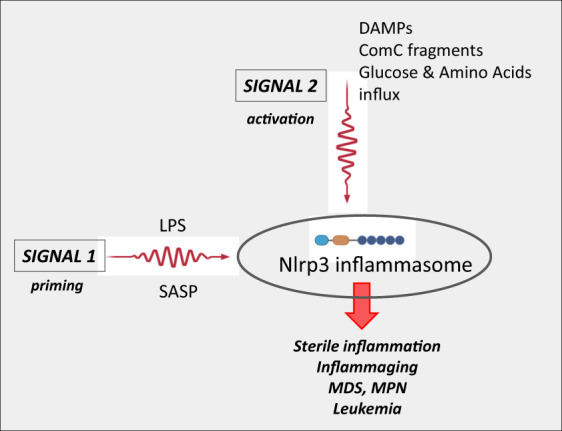
Fig. 1
Fig. 1. Priming and activation of Nlrp3 inflammasome by “Signal 1” and “Signal 2,” respectively.
The important priming factors that deliver “Signal 1” are (i) intestinal bacteria-derived liposaccharide (LPS) and (ii) senescence-associated secretory phenotype (SASP) cytokines such as TNF-α and IL-6. “Signal 2” that activates Nlrp3 inflammasome is delivered by danger-associated molecular pattern molecules (DAMPs) or alarmines including eATP, HMGB1, S100A8/A9, uric acid crystals, extracellular DNA and mRNA complexes, ComC cleavage fragments (C3a, C5a, C5b–C9) and glucose/amino acid influx. In response to these signals Nlrp3 inflammasome mediates sterile inflammation in hematopoietic tissues and inflammaging that may promote myelodysplasia (MDS), myeloproliferative neoplasms (MPN), and leukemia.
Fig. 2
Fig. 2. Expression of Nlrp3 complex mRNAs in HSPCs.
The expression of inflammasome genes was detected in purified mRNA in human CD34+ and CD34+linCD45+ cells by reverse transcription polymerase chain reaction (RT-PCR). Samples containing only water instead of cDNA and samples without reverse transcriptase were used in each run as negative controls. Representative agarose gels of the RT-PCR amplicons are shown.
Fig. 3
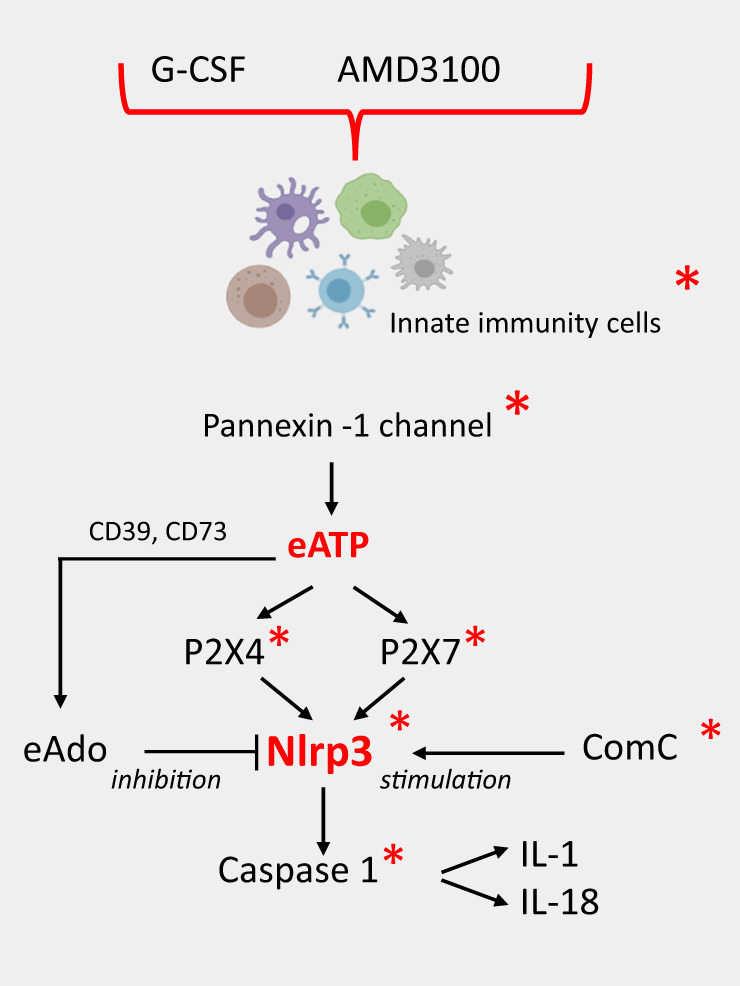
Fig. 3. The purinergic signaling–Nlrp3 inflammasome–ComC network in the mobilization of HSPCs.
Promobilizing agents stimulate the release of eATP from innate immunity cells (granulocytes, monocytes, and dendritic cells) in a pannexin-1-channel-dependent manner. eATP activates the Nlrp3 inflammasome in these cells via the P2X4 and P2X7 receptors in an autocrine/paracrine manner, which subsequently activates caspase-1 to release active IL-1β and IL-18. Autocrine/paracrine stimulation of innate immunity cells by both of these cytokines leads to release of several other DAMPs and activation of the ComC. As we propose, IL-1β and IL-18 form an endogenous positive feedback promobilization “machinery” in HSPCs. Red asterisks indicate elements whose attenuation results in poor mobilization in our recently published or preliminary results. This process is negatively regulated by the anti-inflammatory action of eATP metabolite extracellular adenosine (eAdo) that activates heme oxygenase 1 (HO-1) that inhibits Nlrp3 inflammasome. The metabolism of eATP to Ado is mediated by the cell-surface ectonucleotidases CD39 and CD73.
Fig. 4
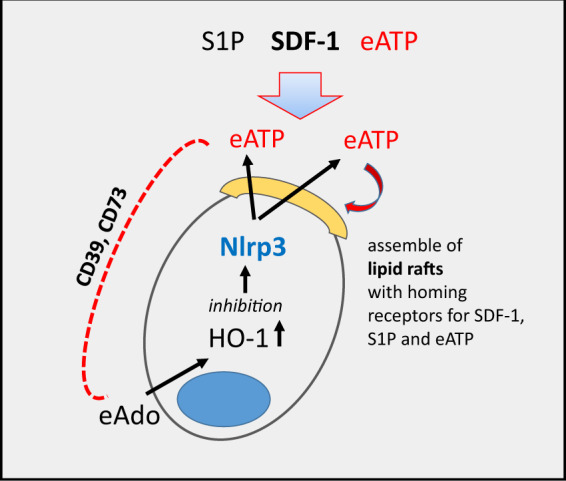
Fig. 4. The role of eATP in the homing and engraftment of HSPCs.
eATP plays a dual role in the homing of HSPCs to BM. On the one hand, eATP, whether autocrine-secreted from transplanted HSPCs or secreted in response to conditioning for transplantation from cells in the BM microenvironment, promotes formation of membrane lipid rafts (yellow cap), which assemble major chemoattractant receptors for HSPCs (SDF-1, S1P and eATP). Mobilization and homing of HSPCs are negatively controlled by the eATP metabolite eAdo due to upregulation of intracellular HO-1, which is an Nlrp3 inflammasome inhibitor. The metabolism of eATP to eAdo is mediated by the cell-surface ectonucleotidases CD39 and CD73.
Fig. 5
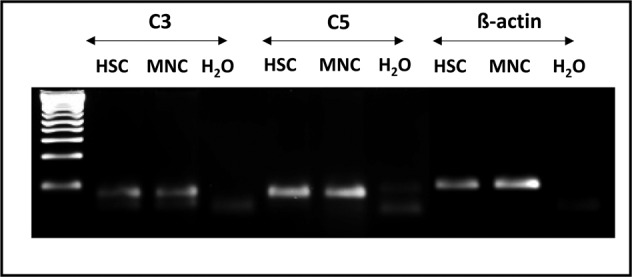
Fig. 5. Expression of C3 and C5 mRNA in HSPCs.
The expression of mRNA for the C3 and C5 genes was detected in purified mRNA in human CD34+ cells by reverse transcription polymerase chain reaction (RT-PCR). Samples containing only water instead of cDNA and samples without reverse transcriptase were used in each run as negative controls. Representative agarose gels of the RT-PCR amplicons are shown. Based on this, the potential role of the complosome in the biology of HSPCs requires further study.

References

    1. Franchi L, Munoz-Planillo R, Nunez G. Sensing and reacting to microbes through the inflammasomes. Nat Immunol. 2012;13:325–32. - PMC - PubMed
    1. Place DE, Kanneganti TD. Recent advances in inflammasome biology. Curr Opin Immunol. 2018;50:32–8. - PMC - PubMed
    1. Groslambert M, Py BF. Spotlight on the NLRP3 inflammasome pathway. J Inflamm Res. 2018;11:359–74. - PMC - PubMed
    1. He Y, Hara H, Nunez G. Mechanism and regulation of NLRP3 inflammasome activation. Trends Biochem Sci. 2016;41:1012–21. - PMC - PubMed
    1. Ting JP, Lovering RC, Alnemri ES, Bertin J, Boss JM, Davis BK, et al. The NLR gene family: a standard nomenclature. Immunity. 2008;28:285–7. - PMC - PubMed

Publication types

MeSH terms

Substances