


An Epidemiological Study on COVID-19: A Rapidly Spreading Disease
- PMID: 32313754
- PMCID: PMC7164711
- DOI: 10.7759/cureus.7313
An Epidemiological Study on COVID-19: A Rapidly Spreading Disease
Abstract
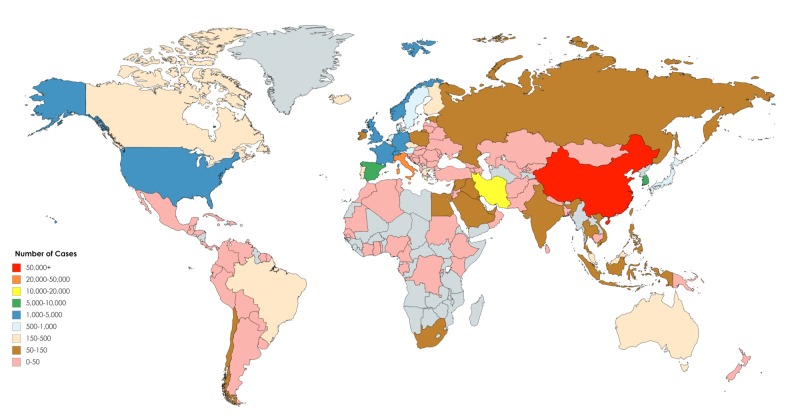
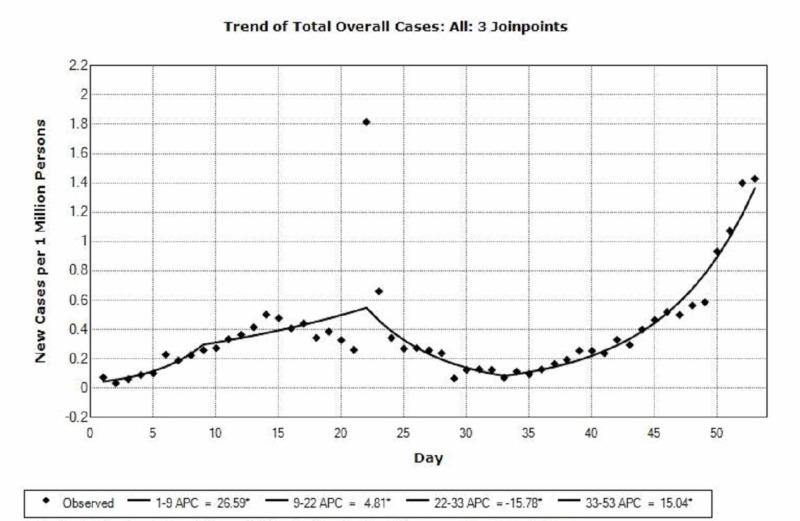
Background The outbreak of the novel coronavirus disease in 2019 (COVID-19) caused a major public health crisis worldwide and challenged healthcare systems across the six continents. The high infectivity of the disease led many governments to adopt strict regulations and measures with the aim of containing its spread. The purpose of this study is to assess the incidence, severity, and territorial expansion of COVID-19. Methods Data from the World Health Organization was screened, and COVID-19 situation reports were extracted from January 21 up till March 14 (inclusive). Our data included the total number of cases, total number of new cases, total number of cured cases, and total number of related deaths. Percentage change of cases over the days of our study were calculated using the Joinpoint regression, with a significance level set at greater than 0.05. Results The total number of COVID-19 cases reached 156,622, with 5,845 subsequent deaths. China, Italy, and Iran have the highest number of cases worldwide. During the first 22 days, the incidence rate of COVID-19 increased significantly to reach 1.81 cases per million persons (p<0.001). That was followed by a significant decrease over the next 11 days (p<0.001) to reach 0.071 cases per million persons. A steady rise then followed, which saw a significant increase in incidence rate to 1.429 cases per million persons (p<0.001). Percentages of death and cured cases varied across the different countries; nevertheless, death percentages have generally been decreasing since the start of the crisis. Conclusion Adopting precautionary regulations such as social isolation, increasing sanitation, and employing strict quarantine measures have proved to be beneficial in containing the virus. Further research needs to be conducted to help discover therapeutic modalities and improve outcomes.
Keywords: coronavirus; covid-19; epidemiology; infectious disease; novel coronavirus.
Copyright © 2020, Khachfe et al.
Conflict of interest statement
The authors have declared that no competing interests exist.
Figures


References
-
- An Invited Commentary on “World Health Organization declares global emergency: A review of the 2019 novel Coronavirus (COVID- 19)": Emergency or new reality? Purcell LN, Charles AG. https://doi.org/10.1016/j.ijsu.2020.03.002. Int J Surg. 2020;76:111. - PMC - PubMed
LinkOut - more resources
Full Text Sources
Other Literature Sources