. 2021 Jan;50(1):49-59.
doi: 10.1007/s13280-020-01333-9. Epub 2020 Apr 20.

Why bees are critical for achieving sustainable development

Affiliations

Why bees are critical for achieving sustainable development

Vidushi Patel et al. Ambio. 2021 Jan.

Abstract

Reductions in global bee populations are threatening the pollination benefits to both the planet and people. Whilst the contribution of bee pollination in promoting sustainable development goals through food security and biodiversity is widely acknowledged, a range of other benefits provided by bees has yet to be fully recognised. We explore the contributions of bees towards achieving the United Nation's Sustainable Development Goals (SDGs). Our insights suggest that bees potentially contribute towards 15 of the 17 SDGs and a minimum of 30 SDG targets. We identify common themes in which bees play an essential role, and suggest that improved understanding of bee contributions to sustainable development is crucial for ensuring viable bee systems.

Keywords: Bees; Biodiversity; Complex systems; Human–environment interactions; Pollination; Sustainable Development Goals.


Figures
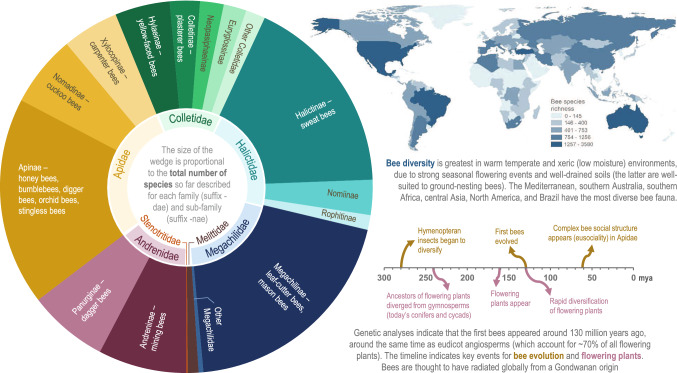
Fig. 1
Fig. 1
A snapshot of the diversity of bees. Bees are taxonomically classified under the insect Order Hymenoptera, along with ants, wasps and sawflies, and are part of the superfamily Apoidea, and clade Anthophila, with seven recognised families. Although only 50 of the ~ 20 000 described bee species are actively managed by people, the entire clade is important for ecosystem functioning and human well-being. Bees and flowering plants have co-evolved, making bees effective pollinators of a large proportion of flowering plant species. There are perhaps a further ~ 5 000 bee species that are yet to be described. Data source: Ascher and Pickering (2014). Information for this figure was sourced from Michener ; Michener ; Michez and Patiny ; Litman et al. ; Cappellari et al. ; Peters et al. ; Meiners et al.
Fig. 2
Fig. 2
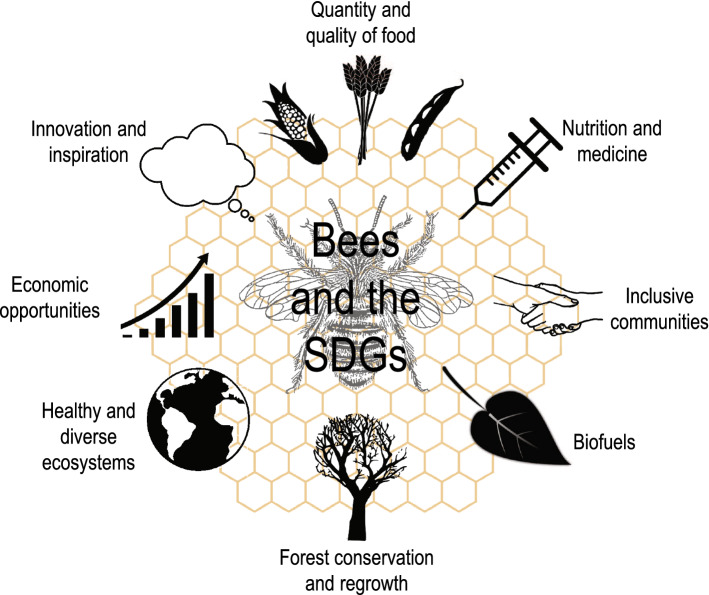
Bees and the SDGs. Overarching themes whereby bees contribute to sustainable development targets

References

    1. Aizen MA, Harder LD. The global stock of domesticated honey bees is growing slower than agricultural demand for pollination. Current Biology. 2009;19:915–918. - PubMed
    1. Aizen MA, Aguiar S, Biesmeijer JC, Garibaldi LA, Inouye DW, Jung C, Martins DJ, Medel R, et al. Global agricultural productivity is threatened by increasing pollinator dependence without a parallel increase in crop diversification. Global Change Biology. 2019;25:3516–3527. - PMC - PubMed
    1. Alger SA, Burnham PA, Boncristiani HF, Brody AK. RNA virus spillover from managed honeybees (Apis mellifera) to wild bumblebees (Bombus spp.) PLoS ONE. 2019;14:e0217822. - PMC - PubMed
    1. Amjad Khan W, Chun-Mei H, Khan N, Iqbal A, Lyu S-W, Shah F. Bioengineered plants can be a useful source of omega-3 fatty acids. BioMed Research International. 2017;2017:7348919–7348919. - PMC - PubMed
    1. Amulen DR, Dhaese M, D’haene E, Acai JO, Agea JG, Smagghe G, Cross P. Estimating the potential of beekeeping to alleviate household poverty in rural Uganda. PLoS ONE. 2019;14:e0214113. - PMC - PubMed

LinkOut - more resources