


Benefits of Teledermatology for Geriatric Patients: Population-Based Cross-Sectional Study
- PMID: 32314966
- PMCID: PMC7201316
- DOI: 10.2196/16700
Benefits of Teledermatology for Geriatric Patients: Population-Based Cross-Sectional Study
Abstract
Background: Teledermatology is a health care tool that has been increasingly used around the world, mostly because dermatology has an emphasis on visual diagnosis. Many studies have shown that access to specialized care improves using teledermatology, which provides accurate diagnosis and reduces the time taken for treatment, with high patient satisfaction. As the population around the world grows old, there will be even more demand for dermatologists in years to come. It is essential to know which are the most prevalent skin conditions in the primary care population and if they can be addressed through teledermatology.
Objective: Our main goal was to evaluate the proportion of lesions in individuals aged 60 years and older that could be managed using teledermatology in conjunction with primary care physicians. Second, we aimed to assess the most frequent skin lesions, the most common treatments provided to patients, and the distribution and causes of referrals made by the teledermatologists.
Methods: This was a retrospective cohort study from July 2017 to July 2018 in São Paulo, Brazil. We included 6633 individuals aged 60 years and older who presented with 12,770 skin lesions. Teledermatologists had three options to refer patients: (1) to undergo biopsy directly, (2) to an in-person dermatologist visit, and (3) back to the primary care physician with the most probable diagnosis and treatment.
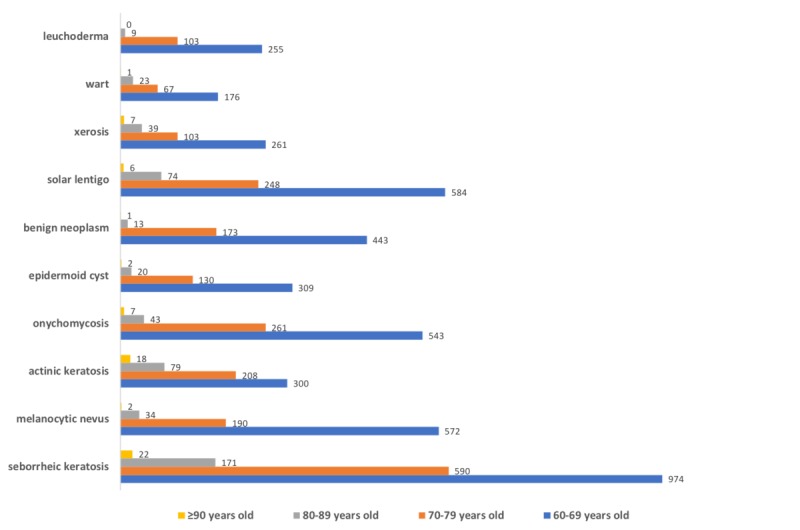
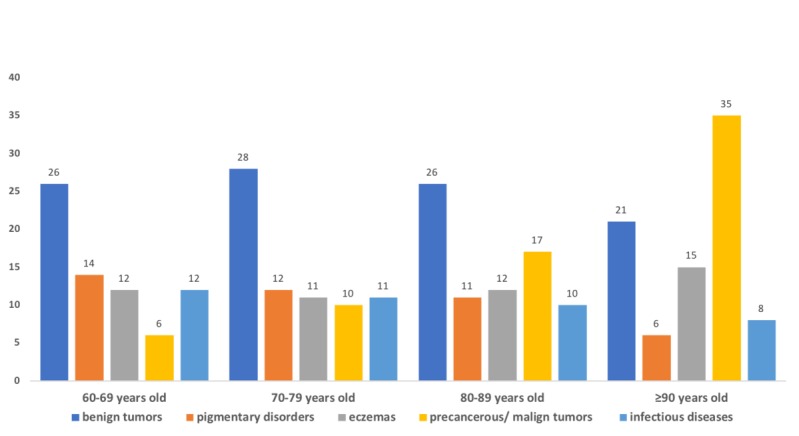
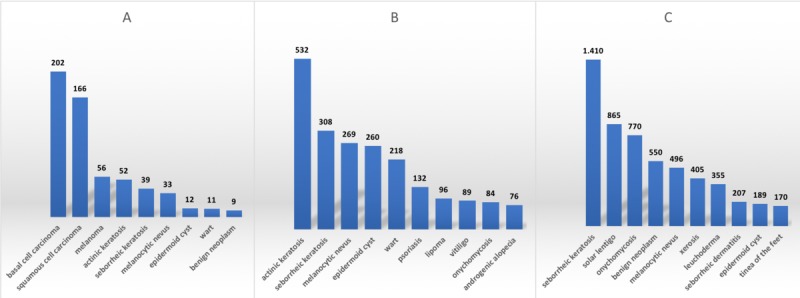
Results: Teledermatology managed 66.66% (8408/12614) of dermatoses with the primary care physician without the need for an in-presence visit; 27.10% (3419/12614) were referred to dermatologists, and 6.24% (787/12614) directly to biopsy. The most frequent diseases were seborrheic keratosis, solar lentigo, onychomycosis, melanocytic nevus, benign neoplasms, actinic keratosis, epidermoid cyst, xerosis, leucoderma, and wart, with significant differences between sexes. Malignant tumors increased with age and were the leading cause for biopsies, while infectious skin conditions and pigmentary disorders decreased. Emollient was the most frequent treatment prescribed, in 31.88% (909/2856) of the cases.
Conclusions: Teledermatology helped to treat 67% of the dermatoses of older individuals, addressing cases of minor complexity quickly and conveniently together with the primary care physician, thus optimizing dermatological appointments for the most severe, surgical, or complex diseases. Teledermatology does not aim to replace a face-to-face visit with the dermatologist; however, it might help to democratize dermatological treatment access for patients and decrease health care expenses.
Keywords: access to and use of services; decision making; economics; epidemiology; geriatric population; health care systems and management (telehealth); management; technology; teledermatology.
©Mara G Bianchi, Andre Santos, Eduardo Cordioli. Originally published in the Journal of Medical Internet Research (http://www.jmir.org), 21.04.2020.
Conflict of interest statement
Conflicts of Interest: None declared.
Figures
References
-
- O'Connor DM, Jew OS, Perman MJ, Castelo-Soccio LA, Winston FK, McMahon PJ. Diagnostic accuracy of pediatric teledermatology using parent-submitted photographs: a randomized clinical trial. JAMA Dermatol. 2017 Dec 01;153(12):1243–1248. doi: 10.1001/jamadermatol.2017.4280. http://europepmc.org/abstract/MED/29141082 - DOI - PMC - PubMed
-
- Instituto Brasileiro de Geografia e Estatística. [2019-02-02]. Panorama São Paulo https://cidades.ibge.gov.br/brasil/sp/sao-paulo/panorama.
-
- Rede Brasil Atual. [2019-02-02]. No estado de São Paulo, 25 milhões de pacientes dependem do SUS https://tinyurl.com/wvj5hpt.
MeSH terms
LinkOut - more resources
Full Text Sources
Medical
Research Materials
