


Participant and Caregiver Perspectives on Clinical Research During Covid-19 Pandemic
- PMID: 32315076
- PMCID: PMC7264630
- DOI: 10.1111/jgs.16500
Participant and Caregiver Perspectives on Clinical Research During Covid-19 Pandemic
Abstract
Background/objectives: The COVID-19 pandemic has massively disrupted essential clinical research. Many regulatory organizations have rightfully advocated to temporarily halt enrollment and curtail all face-to-face interactions. Views and opinions of patients and their caregivers are seldom considered while making such decisions. The objective was to study older participants' and their caregivers' perspectives to participate in ongoing clinical research during the COVID-19 pandemic.
Design: Cross-sectional.
Setting: VISN-16/Geriatric Research, Education and Clinical Center (GRECC), Department of Veterans Affairs.
Participants: Older participants and their caregivers (N = 51) enrolled in ongoing clinical research studies.
Measurements: Questions about perceptions of safety to attend research visit, the level of panic among the general public, and medical center's preparedness in handling the pandemic. Other questions identified the source of pandemic information and the preference of a phone or in-person visit.
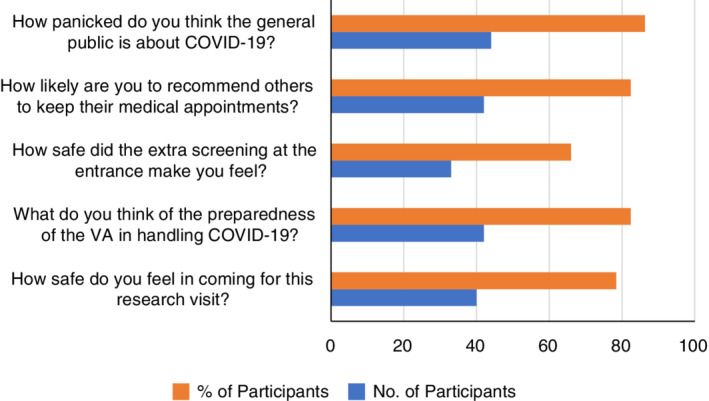
Results: Mean age was 69.3 (±9.4) years, 53% were male, 39% were caregivers, and 65% were Caucasian. Majority (78%) of the participants felt safe/very safe attending the scheduled research appointment; 63% felt that the extra screening made them feel safe/very safe; 82% felt that the medical center was prepared/very prepared for the pandemic. Participants split evenly on their preference for phone versus in-person visits. Family members and television news media were the commonly used sources of pandemic information irrespective of their education. Perceptions were influenced by gender and source of information, not by age or education. Females perceived higher level of panic compared to males (P = .02). Those relying on news media felt safer compared to those that relied on family members (P = .008).
Conclusion: Even though informants felt that the medical center was prepared to handle the pandemic, only half the participants preferred the in-person visit. Pandemic information was obtained from family members or the television news media. Knowing patients' perspectives may help researchers be better prepared for future pandemics. J Am Geriatr Soc 68:E14-E18, 2020.
Keywords: COVID-19; pandemic; patient perspectives.
Published 2020. This article is a U.S. Government work and is in the public domain in the USA.
Conflict of interest statement
There are no financial conflicts of interest or personal conflict of interest relevant to the submitted manuscript for any authors.
Figures
References
-
- Center for Disease Control and Prevention. COVID19. 2020. https://www.cdc.gov/coronavirus/2019-ncov/index.html. Accessed March 17, 2020.
-
- National Institutes of Health. COVID19 guidance. 2020. https://grants.nih.gov/grants/natural_disasters/corona-virus.htm. Accessed March 17, 2020.
MeSH terms
Grants and funding
LinkOut - more resources
Full Text Sources
Medical
