Review
. 2020 Apr 17;21(8):2802.
doi: 10.3390/ijms21082802.

Clinical Spectrum of KCNA1 Mutations: New Insights into Episodic Ataxia and Epilepsy Comorbidity

Affiliations
Review

Clinical Spectrum of KCNA1 Mutations: New Insights into Episodic Ataxia and Epilepsy Comorbidity

Kelsey Paulhus et al. Int J Mol Sci. .

Abstract

Mutations in the KCNA1 gene, which encodes voltage-gated Kv1.1 potassium channel α-subunits, cause a variety of human diseases, complicating simple genotype-phenotype correlations in patients. KCNA1 mutations are primarily associated with a rare neurological movement disorder known as episodic ataxia type 1 (EA1). However, some patients have EA1 in combination with epilepsy, whereas others have epilepsy alone. KCNA1 mutations can also cause hypomagnesemia and paroxysmal dyskinesia in rare cases. Why KCNA1 variants are associated with such phenotypic heterogeneity in patients is not yet understood. In this review, literature databases (PubMed) and public genetic archives (dbSNP and ClinVar) were mined for known pathogenic or likely pathogenic mutations in KCNA1 to examine whether patterns exist between mutation type and disease manifestation. Analyses of the 47 deleterious KCNA1 mutations that were identified revealed that epilepsy or seizure-related variants tend to cluster in the S1/S2 transmembrane domains and in the pore region of Kv1.1, whereas EA1-associated variants occur along the whole length of the protein. In addition, insights from animal models of KCNA1 channelopathy were considered, as well as the possible influence of genetic modifiers on disease expressivity and severity. Elucidation of the complex relationship between KCNA1 variants and disease will enable better diagnostic risk assessment and more personalized therapeutic strategies for KCNA1 channelopathy.

Keywords: KCNA1; Kv1.1; epilepsy; episodic ataxia.


Conflict of interest statement

The authors declare no conflict of interest.

Figures
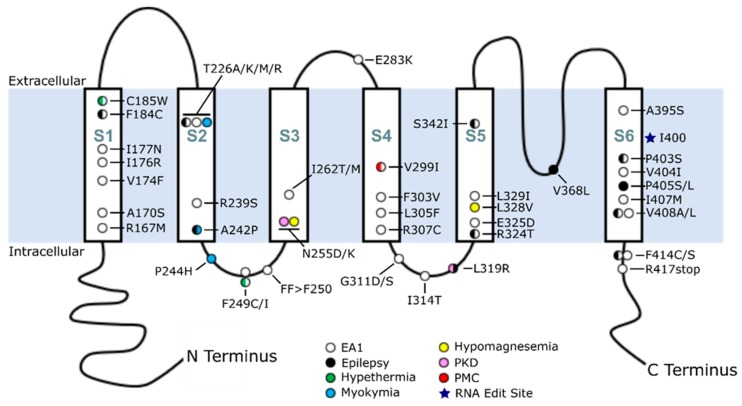
Figure 1
Figure 1
Map of KCNA1 mutations associated with human disease. Human mutations in KCNA1 were mapped across the protein and color-coded to indicate their clinically documented disease association. Circles with two colors represent mutations with multiple phenotypes. Multiple circles at a given amino acid position represent multiple diseases caused by different amino acid changes at the same position (e.g., N255D/K). Abbreviations: PMC, paradoxical myotonic congenita; PKD, paroxysmal kinesigenic dyskinesia.
Figure 2
Figure 2
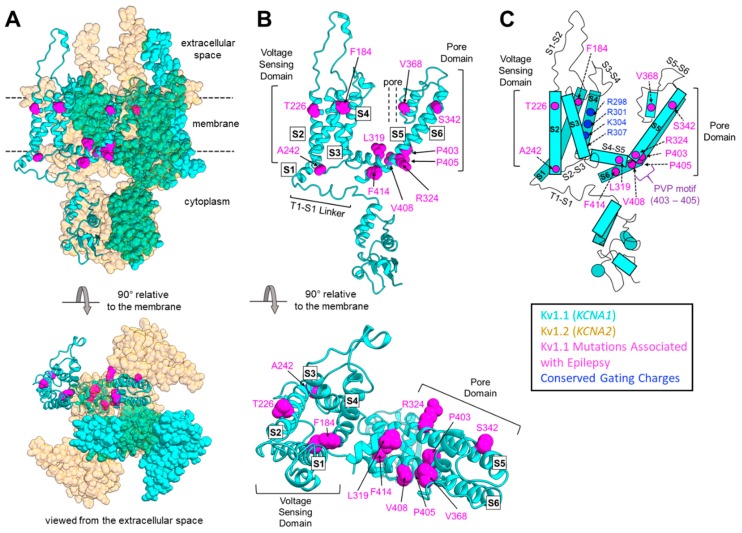
Modeling KCNA1 mutations associated with epilepsy. (A) Model of a Kv1.1–Kv1.2 heterotetramer built using a homology model of human Kv1.1 (blue) and human Kv1.2 (orange), which were made with SWISS-MODEL [92] using the crystal structure of rat Kv1.2 (RCSB PDB: 3LUT) [74]. Human Kv1.1 and Kv1.2 share 80% and 99.4% sequence identity with rat Kv1.2, respectively. One Kv1.1 subunit is shown in ribbons, with epilepsy-associated mutations shown in van der Waals (vdW) representation colored magenta, and other subunits shown in vdW representation. (B) Homology model of a single Kv1.1 subunit with epilepsy-associated mutations shown in magenta in vdW representation. (C) Two-dimensional representation of a human Kv1.1 subunit. Magenta circles represent mutations associated with epilepsy; blue circles are conserved gating charges in the voltage-sensing domain. The highly conserved PVP motif is noted in purple.

References

    1. Choi K.-D., Choi J.-H. Episodic Ataxias: Clinical and Genetic Features. J. Mov. Disord. 2016;9:129–135. doi: 10.14802/jmd.16028. - DOI - PMC - PubMed
    1. Zhang X.J., Xu Z., Wu Y., Tan E.-K. Paroxysmal movement disorders: Recent advances and proposal of a classification system. Park. Relat. Disord. 2019;59:131–139. doi: 10.1016/j.parkreldis.2019.02.021. - DOI - PubMed
    1. Méneret A., Roze E. Paroxysmal movement disorders: An update. Mov. Disord. 2016;172:433–445. doi: 10.1016/j.neurol.2016.07.005. - DOI - PubMed
    1. Sanger T.D., Delgado M.R., Gaebler-Spira D., Hallett M., Mink J.W. Classification and Definition of Disorders Causing Hypertonia in Childhood. Pediatrics. 2003;111:e89–e97. doi: 10.1542/peds.111.1.e89. - DOI - PubMed
    1. Damak M., Riant F., Boukobza M., Tournier-Lasserve E., Bousser M.G., Vahedi K. Late onset hereditary episodic ataxia. J. Neurol. Neurosurg. Psychiatry. 2009;80:566–568. doi: 10.1136/jnnp.2008.150615. - DOI - PubMed

Substances

Supplementary concepts