AKI!Now Initiative: Recommendations for Awareness, Recognition, and Management of AKI
- PMID: 32317329
- PMCID: PMC7769012
- DOI: 10.2215/CJN.15611219
AKI!Now Initiative: Recommendations for Awareness, Recognition, and Management of AKI
Abstract
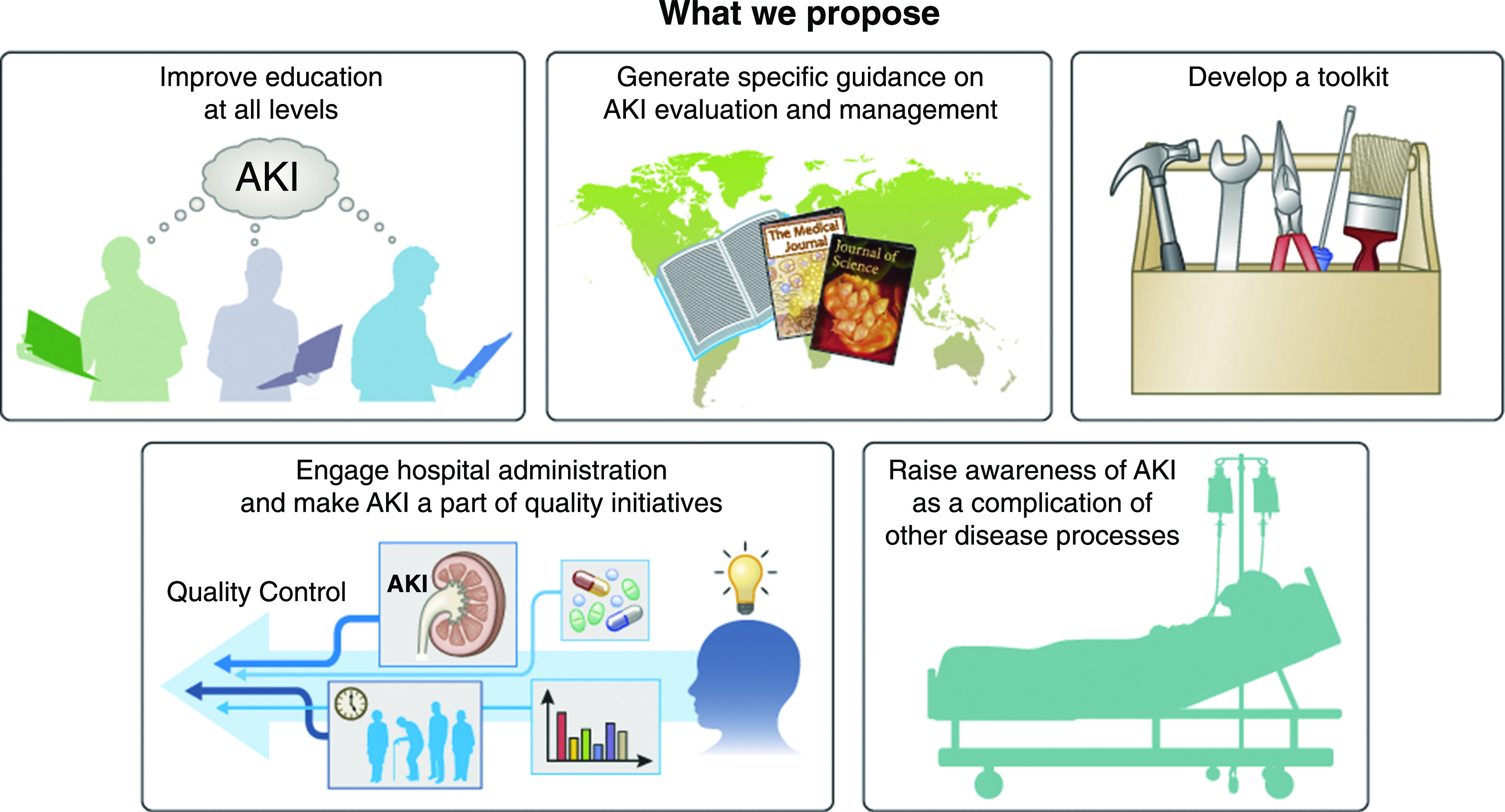
The American Society of Nephrology has established a new initiative, AKI!Now, with the goal of promoting excellence in the prevention and treatment of AKI by building a foundational program that transforms education and delivery of AKI care, aiming to reduce morbidity and associated mortality and to improve long-term outcomes. In this article, we describe our current efforts to improve early recognition and management involving inclusive interdisciplinary collaboration between providers, patients, and their families; discuss the ongoing need to change some of our current AKI paradigms and diagnostic methods; and provide specific recommendations to improve AKI recognition and care. In the hospital and the community, AKI is a common and increasingly frequent condition that generates risks of adverse events and high costs. Unfortunately, patients with AKI may frequently have received less than optimal quality of care. New classifications have facilitated understanding of AKI incidence and its impact on outcomes, but they are not always well aligned with AKI pathophysiology. Despite ongoing research efforts, treatments to promote or hasten kidney recovery remain ineffective. To avoid progression, the current approach to AKI emphasizes the promotion of early recognition and timely response. However, a lack of awareness of the importance of early recognition and treatment among health care team members and the heterogeneity of approaches within the health care teams assessing the patient remains a major challenge. Early identification is further complicated by differences in settings where AKI occurs (the community or the hospital), and by differences in patient populations and cultures between the intensive care unit and ward environments. To address these obstacles, we discuss the need to improve education at all levels of care and to generate specific guidance on AKI evaluation and management, including the development of a widely applicable education and an AKI management toolkit, engaging hospital administrators to incorporate AKI as a quality initiative, and raising awareness of AKI as a complication of other disease processes.
Keywords: AKI awareness; AKI biomarkers; AKI multidisciplinary management; AKI pathology; AKI recognition; AKI urinalysis; acute kidney injury; artificial intelligence; critical care nephrology; electronic alerts; goals; hospital administrators; incidence; intensive care units; kidney; longitudinal studies; morbidity; patient care team; quality of health care.
Copyright © 2020 by the American Society of Nephrology.
Figures
References
-
- Hoste EAJ, Kellum JA, Selby NM, Zarbock A, Palevsky PM, Bagshaw SM, Goldstein SL, Cerdá J, Chawla LS: Global epidemiology and outcomes of acute kidney injury. Nat Rev Nephrol 14: 607–625, 2018 - PubMed
-
- Mehta RL, Cerdá J, Burdmann EA, Tonelli M, García-García G, Jha V, Susantitaphong P, Rocco M, Vanholder R, Sever MS, Cruz D, Jaber B, Lameire NH, Lombardi R, Lewington A, Feehally J, Finkelstein F, Levin N, Pannu N, Thomas B, Aronoff-Spencer E, Remuzzi G: International society of nephrology’s 0by25 initiative for acute kidney injury (zero preventable deaths by 2025): A human rights case for nephrology. Lancet 385: 2616–2643, 2015 - PubMed
-
- Ostermann M, Cerdá J: The burden of acute kidney injury and related financial issues. Contrib Nephrol 193: 100–112, 2018 - PubMed
-
- Kellum JA, Lameire N, Aspelin P, Barsoum RS, Burdmann EA, Goldstein SL, Herzog CA, Joannidis M, Kribben A, Levey AS, MacLeod AM, Mehta RL, Murray PT, Naicker S, Opal SM, Schaefer F, Schetz M, Uchino S: Kidney Disease: Improving Global Outcomes (KDIGO) acute kidney injury work group. KDIGO clinical practice guideline for acute kidney injury. Kidney Int Suppl 2: 1–138, 2012
Publication types
MeSH terms
Grants and funding
LinkOut - more resources
Full Text Sources