


Efficacy of Wholetones® 2Sleep and classical music on sleep and health behaviors of adults with insomnia symptoms: A single blind, randomized, controlled, crossover pilot trial
- PMID: 32318252
- PMCID: PMC7159072
- DOI: 10.5935/1984-0063.20190091
Efficacy of Wholetones® 2Sleep and classical music on sleep and health behaviors of adults with insomnia symptoms: A single blind, randomized, controlled, crossover pilot trial
Abstract
Objectives: To conduct a randomized single-blind placebo-controlled crossover trial on adults with insomnia symptoms to examine the efficacy of Wholetones® 2Sleep Music (WM) and Classical Music (CM) on sleep quality, anxiety/stress, fatigue, productivity, and mood.
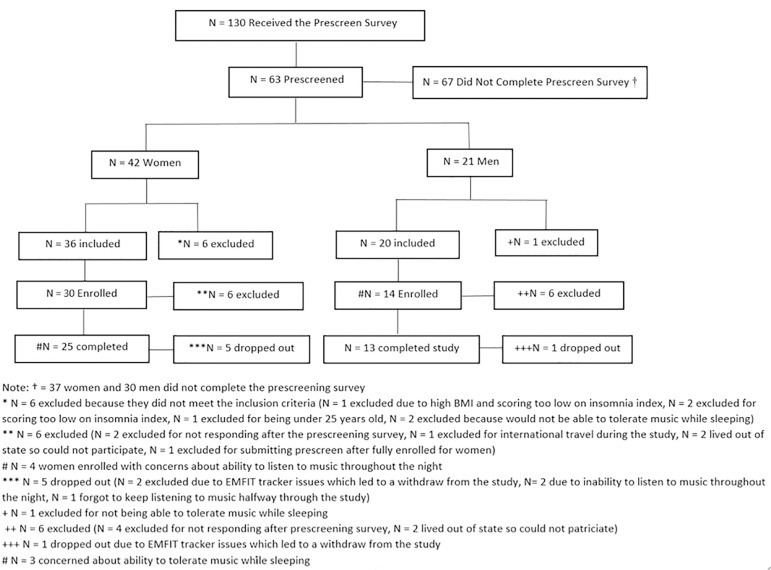
Methods: Following baseline assessments, 38 adults (M age = 46.6 years) were randomized to either WM or CM conditions for 10 days and then the alternative music for 10 days after a 4 day "wash-out". The outcomes were sleep quality (i.e., Pittsburgh Sleep Quality Index) and psychological measures.
Results: Listening to both the WM and CM resulted in significant improvements from baseline for sleep quality, stress/anxiety, fatigue, productivity, and mood (p<0.05).
Conclusion: WM and CM provides a simple, noninvasive, and non-pharmacological intervention to promote sleep quality resulting in improved daytime mood, fatigue, productivity, and anxiety/stress.
Keywords: Anxiety; Fatigue; Mood; Music; Sleep Disorders.
Figures
References
-
- American Psychiatric Association (APA) Diagnostic and statistical manual of mental disorders (DSM-5) 5th ed. Washington: APA; 2013.
-
- Taylor DJ, Lichstein KL, Durrence HH. Insomnia as a health risk factor. Behav Sleep Med. 2003;1(4):227–247. - PubMed
-
- Ancoli-Israel S, Roth T. Characteristics of insomnia in the United States: results of the 1991 National Sleep Foundation Survey. I. Sleep. 1999;22(Suppl 2):S347–S353. - PubMed
-
- Roth T, Coulouvrat C, Hajak G, Lakoma MD, Sampson NA, Shahly V, et al. Prevalence and perceived health associated with insomnia based on DSM-IV-TR; International Statistical Classification of Diseases and Related Health Problems, Tenth Revision; and Research Diagnostic Criteria/International Classification of Sleep Disorders, Second Edition criteria: results from the America Insomnia Survey. Biol Psychiatry. 2011;69(6):592–600. - PubMed
-
- de Niet G, Tiemens B, Lendemeijer B, Hutschemaekers G. Music-assisted relaxation to improve sleep quality: meta-analysis. J Adv Nurs. 2009;65(7):1356–1364. - PubMed
LinkOut - more resources
Full Text Sources