


Qualitative and quantitative analysis of bacterial aerosols in dental clinical settings: Risk exposure towards dentist, auxiliary staff, and patients
- PMID: 32318458
- PMCID: PMC7113934
- DOI: 10.4103/jfmpc.jfmpc_863_19
Qualitative and quantitative analysis of bacterial aerosols in dental clinical settings: Risk exposure towards dentist, auxiliary staff, and patients
Abstract
Introduction: Cross-infection or contamination are the major threats related to any medical profession. Microorganisms present in the dental clinic can cause cross-infection to the dentist, auxiliary staff and even towards the patients.
Aims: The study was conducted to assess the level of atmospheric microbial contamination and composition of aerosols before, during and after dental treatment procedures in four clinical settings.
Methods and materials: The present study was conducted over a two-week period in a private dental college setting. An equal number of culture medium plates (blood agar) were placed 30 min prior to the initiation of work sessions in the selected area and 1 h after the working session began and after 2 h of cessation of the working period. After the collection of samples, the culture medium plates were incubated aerobically at 37°C in an incubator for 48 h. The number of colonies was expressed as colonies per media plate. After counting the colonies bacterial cell morphology was determined by a microscopic examination using a Reichert-Jung Series 150 light microscope.
Statistical analysis: Statistical analysis such as ANOVA test for mean values and post hock was done using statistical package for social sciences (SPSS).
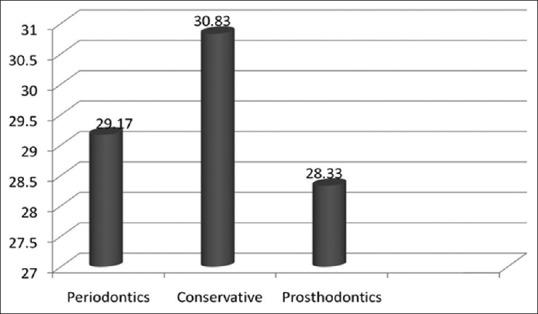
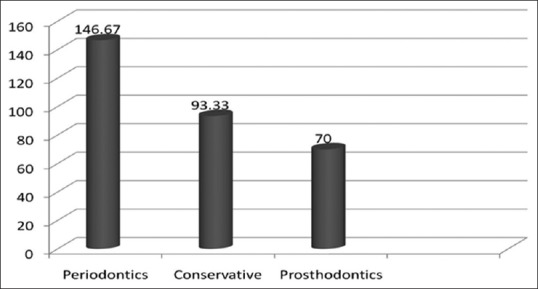
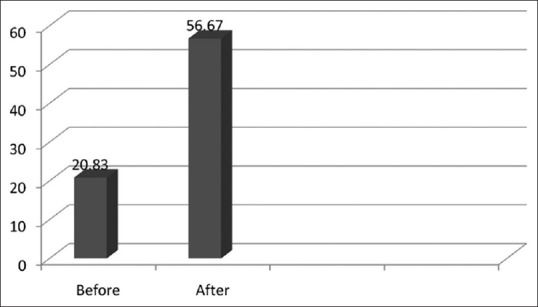
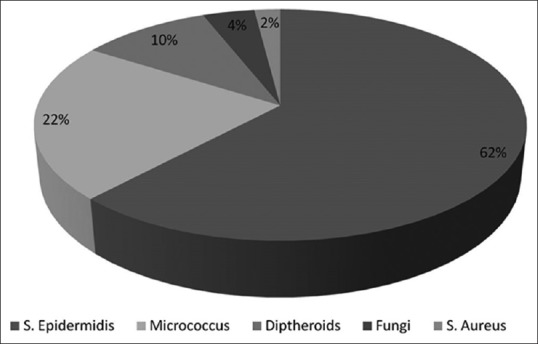
Results: It shows that colony count increased after the working session and which reduced by itself once the working session was concluded which was significant (P < 0.001). The highest increase in the mean colony count was found in the department of periodontology during the treatment sessions. In the blood agar plates, the S. epidermidis was found maximum 62%, micrococcus was 22%, diphtheroid was 10%, fungi 4% and the least S. aureus 2%.
Conclusion: This study demonstrates that aerosols increase during and after work sessions and, therefore, increases the chance for infectious agent transmission in clinical settings.
Keywords: Bacterial aerosols; clinical dentistry; cross-infection; microbial contamination.
Copyright: © Journal of Family Medicine and Primary Care.
Conflict of interest statement
There are no conflicts of interest.
Figures
References
-
- Mansour RA, Ali G, Mohammad RM, Negar FN. Airborn microbial contamination of dental units. Tanaffos. 2008;7:54–7.
-
- Merchant VA. Herpesvirus and other microorganisms of the concern to dentistry. Dent Clin North Am. 1991;35:283–98. - PubMed
-
- Al Maghlouth A, Al Yousef Y, Al Bagieh N. Qualitative and quantitat ive analysis of bacterial aerosols. J Contemp Dent Pract. 2004;4:91–100. - PubMed
-
- Lu DP, Zambito RF. Aerosols and cross infection in dental practice- A historic view. Gen Dent. 1981;29:136–42. - PubMed
LinkOut - more resources
Full Text Sources