


Cancer Ecology and Evolution: Positive interactions and system vulnerability
- PMID: 32318644
- PMCID: PMC7172748
- DOI: 10.1016/j.coisb.2019.09.001
Cancer Ecology and Evolution: Positive interactions and system vulnerability
Abstract
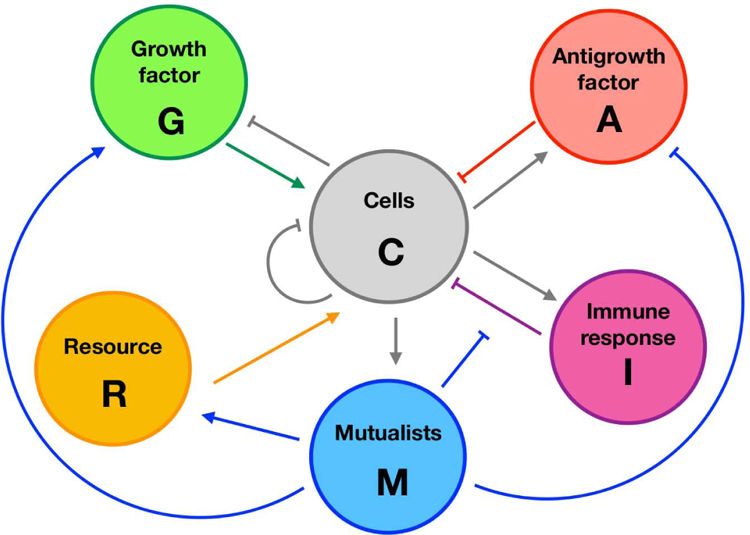
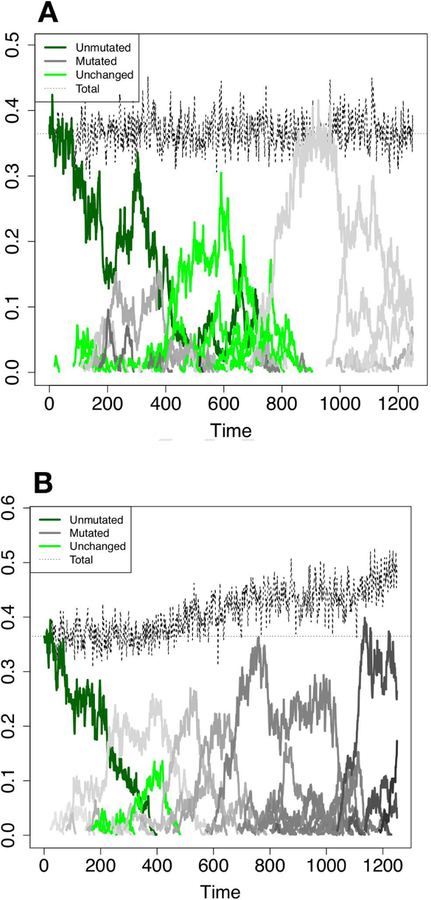
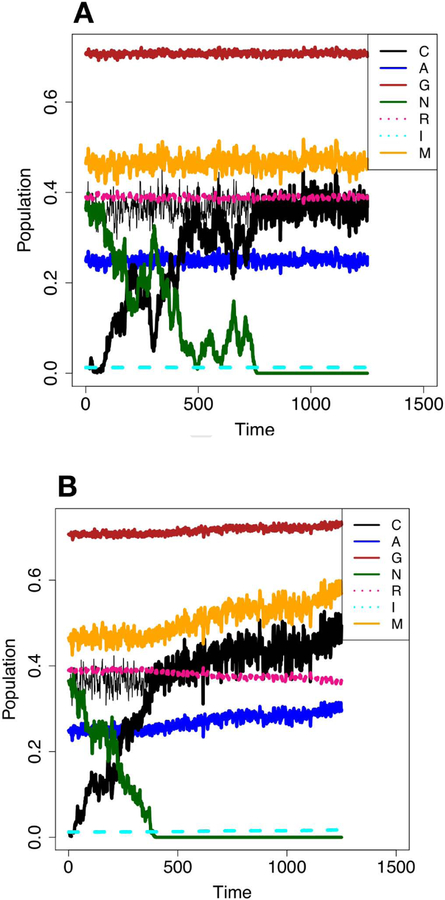
Parallels of cancer with ecology and evolution have provided new insights into the initiation and spread of cancer, and new approaches to therapy. This review describes those parallels while emphasizing some key contrasts. We argue that cancers are less like invasive species than like native species or even crops that have escaped control, and that ecological control and homeo-static control differ fundamentally through both their ends and their means. From our focus on the role of positive interactions in control processes, we introduce a novel mathematical modeling framework that tracks how individual cell lineages arise, and how the many layers of control break down in the emergence of cancer. The next generation of therapies must continue to look beyond cancers as being created by individual renegade cells and address not only the network of interactions those cells inhabit, but the evolutionary logic that created those interactions and their intrinsic vulnerability.
Keywords: cancer; ecology; evolution; invasive species; mathematical model.
Figures
References
-
- Anderson AR, Maini PK, Mathematical oncology, Bull. Math. Biol 80 (2018) 945–953 (2018). - PubMed
-
-
Crespi BJ, Summers K, Evolutionary biology of cancer, Trends Ecol. Evol 20 (2005) 545–552 (2005).
● Creative and influential insights into the evolution of cancer
-
-
- Tabassum DP, Polyak K, Tumorigenesis: it takes a village, Nat. Rev. Cancer 15 (2015) 473–483 (2015). - PubMed
-
- Maley CC, Aktipis A, Graham TA, Sottoriva A, Boddy AM, Janiszewska M, Silva AS, Gerlinger M, Yuan Y, Pienta KJ, Anderson KS, Gatenby R, Swanton C, Posada D, Wu C-I, Schiffman JD, Hwang ES, Polyak K, Anderson ARA, Brown JS, Greaves M, Shibata D, Classifying the evolutionary and ecological features of neoplasms, Nat. Rev. Cancer 17 (2017) 605–619 (2017). - PMC - PubMed
-
-
Kareva I, What can ecology teach us about cancer?, Translational Oncology 4 (2011) 266–270 (2011).
● Clear exposition of ecological approaches to cancer, with interesting links to invasion biology and extinction dynamics.
-
Grants and funding
LinkOut - more resources
Full Text Sources