. 2020 Jun 1;156(6):659-667.
doi: 10.1001/jamadermatol.2020.0796.

Systemic Immunomodulatory Treatments for Patients With Atopic Dermatitis: A Systematic Review and Network Meta-analysis

Affiliations

Systemic Immunomodulatory Treatments for Patients With Atopic Dermatitis: A Systematic Review and Network Meta-analysis

Aaron M Drucker et al. JAMA Dermatol. .

Abstract

Importance: Most clinical trials assessing systemic immunomodulatory treatments for patients with atopic dermatitis are placebo-controlled.

Objective: To compare the effectiveness and safety of systemic immunomodulatory treatments for patients with atopic dermatitis in a systematic review and network meta-analysis.

Data sources: The Cochrane Central Register of Controlled Trials, MEDLINE, Embase, Latin American and Caribbean Health Science Information database, Global Resource of Eczema Trials database, and clinical trial registries were searched from inception to October 28, 2019.

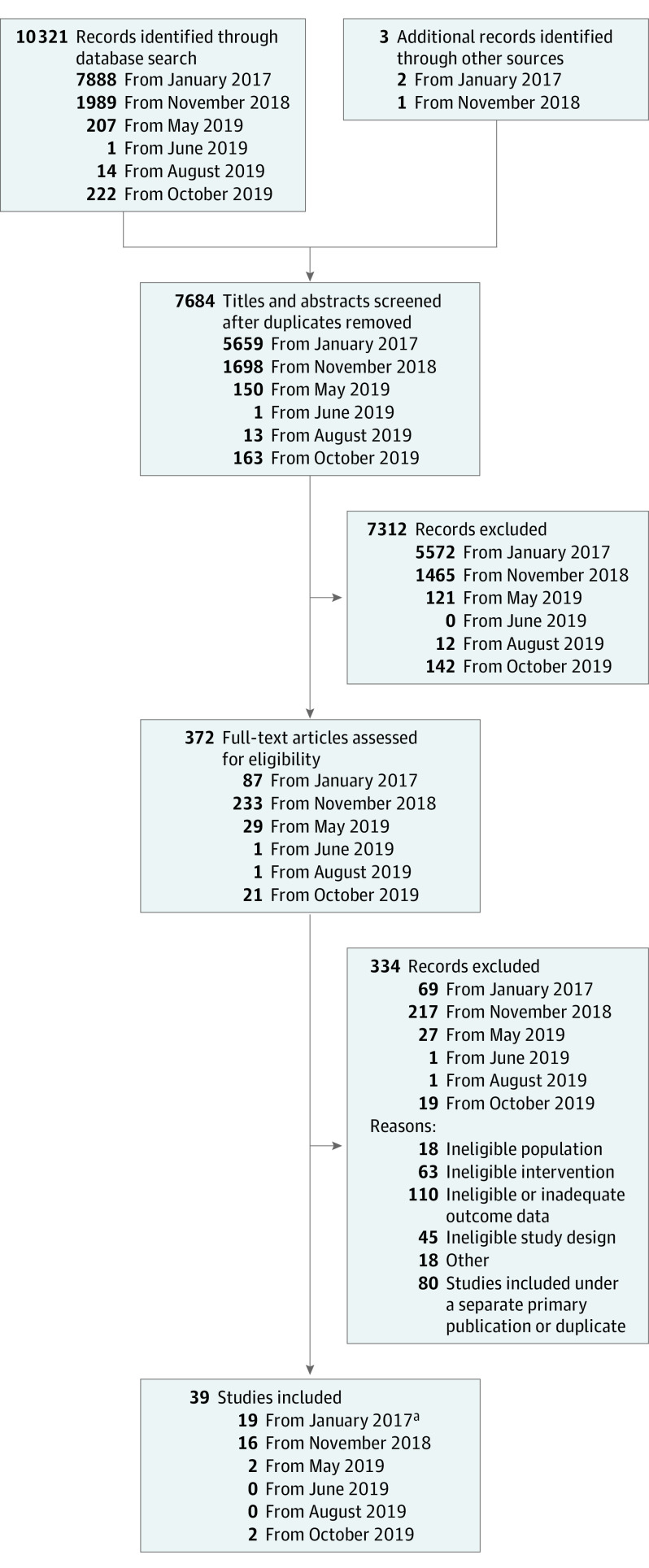
Study selection: English-language randomized clinical trials of 8 weeks or more of treatment with systemic immunomodulatory medications for moderate to severe atopic dermatitis were included. Titles, abstracts, and articles were screened in duplicate. Of 10 324 citations, 39 trials were included.

Data extraction and synthesis: Data were extracted in duplicate, and the review adhered to Preferred Reporting Items for Systematic Reviews and Meta-analyses for Network Meta-Analyses guidelines. Random-effects bayesian network meta-analyses were performed and certainty of evidence was assessed using Grading of Recommendations Assessment, Development and Evaluation criteria.

Main outcomes and measures: Prespecified outcomes were change in signs of disease, symptoms, quality of life, itch, withdrawals, and serious adverse events.

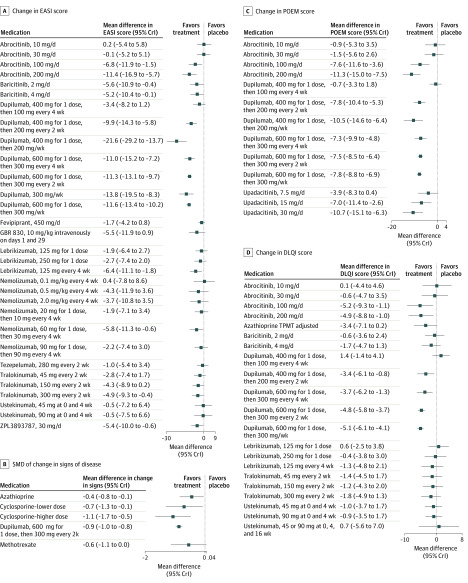
Results: A total of 39 trials with 6360 patients examining 20 medications and placebo were included. Most trials were conducted for adults receiving up to 16 weeks of therapy. Dupilumab, 300 mg every 2 weeks, was associated with improvement in the Eczema Area and Severity Index score vs placebo (mean difference, 11.3-point reduction; 95% credible interval [CrI], 9.7-13.1 [high certainty]). Cyclosporine (standardized mean difference, -1.1; 95% CrI, -1.7 to -0.5 [low certainty]) and dupilumab (standardized mean difference, -0.9; 95% CrI, -1.0 to -0.8 [high certainty]) were similarly effective vs placebo in clearing clinical signs of atopic dermatitis and may be superior to methotrexate (standardized mean difference, -0.6; 95% CrI, -1.1 to 0.0 [low certainty]) and azathioprine (standardized mean difference, -0.4; 95% CrI, -0.8 to -0.1 [low certainty]). Several investigational medications for atopic dermatitis are promising, but data to date are limited to small early-phase trials. Safety analyses were limited by low event rates.

Conclusions and relevance: Dupilumab and cyclosporine may be more effective for up to 16 weeks of treatment than methotrexate and azathioprine for treating adult patients with atopic dermatitis. More studies directly comparing established and novel treatments beyond 16 weeks are needed and will be incorporated into future updates of this review.


Conflict of interest statement

Conflict of Interest Disclosures: Dr Drucker reported serving as an investigator and receiving research funding from Sanofi and Regeneron; serving as a consultant for Sanofi, RTI Health Solutions, Eczema Society of Canada, and Canadian Agency for Drugs and Technology in Health; and receiving honoraria from Prime Inc, Spire Learning, CME Outfitters, Eczema Society of Canada, and the Canadian Dermatology Association; and his institution has received educational grants from Sanofi and AbbVie. Dr Spuls reported being chief investigator of the government-funded TREAT NL registry (www.treatregister.nl) and principal investigator of the Methotrexate Versus Azathioprine in Severe Atopic Dermatitis RCTs; serving as an unpaid consultant for Sanofi and AbbVie; receiving independent research grants from Schering Plough and LeoPharma; and performing clinical trials with many pharmaceutical industries that manufacture drugs used for the treatment of psoriasis and atopic dermatitis for which her department receives financial compensation. Mss Küster and Siegels reported receiving institutional funding for investigator-initiated trials from Novartis, Sanofi, Pfizer, and ALK. Dr Schmitt reported receiving institutional funding for investigator-initiated trials from Novartis, Sanofi, Pfizer, and ALK; receiving fees for consulting from Novartis and Pfizer; and being co–principal investigator of the German national AD registry TREATgermany, which is funded by Sanofi. Dr Flohr reported being chief investigator of the UK National Institute for Health Research–funded TREAT (ISRCTN15837754) and SOFTER (ClinicalTrials.gov: NCT03270566) trials as well as the UK-Irish Atopic Eczema Systemic Therapy Register (A-STAR; ISRCTN11210918) and being a principal investigator in the European Union Horizon 2020–funded BIOMAP Consortium (http://www.biomap-imi.eu/); and his department has received funding from Sanofi-Genzyme for skin microbiome work. No other disclosures were reported.

Figures

Figure 1.
Figure 1.. Study Selection Process
aDupilumab SOLO (Study of Dupilumab [REGN668/SAR231893] Monotherapy Administered to Adult Patients With Moderate-to-Severe Atopic Dermatitis) 1 and SOLO 2 studies were published in a single article.
Figure 2.
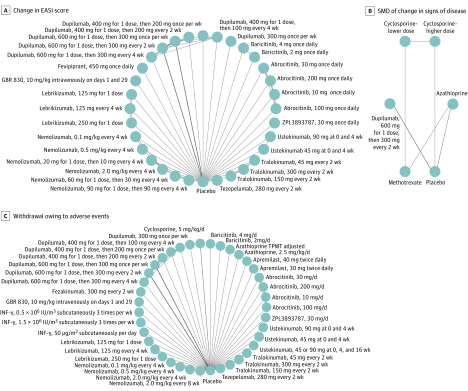
Figure 2.. Network Graphs of Studies Included in the Analysis of Atopic Dermatitis Treatment Between 8 and 16 Weeks
A, Change in Eczema Area and Severity Index (EASI) score. B, The standardized mean difference (SMD) of change in signs of the disease among medications currently in use. C, Withdrawal owing to adverse events. The width of each line connecting 2 treatments (nodes) is proportional to the number of head-to-head trials for that comparison. INF indicates interferon; and TPMT, thiopurine methyltransferase.
Figure 3.
Figure 3.. Forest Plots of Network Meta-analysis Results for Atopic Dermatitis Treatment Between 8 and 16 Weeks
A, Change in Eczema Area and Severity Index (EASI) score. B, The standardized mean difference (SMD) of change in signs of the disease among medications currently in use. C, Change in Patient-Oriented Eczema Measure (POEM) score. D, Change in Dermatology Life Quality Index (DLQI) score. Results for fevripitant are available only in clinical trial registries. The SEs given for the change in EASI score are very small and may be in error. If in fact these SEs are erroneous, they may have changed the precision of the effect estimates for comparisons with fevripirant. Each systemic medication is compared with placebo. Negative values represent improvement in the disease state.

References

    1. Silverberg JI, Simpson EL. Associations of childhood eczema severity: a US population-based study. Dermatitis. 2014;25(3):107-114. doi:10.1097/DER.0000000000000034 - DOI - PMC - PubMed
    1. Barbarot S, Auziere S, Gadkari A, et al. . Epidemiology of atopic dermatitis in adults: results from an international survey. Allergy. 2018;73(6):1284-1293. doi:10.1111/all.13401 - DOI - PubMed
    1. Flohr C, Mann J. New insights into the epidemiology of childhood atopic dermatitis. Allergy. 2014;69(1):3-16. doi:10.1111/all.12270 - DOI - PubMed
    1. Sidbury R, Davis DM, Cohen DE, et al. ; American Academy of Dermatology . Guidelines of care for the management of atopic dermatitis: section 3: management and treatment with phototherapy and systemic agents. J Am Acad Dermatol. 2014;71(2):327-349. doi:10.1016/j.jaad.2014.03.030 - DOI - PMC - PubMed
    1. Taylor K, Swan DJ, Affleck A, Flohr C, Reynolds NJ; U.K. Translational Research Network in Dermatology and the U.K. Dermatology Clinical Trials Network . Treatment of moderate-to-severe atopic eczema in adults within the U.K.: results of a national survey of dermatologists. Br J Dermatol. 2017;176(6):1617-1623. doi:10.1111/bjd.15235 - DOI - PMC - PubMed

Publication types

MeSH terms