Randomized Controlled Trial
. 2020 Aug 1;112(2):413-426.
doi: 10.1093/ajcn/nqaa072.

Nicotinamide riboside supplementation alters body composition and skeletal muscle acetylcarnitine concentrations in healthy obese humans

Affiliations
Randomized Controlled Trial

Nicotinamide riboside supplementation alters body composition and skeletal muscle acetylcarnitine concentrations in healthy obese humans

Carlijn M E Remie et al. Am J Clin Nutr. .

Abstract

Background: Nicotinamide riboside (NR) is an NAD+ precursor that boosts cellular NAD+ concentrations. Preclinical studies have shown profound metabolic health effects after NR supplementation.

Objectives: We aimed to investigate the effects of 6 wk NR supplementation on insulin sensitivity, mitochondrial function, and other metabolic health parameters in overweight and obese volunteers.

Methods: A randomized, double-blinded, placebo-controlled, crossover intervention study was conducted in 13 healthy overweight or obese men and women. Participants received 6 wk NR (1000 mg/d) and placebo supplementation, followed by broad metabolic phenotyping, including hyperinsulinemic-euglycemic clamps, magnetic resonance spectroscopy, muscle biopsies, and assessment of ex vivo mitochondrial function and in vivo energy metabolism.

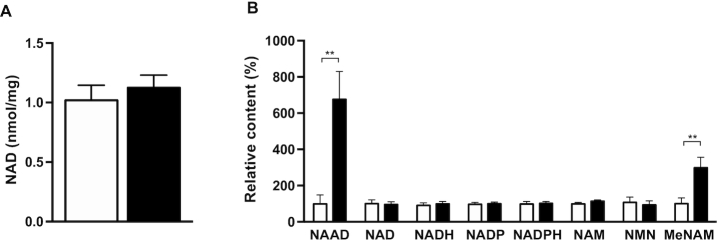
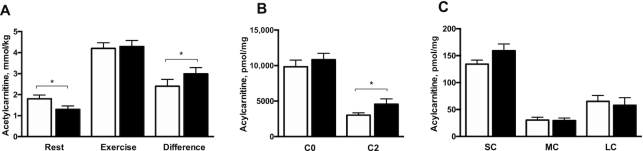
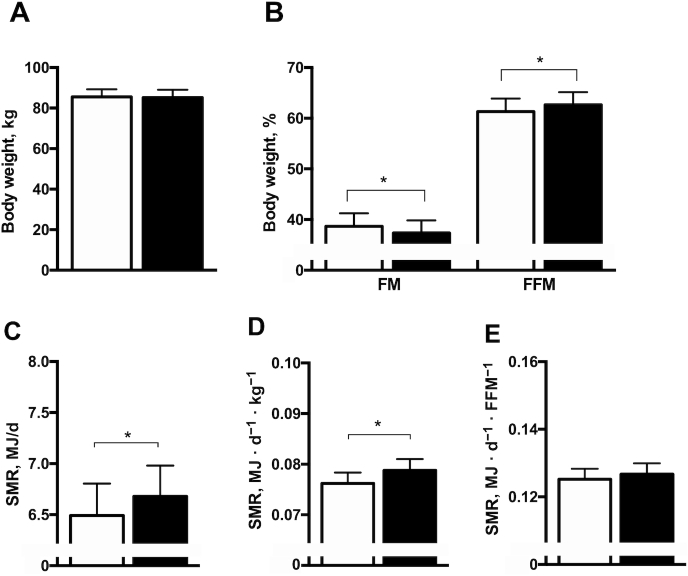
Results: Markers of increased NAD+ synthesis-nicotinic acid adenine dinucleotide and methyl nicotinamide-were elevated in skeletal muscle after NR compared with placebo. NR increased body fat-free mass (62.65% ± 2.49% compared with 61.32% ± 2.58% in NR and placebo, respectively; change: 1.34% ± 0.50%, P = 0.02) and increased sleeping metabolic rate. Interestingly, acetylcarnitine concentrations in skeletal muscle were increased upon NR (4558 ± 749 compared with 3025 ± 316 pmol/mg dry weight in NR and placebo, respectively; change: 1533 ± 683 pmol/mg dry weight, P = 0.04) and the capacity to form acetylcarnitine upon exercise was higher in NR than in placebo (2.99 ± 0.30 compared with 2.40 ± 0.33 mmol/kg wet weight; change: 0.53 ± 0.21 mmol/kg wet weight, P = 0.01). However, no effects of NR were found on insulin sensitivity, mitochondrial function, hepatic and intramyocellular lipid accumulation, cardiac energy status, cardiac ejection fraction, ambulatory blood pressure, plasma markers of inflammation, or energy metabolism.

Conclusions: NR supplementation of 1000 mg/d for 6 wk in healthy overweight or obese men and women increased skeletal muscle NAD+ metabolites, affected skeletal muscle acetylcarnitine metabolism, and induced minor changes in body composition and sleeping metabolic rate. However, no other metabolic health effects were observed.This trial was registered at clinicaltrials.gov as NCT02835664.

Keywords: NAD; acetylcarnitine; body composition; human; insulin sensitivity; metabolic health; mitochondrial function; nicotinamide riboside; obesity.


Figures

FIGURE 1
FIGURE 1
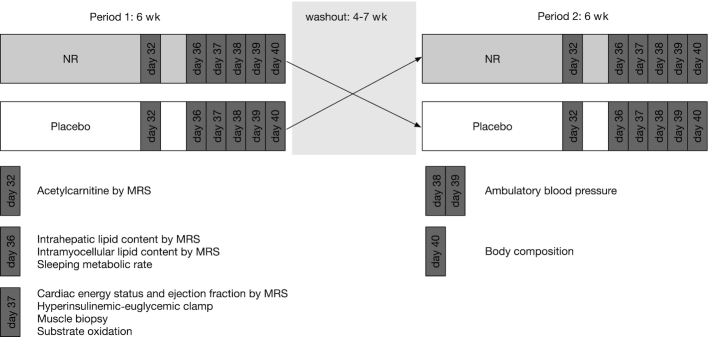
Study design. In this crossover study, participants were randomly assigned to start with 6 wk NR supplementation or 6 wk placebo treatment. After a washout period of 4–7 wk, participants entered the other intervention arm such that all participants served as their own control. Participants were studied in week 5 (day 32) and in week 6 (day 36–40) of each of the 2 interventions. MRS, magnetic resonance spectroscopy; NR, nicotinamide riboside.
FIGURE 2
FIGURE 2
NAD+ metabolites in skeletal muscle after NR and placebo supplementation. (A) NAD+ concentrations measured in skeletal muscle biopsy specimens by enzymatic assay, n = 8. (B) NAD+ metabolites measured in skeletal muscle biopsy specimens by MS, n = 12. Black bars are NR, open bars are placebo. Data are expressed as mean ± SE. P values are derived from the analysis of the mean within-person changes and the SEM of the within-group changes. **P < 0.01. MeNAM, methylnicotinamide; NAAD, nicotinic acid adenine dinucleotide; NAM, nicotinamide adenosine mononucleotide; NMN, nicotinamide mononucleotide; NR, nicotinamide riboside.
FIGURE 3
FIGURE 3
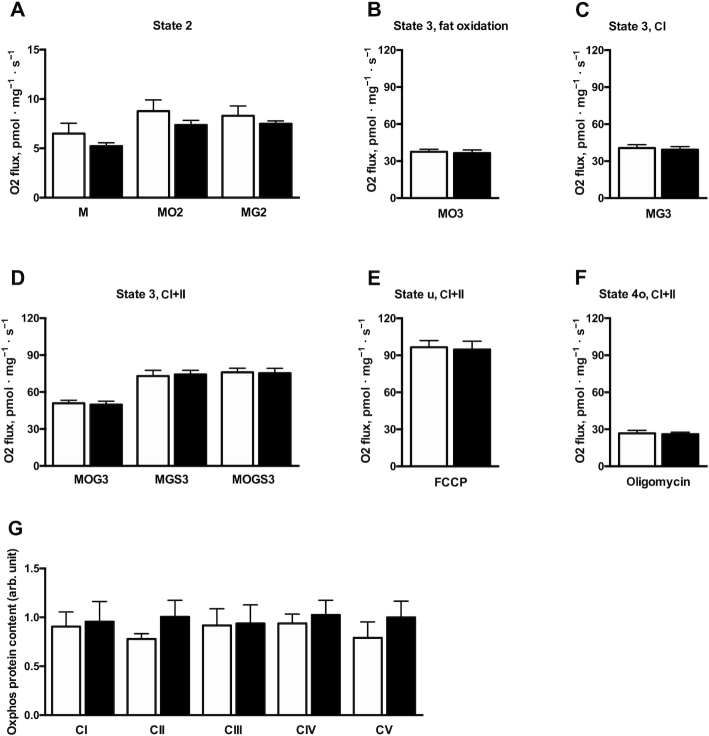
Skeletal muscle ex vivo mitochondrial respiratory capacity after NR and placebo supplementation. (A) State 2 respiration upon M, MO2, and MG2. (B) ADP-stimulated state 3 respiration upon lipid-derived substrate, MO3. (C) ADP-stimulated state 3 respiration upon CI substrates, MG3. (D) ADP-stimulated state 3 respiration upon parallel electron input to both CI and II, MOG3, MGS3, and MOGS3. (E) State u: maximal FCCP-induced uncoupled respiration. (F) State 4o: oligomycin-induced respiration not coupled to ATP synthesis. (G) Protein content of individual complexes of the electron transport chain. Black bars are NR, open bars are placebo. n = 12. Data are expressed as mean ± SE. C, Complex; FCCP, carbonyl cyanide p-trifluoro-methoxyphenyl hydrazone; M, malate; MGS3, malate + glutamate + succinate; MG2, malate + glutamate; MG3, malate + glutamate; MOG3, malate + octanoyl carnitine + glutamate; MOGS3, malate + octanoyl carnitine + glutamate + succinate; MO2, malate + octanoyl carnitine; MO3, malate + octanoyl carnitine + glutamate; NR, nicotinamide riboside; Oxphos, oxidative phosphorylation.
FIGURE 4
FIGURE 4
Skeletal muscle acylcarnitine concentrations measured in the morning and evening after NR and placebo supplementation. (A) Acetylcarnitine concentrations measured by magnetic resonance spectroscopy in skeletal muscle in the evening during rest, after exercise, and the capacity to form acetylcarnitine expressed as the difference between rest and exercise. (B) C0 and C2 concentrations measured in muscle biopsy specimens taken in the morning during rest. (C) SC, MC, and LC concentrations measured in biopsy specimens taken during rest. Black bars are NR, open bars are placebo. n = 13. Data are expressed as mean ± SE. P values are derived from the analysis of the mean within-person changes and the SEM of the within-group changes. *P < 0.05. C0, free carnitine; C2, acetylcarnitine; LC, sum of long-chain acylcarnitines; MC, sum of medium-chain acylcarnitines; NR, nicotinamide riboside; SC, sum of short-chain acylcarnitines.
FIGURE 5
FIGURE 5
Body composition and SMR after NR and placebo supplementation. (A) Body weight. (B) FM and FFM. (C) SMR. (D) SMR corrected for body weight. (E) SMR corrected for FFM. Black bars are NR, open bars are placebo. Data are expressed as mean ± SE. n = 13. P values are derived from the analysis of the mean within-person changes and the SEM of the within-group changes. *P < 0.05. FFM, fat-free mass; FM, fat mass; NR, nicotinamide riboside; SMR, sleeping metabolic rate.

Comment in

References

    1. Bieganowski P, Brenner C. Discoveries of nicotinamide riboside as a nutrient and conserved NRK genes establish a Preiss-Handler independent route to NAD+ in fungi and humans. Cell. 2004;117(4):495–502. - PubMed
    1. Connell NJ, Houtkooper RH, Schrauwen P. NAD+ metabolism as a target for metabolic health: have we found the silver bullet?. Diabetologia. 2019;62(6):888–99. - PMC - PubMed
    1. Houtkooper RH, Auwerx J. Exploring the therapeutic space around NAD+. J Cell Biol. 2012;199(2):205–9. - PMC - PubMed
    1. Imai S, Guarente L. NAD+ and sirtuins in aging and disease. Trends Cell Biol. 2014;24(8):464–71. - PMC - PubMed
    1. Bonkowski MS, Sinclair DA. Slowing ageing by design: the rise of NAD+ and sirtuin-activating compounds. Nat Rev Mol Cell Biol. 2016;17(11):679–90. - PMC - PubMed

Publication types

MeSH terms

Associated data