Factors Associated With Child Stunting, Wasting, and Underweight in 35 Low- and Middle-Income Countries
- PMID: 32320037
- PMCID: PMC7177203
- DOI: 10.1001/jamanetworkopen.2020.3386
Factors Associated With Child Stunting, Wasting, and Underweight in 35 Low- and Middle-Income Countries
Abstract
Importance: Evidence on the relative importance of various factors associated with child anthropometric failures (ie, stunting, underweight, and wasting) and their heterogeneity across countries can inform global and national health agendas.
Objective: To assess the relative significance of factors associated with child anthropometric failures in 35 low- and middle-income countries (LMICs).
Design, setting, and participants: This cross-sectional study of 299 353 children who were born singleton and aged 12 to 59 months with nonpregnant mothers and valid anthropometric measures assessed the strengths of associations of 26 factors with child stunting, underweight, and wasting, using Demographic and Health Surveys (2007-2018) from 35 LMICs. Data analysis was conducted from July 2019 to February 2020.
Exposures: A total of 9 direct factors (ie, dietary diversity score; breastfeeding initiation; vitamin A supplements; use of iodized salt; infectious disease in past 2 weeks; oral rehydration therapy for children with diarrhea; care seeking for suspected pneumonia; full vaccination; and indoor pollution) and 17 indirect factors (household wealth; maternal and paternal education; maternal and paternal height and body mass index; maternal autonomy for health care, movement, and money; water source; sanitation facility; stool disposal; antenatal care; skilled birth attendant at delivery; family planning needs; and maternal marriage age) were assessed.
Main outcomes and measures: Three anthropometric failure outcomes were constructed based on the 2006 World Health Organization child growth standards: stunting (height-for-age z score less than -2 standard deviations [SDs]), underweight (weight-for-age z score less than -2 SDs), and wasting (weight-for-height z score less than -2 SDs).
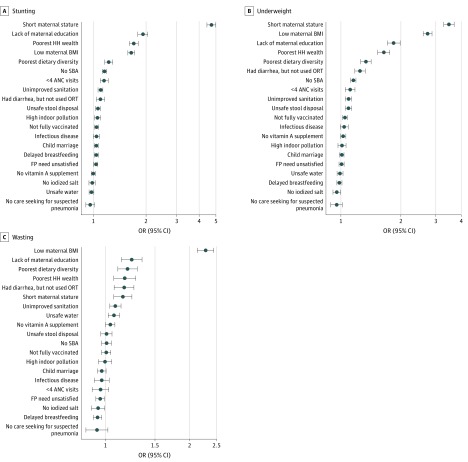
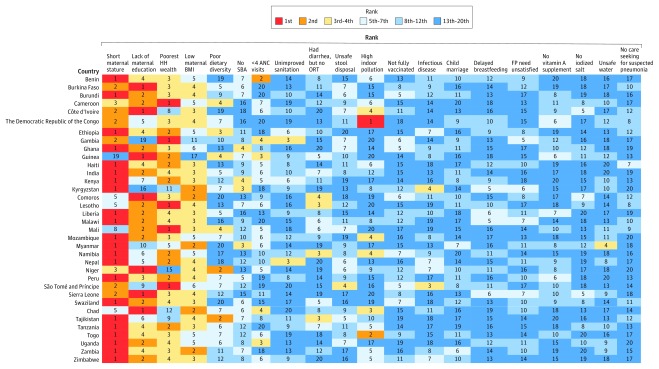
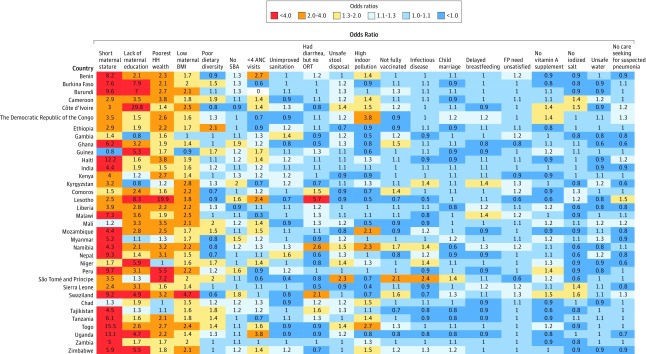
Results: Among the 299 353 children aged 12 to 59 months included in the analysis, 38.8% (95% CI, 38.6%-38.9%) had stunting, 27.5% (95% CI, 27.3%-27.6%) had underweight, and 12.9% (95% CI, 12.8%-13.0%) had wasting. In the pooled sample, short maternal height was the strongest factor associated with child stunting (odds ratio [OR], 4.7; 95% CI, 4.5-5.0; P < .001), followed by lack of maternal education (OR, 1.9; 95% CI, 1.8-2.0; P < .001), poorest household wealth (OR, 1.7; 95% CI,1.6-1.8; P < .001), and low maternal body mass index (OR, 1.6; 95% CI, 1.6-1.7; P < .001). Short paternal height was also significantly associated with higher odds of stunting (OR, 1.9; 95% CI, 1.7-2.2; P < .001). Consistent results were found for underweight (eg, short maternal height: OR, 3.5; 95% CI, 3.3-3.7; P < .001; lack of maternal education: OR, 1.8; 95% CI, 1.7-2.0; P < .001) and wasting (eg, low maternal body mass index: OR, 2.3; 95% CI, 2.1-2,4; P < .001; poorest household wealth: OR, 1.2; 95% CI, 1.1-1.3; P < .001). Parental nutritional status and household socioeconomic conditions ranked the strongest (1st to 4th) for most countries, with a few exceptions (eg, lack of maternal education ranked 18th-20th in 8 countries for child wasting). Other factors were not associated with anthropometric failures in pooled analysis and had large country-level heterogeneity; for example, unsafe water was not associated with child underweight in the pooled analysis (OR, 0.97; 95% CI, 0.95-1.00; P < .001), and it ranked from 4th to 20th across countries.
Conclusions and relevance: In this study, socioeconomic conditions and parental nutritional status were the strongest factors associated with child anthropometric failures. Poverty reduction, women's education, and nutrition programs for households could be important strategies for reducing child undernutrition; however, country-specific contexts should be considered in national policy discussions.
Conflict of interest statement
Figures
References
-
- United Nations Children’s Fund Malnutrition. Accessed March 24, 2020. https://data.unicef.org/topic/nutrition/malnutrition/
-
- Abarca-Gómez L, Abdeen ZA, Hamid ZA, et al. ; NCD Risk Factor Collaboration (NCD-RisC) . Worldwide trends in body-mass index, underweight, overweight, and obesity from 1975 to 2016: a pooled analysis of 2416 population-based measurement studies in 128·9 million children, adolescents, and adults. Lancet. 2017;390(10113):-. doi: 10.1016/S0140-6736(17)32129-3 - DOI - PMC - PubMed
-
- United Nations Sustainable development goals: goal 3: ensure healthy lives and promote well-being for all at all ages. Accessed March 24, 2020. https://www.un.org/sustainabledevelopment/health/
-
- Black R, Alderman H, Bhutta Z, et al. Executive summary of The Lancet maternal and child nutrition series. Lancet. Published June 6, 2013. Accessed March 24, 2020. https://www.thelancet.com/series/maternal-and-child-nutrition
-
- United Nations Children’s Fund Improving child nutrition: the achievable imperative for global progress. Accessed March 24, 2020. https://www.unicef.org/nutrition/index_68661.html
MeSH terms
Substances
LinkOut - more resources
Full Text Sources
Medical
Miscellaneous