


The citation advantage of linking publications to research data
- PMID: 32320428
- PMCID: PMC7176083
- DOI: 10.1371/journal.pone.0230416
The citation advantage of linking publications to research data
Abstract
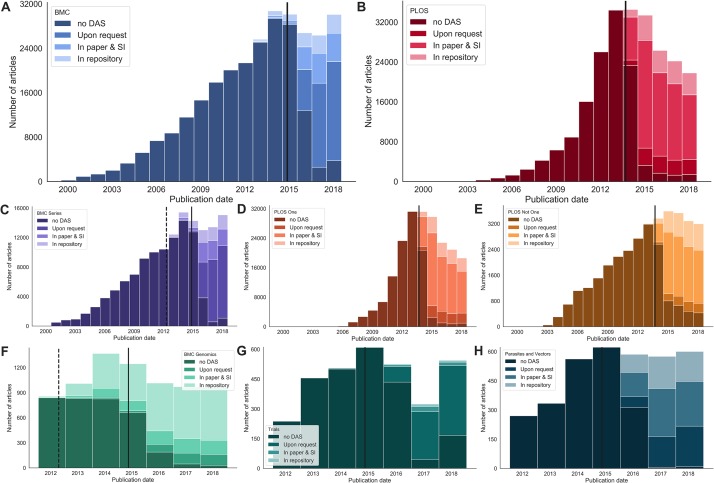
Efforts to make research results open and reproducible are increasingly reflected by journal policies encouraging or mandating authors to provide data availability statements. As a consequence of this, there has been a strong uptake of data availability statements in recent literature. Nevertheless, it is still unclear what proportion of these statements actually contain well-formed links to data, for example via a URL or permanent identifier, and if there is an added value in providing such links. We consider 531, 889 journal articles published by PLOS and BMC, develop an automatic system for labelling their data availability statements according to four categories based on their content and the type of data availability they display, and finally analyze the citation advantage of different statement categories via regression. We find that, following mandated publisher policies, data availability statements become very common. In 2018 93.7% of 21,793 PLOS articles and 88.2% of 31,956 BMC articles had data availability statements. Data availability statements containing a link to data in a repository-rather than being available on request or included as supporting information files-are a fraction of the total. In 2017 and 2018, 20.8% of PLOS publications and 12.2% of BMC publications provided DAS containing a link to data in a repository. We also find an association between articles that include statements that link to data in a repository and up to 25.36% (± 1.07%) higher citation impact on average, using a citation prediction model. We discuss the potential implications of these results for authors (researchers) and journal publishers who make the effort of sharing their data in repositories. All our data and code are made available in order to reproduce and extend our results.
Conflict of interest statement
One of the authors (IH) is at the time of publication in the journal, employed by PLOS, publisher of PLOS ONE. IH was employed by Springer Nature, publisher of the BMC journals, at the time of planning and conducting the research and writing of the original manuscript. This does not alter our adherence to PLOS ONE policies on sharing data and materials. There are no patents, products in development or marketed products associated with this research to declare. All other authors have declared that no other competing interests exist.
Figures
References
-
- Hodson S, Molloy L. Current Best Practice for Research Data Management Policies. 2015.
-
- New policy for structural data. Nature. 1998;394 (6689). - PubMed
-
- Jones L, Grant R, Hrynaszkiewicz I. Implementing publisher policies that inform, support and encourage authors to share data: two case studies. Insights the UKSG journal. 2019;32 10.1629/uksg.463 - DOI
-
- Hrynaszkiewicz I, Birukou A, Astell M, Swaminathan S, Kenall A, Khodiyar V. Standardising and harmonising research data policy in scholarly publishing. IJDC. 2017;12(1). 10.2218/ijdc.v12i1.531 - DOI
-
- Announcement: Where are the data? Nature. 2016;537 (7619). - PubMed
Publication types
MeSH terms
LinkOut - more resources
Full Text Sources
Research Materials
