


Disentangling elevation, annual flooding regime and salinity as hydrochemical determinants of halophyte distribution in non-tidal saltmarsh
- PMID: 32320466
- PMCID: PMC7380465
- DOI: 10.1093/aob/mcaa078
Disentangling elevation, annual flooding regime and salinity as hydrochemical determinants of halophyte distribution in non-tidal saltmarsh
Abstract
Background and aims: Hydrological disconnection, especially in a Mediterranean climate, creates coastal saltmarshes with an annual cycle of flooding that are unlike tidally inundated systems. Winter rainfall produces long, continuous hydroperiods, alternating with continuous exposure caused by evaporation in warm, rain-free summers. We aimed to distinguish the effects of elevation, hydroperiod and salinity on annual and perennial halophytes in such a system.
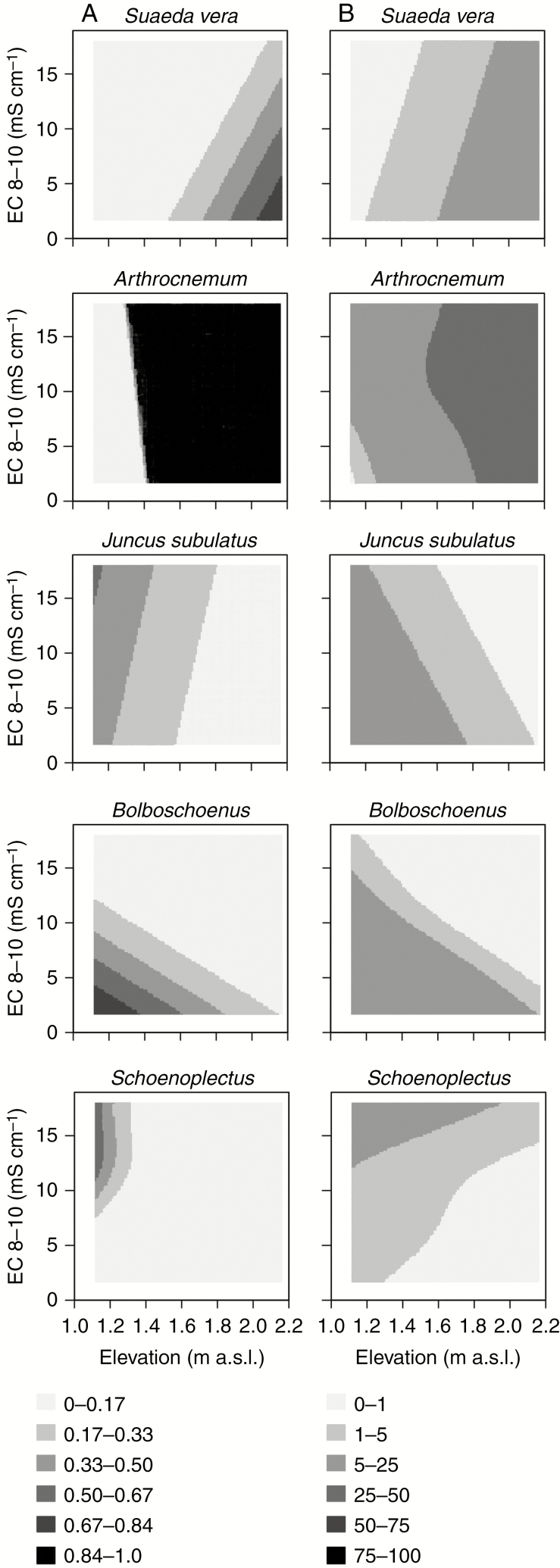
Methods: We recorded vegetation and sediment salinity in permanent quadrats on a marsh in the Doñana National Park, Spain, over seven consecutive years with widely differing rainfall. Elevation was determined from LIDAR data and the duration of the annual hydroperiod from satellite imagery. The independent effects of collaterally varying elevation, hydroperiod and salinity on species distribution were examined using generalized linear models and hierarchical partitioning.
Key results: Both hydroperiod and salinity were inversely related to elevation but interannual fluctuations in rainfall facilitated discrimination of independent effects of the three collaterally varying factors on halophyte distribution. Perennial distribution was strongly structured by elevation, whereas many annual species were more sensitive to hydroperiod. The independent effects of salinity varied according to individual species' salt tolerance from positive to negative. Thus life-history and, in the case of annuals, phenology were important in determining the relative impact of elevation and hydroperiod.
Conclusions: The consequences of elevation for halophyte distribution in seasonally flooded saltmarshes are fundamentally different from those in tidal marshes, because protracted and frequent flooding regimes require different adaptations, and because of the unpredictability of flooding from year to year. These differences could explain greater species diversity in non-tidal marshes and the absence of key saltmarsh species prominent in tidal marshes. The vegetation of non-tidal marshes will be particularly susceptible to the more extreme annual cycles of temperature and rainfall predicted for Mediterranean climates.
Keywords: Coastal marsh; Mediterranean climate; flooding regime; hydroperiod; life history; marsh embankment; remote sensing; salt tolerance.
© The Author(s) 2020. Published by Oxford University Press on behalf of the Annals of Botany Company. All rights reserved. For permissions, please e-mail: journals.permissions@oup.com.
Figures



References
-
- Adam P. 1990. Saltmarsh ecology. Cambridge: Cambridge University Press.
-
- Anastasiou CJ, Brooks JR. 2003. Effects of soil pH, redox potential, and elevation on survival of Spartina patens planted at a west Central Florida salt marsh restoration site. Wetlands 23: 845–859.
-
- Armstrong W, Wright EJ, Lythe S, Gaynard TJ. 1985. Plant zonation and the effects of the spring–neap tidal cycle on soil aeration in a Humber salt marsh. The Journal of Ecology 73: 323–339.
-
- Barclay AM, Crawford RMM. 1982. Plant growth and survival under strict anaerobiosis. Journal of Experimental Botany 33: 541–549.
-
- Barrett-Lennard EG, Bennett SJ, Altman M. 2013. Survival and growth of perennial halophytes on saltland in a Mediterranean environment is affected by depth to watertable in summer as well as subsoil salinity. Crop and Pasture Science 64: 123–136.
Publication types
MeSH terms
LinkOut - more resources
Full Text Sources
