. 2020 Jun:122:104759.
doi: 10.1016/j.yhbeh.2020.104759. Epub 2020 May 27.

Maternal exposure to organophosphate flame retardants alters locomotor and anxiety-like behavior in male and female adult offspring

Affiliations

Maternal exposure to organophosphate flame retardants alters locomotor and anxiety-like behavior in male and female adult offspring

K R Wiersielis et al. Horm Behav. 2020 Jun.

Abstract

Endocrine disrupting chemicals (EDCs) are chemicals found in our environment that interrupt typical endocrine function. Some flame retardants (FRs) are EDCs as shown in their interaction with steroid and nuclear receptors. Humans are consistently exposed to flame retardants as they are used in everyday items such as plastics, clothing, toys, and electronics. Polybrominated diphenyl ethers were used as the major FR until 2004, when they were replaced by organophosphate flame retardants (OPFRs). Previous research in rodent models utilizing a commercial flame retardant mixture containing OPFRs reported alterations in anxiety-like behavior in the elevated plus maze (EPM) for rodents perinatally exposed to OPFRs. In the present study we utilize wild-type mice maternally exposed (gestational day 7 to postnatal day 14) to either an OPFR mixture of tris(1,3-dichloro-2-propyl), triphenyl phosphate, and tricresyl phosphate or a sesame seed oil vehicle. These mice were evaluated for anxiety-like behavior in adulthood on the open field test (OFT) and the light/dark box (LDB) as well as the EPM. Outcomes from the OFT and LDB indicate that males and females maternally exposed to OPFRs exhibit altered locomotor activity. Results of the EPM were sex-specific as we did not observe an effect in females; however, effects in males differed depending on exposure condition. Males maternally exposed to OPFRs exhibited an anxiolytic-like phenotype in contrast to their vehicle counterparts. This effect in perinatally OPFR-exposed males was not due to alterations in locomotor activity. Our research illustrates that there are sex- and exposure-dependent effects of perinatal OPFR exposure on adult locomotor and anxiety-like behaviors in a mouse model.

Keywords: Anxiety; Endocrine disruptors; Maternal exposure; Organophosphate flame retardants; Sex differences.


Figures

Fig. 1.
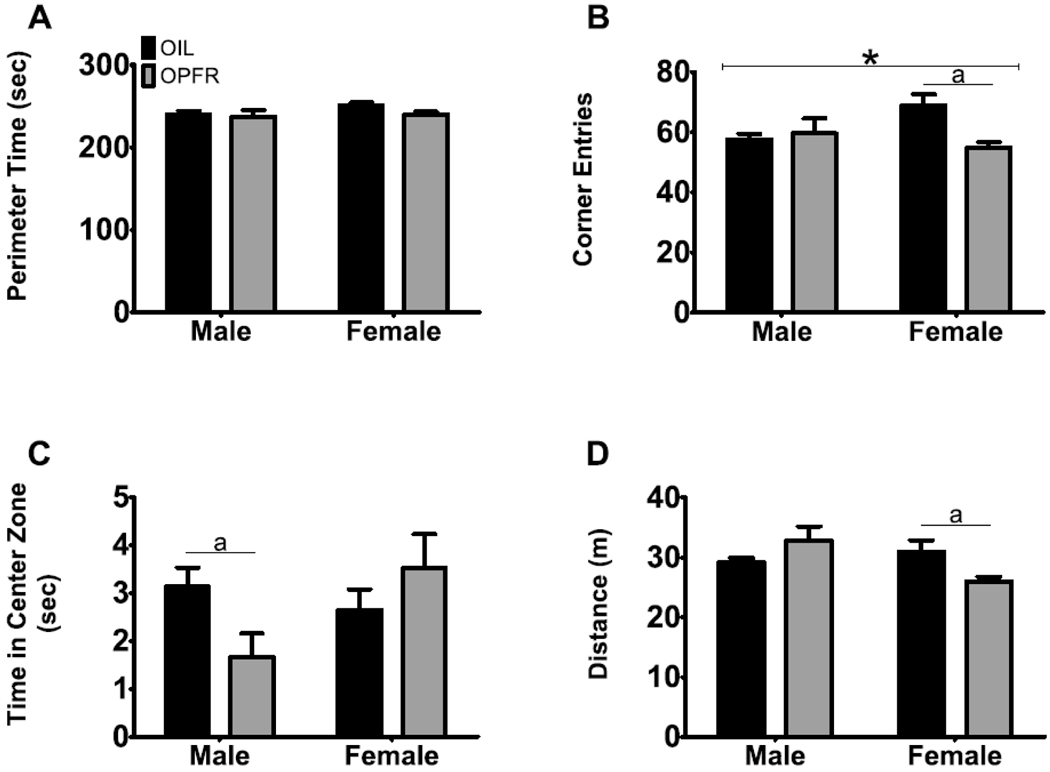
Fig. 1.. Males and females maternally exposed to OPFRs differed on locomotor behavior in the open field test (OFT).
A) No effects were observed in perimeter time (sec). B) OPFR-exposed females exhibited a decrease in the number of entries in the corners of the OFT, in contrast to same-sex oil controls. We saw no effect in OPFR-exposed males in the number of corner entries. C) Maternal exposure to OPFRs reduced time in the 10-cm center zone in males; however, no effect was detected in females on this measure. D) OPFR exposure decreased distance traveled (m) in females. OPFR-exposed males exhibited an inverse trend. This suggests that males and females maternally exposed to OPFRs are differentially affected in locomotor activity on this task. */a = p < .05; capped lines = exposure effect; a = pairwise difference between exposure within sex; data are represented as mean ± SEM.
Fig. 2.
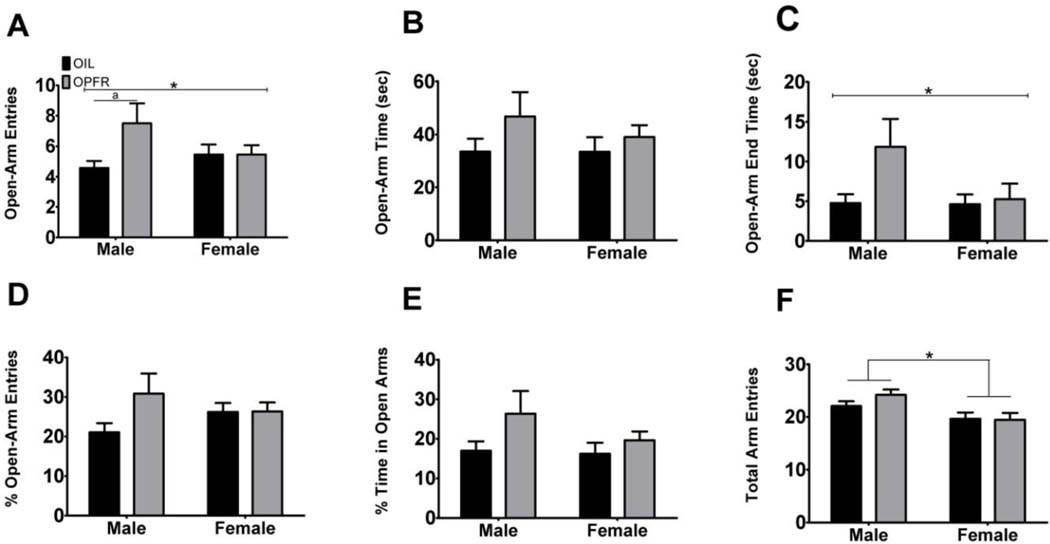
Fig. 2.. Maternally exposed OPFR males exhibit anxiolytic-like behavior on the elevated plus maze (EPM).
A) Maternal exposure to OPFRs increased the number of open-arm entries in males; however, no effect was observed in females on this measure. B) No effects were detected in open-arm time (sec). C) A main effect of exposure was observed in open-arm end time (sec). D) No effects were observed in percentage of open-arm entries. E) No effects were observed in percentage of time in open arms. F) A main effect of sex in total arm entries was observed, such that regardless of exposure males had a greater amount of arm entries than females. These results suggest that the anxiolytic-like behavior observed in OPFR-exposed males compared to same-sex oil controls is not due to exposure differences in locomotor activity. */a = p < .05; capped lines = exposure effect; bracketed lines = sex effect; a = pairwise difference between exposure within sex; data are represented as mean ± SEM.
Fig. 3.
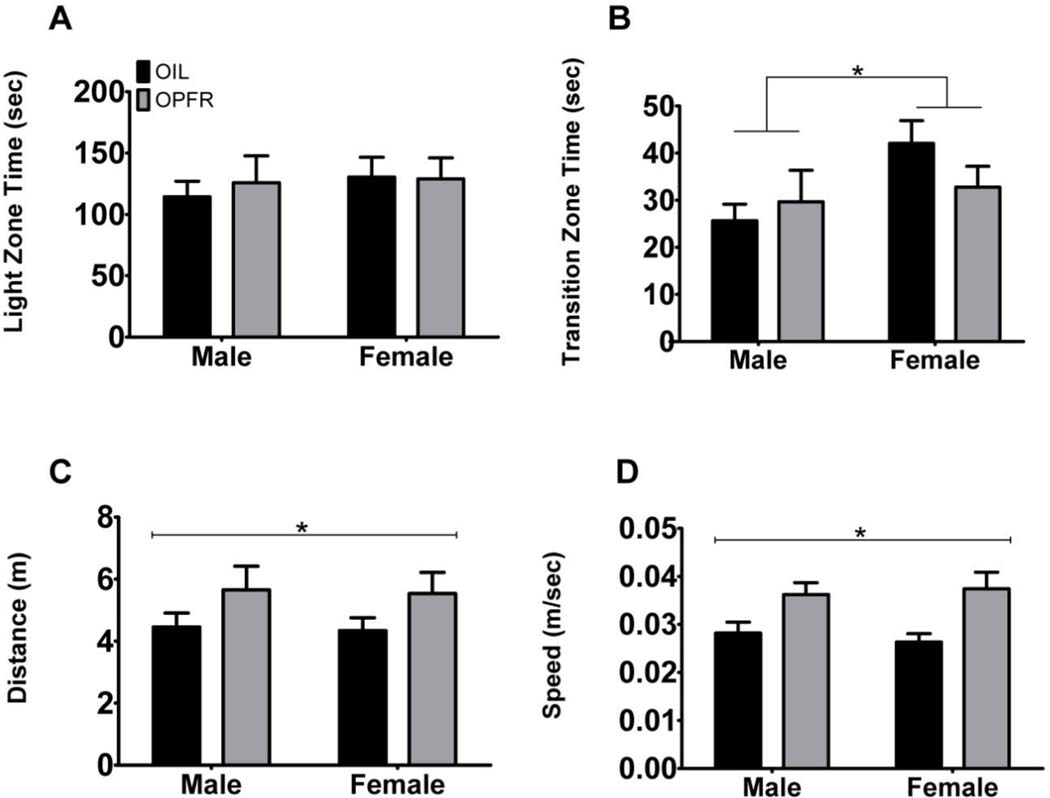
Fig. 3.. Males and females maternally exposed to OPFRs displayed increased locomotor activity in the light/dark box (LDB).
A) No effects were observed in time spent in the light zone (sec). B) Females had an increase in time spent in the transition zone (sec) regardless of exposure. C) OPFR exposure increased the total distance traveled (m) in males and females when compared to their same-sex oil controls. D) Maternal exposure to OPFRs increased speed (m/sec) in both males and females. These results suggest OPFR exposure in both males and females alters locomotor behavior in this task. */a = p < .05; capped lines = exposure effect; bracketed lines = sex effect; data are represented as mean ± SEM.

References

    1. Alaee M, Arias P, Sjödin A, Bergman Å, 2003. An overview of commercially used brominated flame retardants, their applications, their use patterns in different countries/regions and possible modes of release. Environment international 29, 683–689. - PubMed
    1. Archer J, 1973. Tests for emotionality in rats and mice: a review. Animal behaviour 21, 205–235. - PubMed

    1. Bailey J, Oliveri A, Levin ED, 2013. Zebrafish model systems for developmental neurobehavioral toxicology. Birth Defects Research Part C: Embryo Today: Reviews 99, 14–23. - PMC - PubMed
    1. Baldwin KR, Phillips AL, Horman B, Arambula SE, Rebuli ME, Stapleton HM, Patisaul HB, 2017. Sex specific placental accumulation and behavioral effects of developmental Firemaster 550 exposure in Wistar rats. Scientific reports 7, 7118. - PMC - PubMed
    1. Belcher SM, Cookman CJ, Patisaul HB, Stapleton HM, 2014. In vitro assessment of human nuclear hormone receptor activity and cytotoxicity of the flame retardant mixture FM 550 and its triarylphosphate and brominated components. Toxicology letters 228, 93–102. - PMC - PubMed

Publication types

MeSH terms